Planters
The Best African Violet Pots
Two different designs are sold under this name, and only one of them drains. That is the whole decision, and the listings rarely tell you which you are buying.
By Scooter M., enthusiast · Published
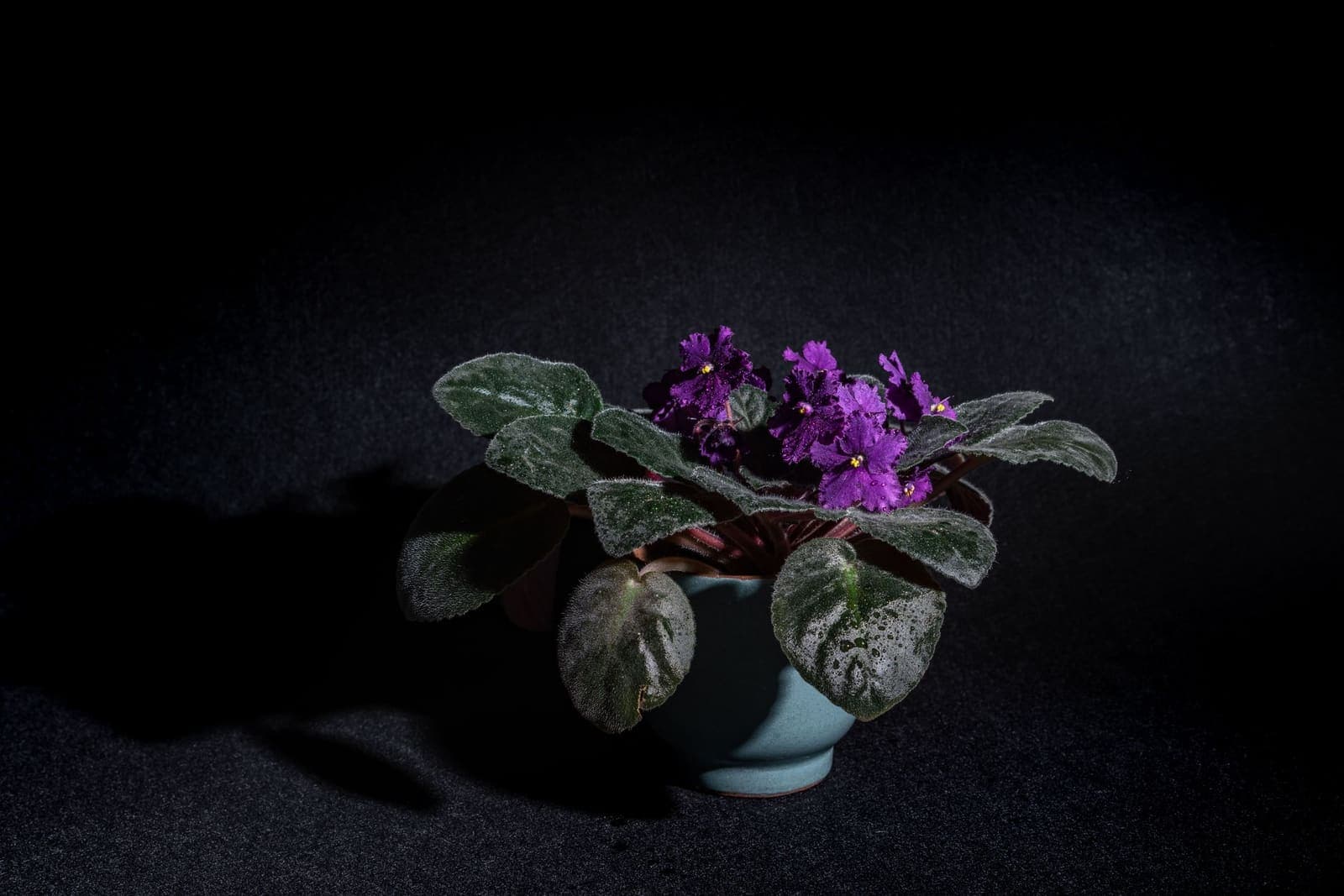
The short answer
Choose a small pot that drains. University of Minnesota Extension says African violet containers should have holes so excess water drains and the plant never sits in water, which makes a plastic wick pot with drainage holes and a reservoir the design that matches the guidance best. The classic two-piece ceramic violet pot keeps water off the leaves and looks better, but its unglazed inner pot often has no hole — check before you buy. Keep pots small, around 4 to 6 inches, and use glazed rims where you can: Clemson Extension notes salts on clay pots can kill leaf stems resting on them.
Disclosure Pot & Prop earns a commission when you buy through the Amazon links on this page, at no extra cost to you. It does not change which products get recommended or what we say about them, and we have not been given any of them. How this site is funded.
Search for an African violet pot and you will be shown two completely different objects under the same name. One is a small plastic pot with a wick running from a basket with drainage holes down into a reservoir. The other is the traditional two-piece ceramic pot: a glazed outer bowl that holds water, and an unglazed inner pot that sits inside it and lets water pass through its wall. Both are sold for violets, both promise to keep the plant watered, and they disagree about the single thing the extension guidance on this plant is firmest about.
That thing is drainage, and this page ranks every pot against it. The rest — size, material, humidity — follows from the same short list of published statements, and each one below is quoted from the source rather than paraphrased from memory.
What the extension guidance actually says
Two extension pages were read in full for this roundup. Their container advice is short, specific, and in places at odds with how violet pots are sold.
- Containers should drain. University of Minnesota Extension: planting containers should have one or more holes in the bottom that allow excess water to drain, and the plant should never sit in water.
- Overwatering is the main killer. The same page calls root rot from overwatering one of the most common reasons African violets die; Clemson Extension says violets are highly subject to root and crown rot if overwatered.
- The roots are fine and want a well-drained mix. Minnesota describes violets as having fine roots that need a well-drained, soilless potting mix, and says to repot in fresh mix once a year.
- Keep water off the leaves, and not cold. Minnesota warns that water on the leaves can cause leaf spots; Clemson says to use only warm water, because cold water causes spots and ring patterns on the leaves.
- Clay under the leaf stems is a problem. Clemson notes that leaf stems in contact with clay pots may be killed by salts that accumulate on the pot.
- A wick is a legitimate method. Minnesota describes wick watering — a wick from the pot into a reservoir — as a way to give the roots steady moisture, and warns not to let the wick dry out.
Put those side by side and the ranking writes itself. A pot that drains, keeps the leaves dry, and does not put bare clay under the lowest leaf stems is doing everything the guidance asks. A pot that fails one of those can still be a reasonable purchase, but it should be bought knowing which one.
The two designs called an African violet pot
| Question | Plastic wick pot with drainage holes | Two-piece ceramic violet pot |
|---|---|---|
| Does it drain excess water? | Yes — holes in the inner basket | Often not — many inner pots are hole-free; check the listing |
| Does it keep water off the leaves? | Yes, it waters from below | Yes, it waters from below |
| Bare clay under the leaf stems? | No | Usually yes — the inner pot is unglazed by design |
| Can you see the water level? | Often, with an indicator | Only by lifting the inner pot |
| Looks like | A practical plastic pot | A finished ceramic object |
The traditional ceramic pot is not a bad design; it is a design with a known trade-off that most listings leave out. Its porous inner wall moves water in slowly and evenly, which is a genuine advantage for a plant that dislikes wet leaves. What a hole-free wall cannot do is shed a surplus quickly, and that is precisely the failure the guidance warns about. Self-watering against a drainage hole sets out the general version of that argument for every plant; for a violet the extension page settles it.
Size: small, and here is why the arithmetic agrees
The pots sold for violets run from about 4 to 6.5 inches — every one on this page sits in that range — and there is a good reason to stay toward the small end. A violet's roots are fine rather than thick, and a pot much larger than the root ball holds mix that no root reaches. That mix stays wet, and wet mix around fine roots is the root rot both extension pages name as the main cause of death. Volume rises with the cube of the diameter, so a size jump is always larger than it looks.
volume ratio = (D2 / D1)^3
4 in to 5 in: (5/4)^3 = 2.0 times the mix. 4 in to 6 in: (6/4)^3 = 3.4 times the mix — more than three times the wet medium around roots that have not grown.
Pot volume on this site is 0.46315 x D^3 cubic inches throughout. Minnesota's advice to repot once a year into fresh mix is the natural moment to move up, and one step at a time. The pot size chart lists every step.
| Pot size | Water from dry to saturated | Saturated mix weight |
|---|---|---|
| 4 in | About 260 ml | About 0.9 lb |
| 5 in | About 500 ml | About 1.8 lb |
| 6 in | About 870 ml | About 3.2 lb |
Those figures come from the dry and saturated mix densities published on the methodology page: the gap between them, divided by the density of water, is the volume a pot takes up going from bone dry to fully wet. They are upper bounds rather than doses, but they are the right scale to judge a reservoir against — which is where most self-watering violet pots stop publishing anything.
How big a violet pot's reservoir really is
Only one pot on this page publishes how much water its reservoir should hold, and it makes the calculation possible. The Dphagesy listing recommends filling the outer pot with 400 ml and warns that more than 500 ml overflows its 5.1-inch inner pot. Set against the table above, that is a very different product from the one the phrase self-watering suggests.
reservoir share = published fill / water per full watering
400 ml recommended fill / about 500 ml for a 5-inch pot = about 0.8 of one full watering. The 500 ml maximum is roughly one full watering.
The fill figures are the listing's own; the 500 ml comes from this site's planning densities for a standard 5-inch pot, and the shallow 3.3-inch inner pot holds somewhat less. Either way, the reservoir is about one watering released slowly — a buffer that evens out moisture, not a month of unattended care.
Clay, glaze, and the lowest leaves
Unglazed terracotta is this site's usual recommendation for plants that want to dry fast, and the material comparison explains why. African violets are the exception with a specific published reason. Clemson Extension notes that leaf stems in contact with clay pots may be killed by accumulated salts, and a violet's lowest leaves rest on the rim of whatever it is planted in.
That points at glazed ceramic or plastic rims. It also means the unglazed inner pot of a traditional violet pot deserves attention: when a white mineral crust forms on the rim, wipe it off, and do not let the lowest leaf stems sit on bare, crusted clay.
Humidity, which the pot does not supply
University of Minnesota Extension gives 40 to 60 percent humidity as the range violets thrive in, and suggests grouping plants or setting them on trays of pebbles and water — with the plant sitting just above the water, never in it. A shallow humidity tray under a drained pot does that without turning into a saucer the pot stands in. The pebble tray guide has the setup; the tray on this page is the one piece of hardware it needs.
Quick picks
Ranked, with the published figure each pick turns on. Tap a row for the full reasoning further down this page.
| # | Product | Best for | Price |
|---|---|---|---|
| 1 | 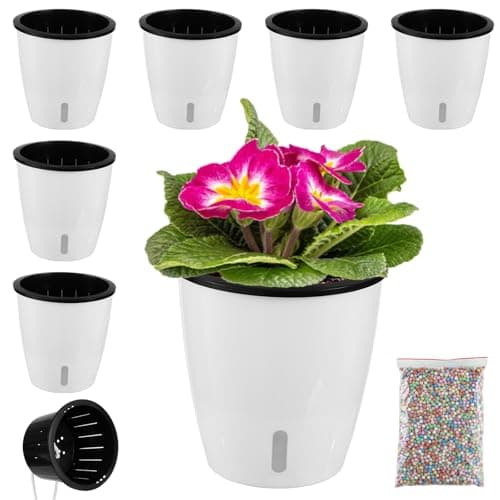 Planterhoma 5 in Self Watering Wick Pots with Drainage Holes and water-level indicator, 6 packDrainage holes and a wick in the same pot, which is exactly the combination extension guidance describes, sold in a six-pack at a price that makes one per violet realistic. | The design that matches both halves of the extension advice | |
| 2 | 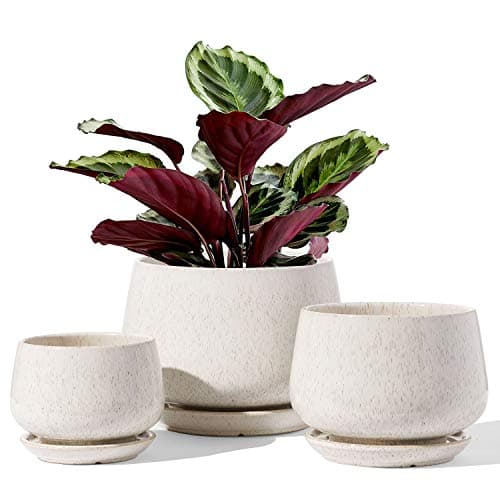 LE TAUCI Ceramic Plant Pots with Drainage and Saucer, set of 3Three graduated sizes with a real hole and a matched saucer in each, which is a lower bar than it sounds and one most decorative ceramic fails. | Three sizes that actually drain | |
| 3 | 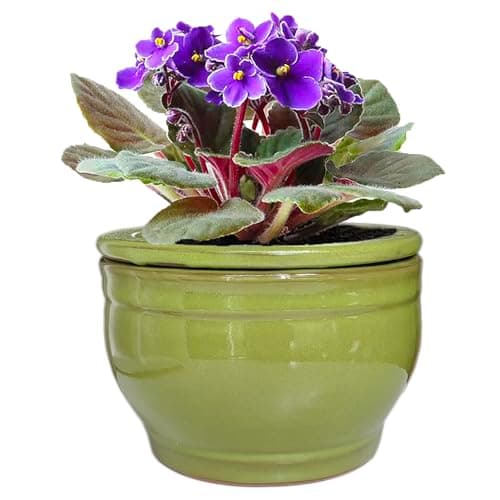 Dphagesy African Violet Self Watering Pot, 6 in, unglazed inner potThe only classic violet pot here that tells you how much water to put in it and how much is too much, which turns a guessing game into a measurement. | The classic two-piece pot, with its reservoir volume published | $19.59 at Amazon $27.99 · 30% off |
| 4 | 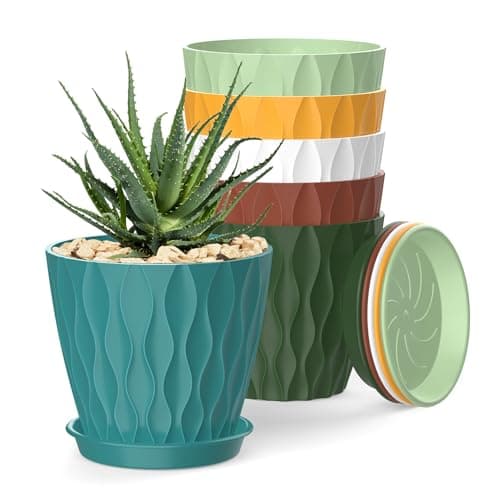 SQKH 4 in Plant Pots with Drainage Holes and attached trays, 6 packSmall, cheap and full of holes, which is all bottom watering asks of a pot — and bottom watering is one of the three methods extension guidance lists for violets. | Bottom-watering a collection for very little | |
| 5 | 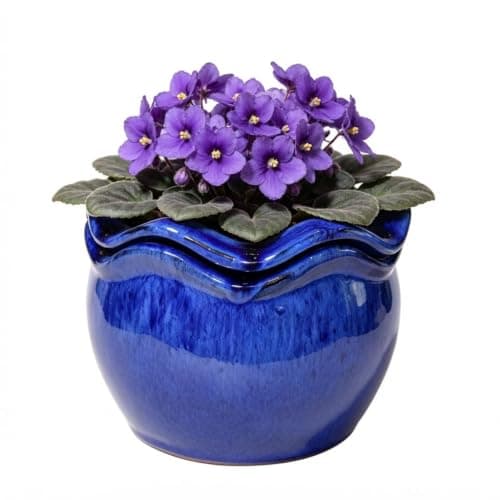 krayce Serenya Ceramic Self-Watering African Violet Pot, 6.5 in, terracotta inner potA handsome two-piece pot that is unusually honest about how it works — and what it says is that the inner pot has no drainage hole at all. | The best-looking classic violet pot, if you accept its trade-off | |
| 6 | 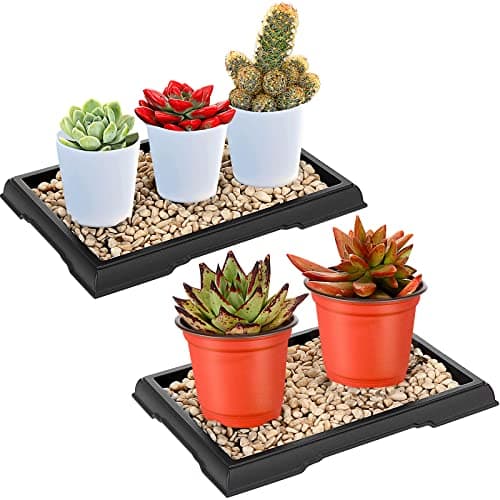 Pinkunn Bonsai Humidity Tray, 7.8 by 5.5 in, 2 packA shallow rectangular tray sized to sit under a single pot, which is the only shape a pebble tray actually works in. | Raising humidity around one small plant |
Links to Amazon are affiliate links. Prices and availability are Amazon's and change without notice.
How we ranked these
Against the published guidance, in order: does it drain, does it keep water off the leaves, does it keep bare clay away from the leaf stems, and does the listing publish enough to check its claims. The Planterhoma wick pot leads because it is the only design here that satisfies both of Minnesota's container statements at once — holes and a wick. The LE TAUCI set follows as the drained, glazed option for anyone watering by hand or from below. The Dphagesy pot is the best of the traditional ceramic design because it publishes its reservoir volume, and is marked down because its listing does not say whether the inner pot drains. The SQKH pots are the cheapest route to bottom watering a collection. The krayce pot is the most attractive traditional pot and the most honest listing, and ranks lower precisely because what it honestly says is that the inner pot has no hole. The humidity tray is last because it is not a pot, and first among the things a violet on a dry windowsill needs.
| You are | Pick | Why |
|---|---|---|
| Away a lot, several violets | 5 in wick pots with drainage, 6 pack | Holes and a wick, with a level you can see |
| Watering by hand or from below, want it to look good | Glazed ceramic set, 4.1 / 5.1 / 6.5 in | Drainage holes and glazed rims |
| Want the traditional violet pot, one plant | Two-piece ceramic with published fill | Tells you 400 ml, and that 500 ml is too much |
| Bottom-watering a windowsill of violets on a budget | 4 in pots with 48 holes, 6 pack | Small, cheap, and they drain |
| Buying a gift, accept the trade-off | Two-piece ceramic, terracotta inner | The best-looking pot; the inner pot has no hole |
| A dry apartment in winter | Humidity tray under any drained pot | 40 to 60 percent is the published range |
Match the pot to how you water
University of Minnesota Extension describes three ways to water a violet, and each suits a different pot. Watering the mix carefully from above, keeping it off the leaves, suits any pot with drainage holes — the glazed set is the natural fit. Bottom watering, by setting the pot in about an inch of room-temperature water until the surface feels moist and then letting it drain, suits small pots with plenty of holes, which is what the SQKH pots are. Wick watering suits the wick pots, which build the wick and reservoir in for you.
The two-piece ceramic pot is a fourth method the extension page does not describe: water through a porous wall. It works, and many growers use it happily. The honest position is that it is the one design here that does not match the published container advice to the letter, and it should be bought, filled and watched with that in mind.
What we deliberately do not recommend
Large pots, which put fine roots in wet mix they cannot reach. Decorative pots with no drainage and no reservoir, which are the condition both extension pages warn about. Unglazed terracotta for the plant itself, given Clemson's note about salts on clay and leaf stems. Watering over the leaves, or with cold water. And filling any self-watering pot beyond what its listing says — or, where the listing says nothing, filling it to the brim on the assumption that more reservoir means less work.
Every pick, in full
We have not handled any of these. What follows is what each listing publishes, what that means once you put a watered pot on it, and who should buy something else.
1. The design that matches both halves of the extension advice
Planterhoma 5 in Self Watering Wick Pots with Drainage Holes and water-level indicator, 6 pack
Drainage holes and a wick in the same pot, which is exactly the combination extension guidance describes, sold in a six-pack at a price that makes one per violet realistic.
#ad · Price as of September 17, 2026. How we are funded
- What the listing publishes
- Published 4.9 in pots, 6 per pack; inner pot with drainage holes and a cotton-rope wick into an outer reservoir; water-level indicator; stated to keep plants watered for up to 2 weeks; reservoir volume not published
- Against a 10-inch pot
- No weight rating is published for this product, so there is nothing to check. That counts against it here rather than being treated as neutral.
University of Minnesota Extension says two things about African violet containers that most violet pots only satisfy one of: the pot should have holes so excess water drains, and a wick running from a reservoir can give the roots steady moisture. A wick pot with drainage holes in the inner basket does both, which is why it leads this page rather than the prettier ceramic designs.
The water-level indicator is the feature that stops a wick system failing quietly. A dry wick stops drawing, and the same extension page warns against letting it dry out — a visible level is how you know before the plant does.
What the listing does not publish is how much the reservoir holds, so the stated two weeks cannot be checked against anything. Treat it as a claim, fill it, and watch how fast the level falls in your own room before relying on it.
What is good
- Drainage holes in the inner pot plus a wick into a reservoir
- Water-level indicator, so a dry wick is visible
- Six pots, which suits a collection rather than a single plant
What is not
- Reservoir volume is not published, so the two-week claim cannot be checked
- Plastic reads as utilitarian on a windowsill that is on show
- The listing warns watering must not exceed the inner basket, so top-ups need care
Skip it if you have one violet and want it to look like a gift. This is a six-pack of practical plastic, and one of the ceramic pots on this page is the better single purchase.
2. Three sizes that actually drain
LE TAUCI Ceramic Plant Pots with Drainage and Saucer, set of 3
Three graduated sizes with a real hole and a matched saucer in each, which is a lower bar than it sounds and one most decorative ceramic fails.
#ad · Price as of September 17, 2026. How we are funded
- What the listing publishes
- 4.1, 5.1 and 6.5 in; drainage hole and a matched saucer on every pot
- Against a 10-inch pot
- No weight rating is published for this product, so there is nothing to check. That counts against it here rather than being treated as neutral.
Saturated mix in these three sizes computes to about 0.9, 1.8 and 3.7 lb, light enough that any shelf holds them and the interesting question is drainage rather than load.
A matched saucer is not decoration. Buying a saucer separately means guessing a diameter, and a saucer an inch too small overflows onto whatever is underneath.
Graduated sets are how you pot up a plant without a second order. A rooted cutting goes in the 4-inch, moves to the 5-inch in a season and the 6.5-inch after that.
What is good
- Every pot has a hole and a matching saucer
- Three sizes cover a potting-up sequence
- Glazed inside, so they do not wick like bare terracotta
What is not
- Nothing here fits a plant bigger than a small pothos
- Ceramic chips if it goes over
- Glazed pots dry slower than terracotta, which suits some plants and kills others
Skip it if you overwater. A glazed, non-porous pot is the least forgiving container for that habit, and terracotta is the fix.
3. The classic two-piece pot, with its reservoir volume published
Dphagesy African Violet Self Watering Pot, 6 in, unglazed inner pot
The only classic violet pot here that tells you how much water to put in it and how much is too much, which turns a guessing game into a measurement.
- What the listing publishes
- Published two-piece ceramic: unglazed inner pot 5.1 in across by 3.3 in tall inside a glazed outer pot 6 in across by 4 in tall; recommended fill 400 ml, not more than 500 ml or the inner pot overflows; listing does not state whether the inner pot has a drainage hole
- Against a 10-inch pot
- No weight rating is published for this product, so there is nothing to check. That counts against it here rather than being treated as neutral.
This is the design most people mean by an African violet pot: a glazed outer bowl that holds water, and an unglazed inner pot that sits in it and lets water pass through its wall into the mix. It keeps water off the leaves, which extension guidance warns causes spotting, and it looks like a finished object rather than a nursery pot.
The published fill figures are the reason it ranks above the other ceramic pot. The listing recommends 400 ml and warns that anything over 500 ml overflows the inner pot. On this site's planning figures a 5-inch pot takes roughly 500 ml going from dry to fully saturated, so the recommended fill is in the region of one full watering, released slowly — a buffer, not a month of water.
The honest gap is drainage. Extension guidance is clear that violet containers should have holes so the plant never sits in water, and this listing does not say whether the inner pot has one. Empty the outer bowl if water stands there for days, and do not overfill past the published limit.
What is good
- Publishes a recommended fill (400 ml) and a maximum (500 ml)
- Keeps water off the leaves by design
- Glazed outer pot does not leak, so it sits on furniture
What is not
- The listing does not state whether the inner pot has a drainage hole
- An unglazed clay rim can collect mineral salts where leaf stems rest on it
- The outer pot needs cleaning; the listing itself recommends every two months
Skip it if you tend to overwater. A reservoir you can overfill is the wrong tool for that habit, and a plain pot with holes watered from below is harder to get wrong.
4. Bottom-watering a collection for very little
SQKH 4 in Plant Pots with Drainage Holes and attached trays, 6 pack
Small, cheap and full of holes, which is all bottom watering asks of a pot — and bottom watering is one of the three methods extension guidance lists for violets.
#ad · Price as of September 17, 2026. How we are funded
- What the listing publishes
- Published 4 in pots, 3.7 in tall, 6 per pack; 48 drainage holes in each base; attached drip tray; extra-thick polypropylene
- Against a 10-inch pot
- No weight rating is published for this product, so there is nothing to check. That counts against it here rather than being treated as neutral.
University of Minnesota Extension describes setting a violet's pot in a bowl of room-temperature water about an inch deep until the surface of the mix feels moist, then lifting it out to drain. That method needs a pot that draws water in quickly and lets it out again, and 48 holes in a 4-inch base does both.
Four inches is small on purpose. Violets have fine roots, and the extension page stresses well-drained mix and never letting the plant sit wet. A small pot dries through; a large one around a small root ball holds wet mix the roots cannot reach.
The attached tray catches drips on the windowsill, but it is shallow and it is not a reservoir. Empty it after watering — a violet left standing in its own runoff is the condition every source on this plant warns against.
What is good
- 48 drainage holes per pot, which suits bottom watering
- Six pots for about the price of one ceramic violet pot
- Attached tray, so nothing to lose or mismatch
What is not
- Plastic in bright colors, which will not suit every room
- The tray is shallow and must be emptied, not left full
- At 4 in, a large standard violet will outgrow it
Skip it if you want a pot you only fill every week or two. These need watering by hand, and the wick pots on this page are the low-attention option.
5. The best-looking classic violet pot, if you accept its trade-off
krayce Serenya Ceramic Self-Watering African Violet Pot, 6.5 in, terracotta inner pot
A handsome two-piece pot that is unusually honest about how it works — and what it says is that the inner pot has no drainage hole at all.
#ad · Price as of September 17, 2026. How we are funded
- What the listing publishes
- Published 6.5 in across by 4.5 in tall, 1.7 lb; glazed leak-proof ceramic outer pot; hole-free unglazed terracotta inner pot that waters by porosity; stated to keep soil moist for 1 to 2 weeks
- Against a 10-inch pot
- No weight rating is published for this product, so there is nothing to check. That counts against it here rather than being treated as neutral.
The listing states plainly that the inner terracotta pot is hole-free and that water moves through its porous wall. That is the traditional design, and the transparency is to its credit: most listings for this style never say whether there is a hole.
It is also why this ranks below the pots with drainage. University of Minnesota Extension says violet containers should have holes so excess water drains and the plant never sits in water, and a hole-free pot cannot drain that way. Porosity moves water in; it is slow to move a surplus out.
The other thing to watch is the rim. Clemson Extension notes that leaf stems resting on clay pots can be killed by salts that accumulate on the clay, and an unglazed terracotta inner pot puts exactly that surface under the lowest leaves. Wipe the rim when white crust appears.
What is good
- States its mechanism openly, including that the inner pot is hole-free
- Glazed outer pot is leak-proof and decorative
- Light at 1.7 lb, and the inner pot lifts out for refilling
What is not
- No drainage hole in the inner pot, contrary to extension guidance for violets
- Unglazed terracotta rim can build up salts where leaf stems rest
- The 1 to 2 week claim comes with no published reservoir volume
Skip it if your violet has already had crown or root rot. A pot that cannot shed surplus water is the wrong place for a plant that has shown it is sensitive to it.
6. Raising humidity around one small plant
Pinkunn Bonsai Humidity Tray, 7.8 by 5.5 in, 2 pack
A shallow rectangular tray sized to sit under a single pot, which is the only shape a pebble tray actually works in.
#ad · Price as of September 17, 2026. How we are funded
- What the listing publishes
- 7.8 by 5.5 in rectangular plastic trays, designed to hold pebbles and water
- Against a 10-inch pot
- No weight rating is published for this product, so there is nothing to check. That counts against it here rather than being treated as neutral.
A pebble tray raises local humidity by evaporation, and evaporation is proportional to surface area. A deep round saucer has almost no exposed water; a wide shallow rectangle has a lot.
The pot must sit on the pebbles, above the water line. A pot standing in the water is being bottom-watered permanently, which is a different and usually worse intervention.
The effect is local and modest. It is measurable a few inches from the tray and gone across the room, so it belongs under the one plant that needs it.
What is good
- A wide shallow shape maximizes evaporating surface
- Rectangular fits a sill better than a round saucer
- Two trays, so two plants
What is not
- The humidity effect is local and modest
- Standing water needs refreshing or it grows things
- Pebbles are not included
Skip it if you want to humidify a room. A pebble tray does not do that at any size, and this is a per-plant measure.
Questions people actually ask
What kind of pot is best for African violets?
Are self-watering pots good for African violets?
What size pot does an African violet need?
Should African violets be in terracotta pots?
Do African violets need drainage holes?
How much water does a self-watering African violet pot hold?
Sources
- University of Minnesota Extension: African violets — containers, wick watering and care
- Clemson HGIC: African Violet — light, watering, fertilizing and problems
- Clemson HGIC: Indoor Plants — watering
- Cornell University, Greenhouse Management: bulk density of greenhouse media components
- Biology Insights: how much a cubic foot of potting soil weighs, dry and saturated
Product specifications are quoted from each seller's own listing and are the seller's claim, not a measurement of ours.