Plant Stands
How to Organize Plants in a Small Apartment
The constraint is never really space. It is light, floor and the weight of the things you cannot move — in that order.
By Scooter M., enthusiast · Published · Last updated
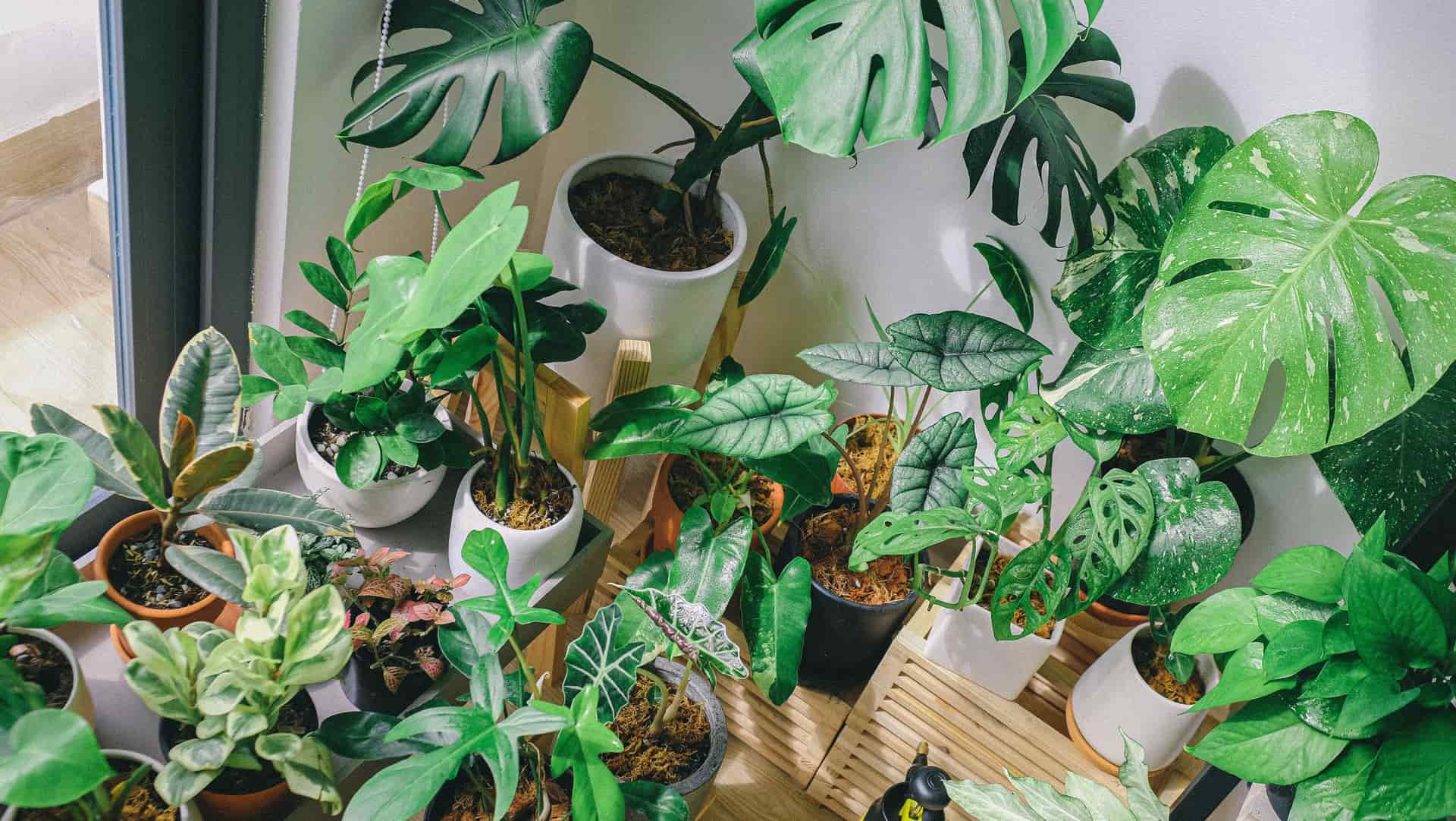
The short answer
Map the light before you buy anything. Put the plants that need the most light closest to the window, spend the vertical space near it rather than the floor, keep the floor for pots too heavy to lift, and use lit shelving to create good positions away from the window instead of competing for the few in front of it.
Disclosure Pot & Prop earns a commission when you buy through the Amazon links on this page, at no extra cost to you. It does not change which products get recommended or what we say about them, and we have not been given any of them. How this site is funded.
Most advice about organizing plants in a small apartment is really advice about styling: group in odd numbers, vary the heights, repeat a pot color. All fine, and all downstream of the actual problem, which is that a small apartment has a fixed and quite small supply of good light, and every plant you add competes for it. Get the light allocation right and the styling mostly takes care of itself. Get it wrong and you have an attractive arrangement of slowly declining plants.
Step one: audit the light, honestly
Spend a day noticing where direct sun actually lands and for how long. Extension guidance on houseplants divides indoor positions into a handful of categories — direct sun, bright indirect, medium and low — and the useful discovery for most people is that a spot they thought was bright is medium, and a corner they wrote off is low rather than dark. Write down four or five positions and what each one gets. That list is your budget.
| Position | What it gets | What it suits |
|---|---|---|
| On the sill, south-facing | Direct sun for hours | Succulents, cacti, herbs |
| Within 3 ft of a bright window | Bright indirect | Most tropical foliage plants |
| Across the room from a window | Medium | Pothos, philodendron, snake plant |
| A corner with no sightline to glass | Low | Very little — this is where a light earns its price |
| North-facing sill | Modest, all day | Ferns, calathea, and honest expectations |
Step two: spend the vertical, not the floor
Floor is the thing you cannot buy more of, and it is also the thing plants use least efficiently. A pothos on the floor and a pothos at eye level cost the same floor area and only one of them is visible. So the order of preference in an apartment is: hang it, shelve it, stand it, and put it on the floor only if it is too heavy to be anywhere else.
- Hanging costs no floor at all and needs a fixing — which in a rented apartment means an adhesive hook rated for the pot or a tension rod across a window reveal.
- Shelving near the window converts one good position into three or four. A window shelf or tension rod is the highest-value purchase in most apartments for exactly this reason.
- Stands buy you positions per square foot; see footprint and slots for what each shape charges.
- Floor is for pots you cannot lift. A 14-inch pot is 40 lb of watered mix and a 16-inch pot is 60 lb — those are not going on a shelf, and they should be on a rated caddy so you can clean behind them.
Step three: group by water, not by looks
The single change that most reduces the effort of keeping plants in a small apartment is grouping them by how often they need water rather than by how they look together. Thirsty plants in one place, drought-tolerant ones in another. Then watering is two tasks a week rather than fourteen, and you stop killing a snake plant because it was standing next to a fern.
Step four: leave the floor clear
This is the difference between an apartment with a lot of plants and an apartment that feels crowded, and it is almost entirely about floor. A room reads as spacious when you can see the floor across it, so plants at height and along walls make a room feel fuller of plants and emptier of clutter at the same time. Anything on the floor should be there for a reason — usually weight.
The order to buy things in
- A caddy for the heaviest plant you own, so you can clean behind it and stop dreading moving it.
- Something vertical near your best window — a shelf, a tension rod, a corner frame. This creates the most new good positions per pound spent.
- Hooks and a hanger, sized to your pots, for the positions no furniture reaches.
- A lit shelf, once the good window positions are full. This is the point at which the collection stops being limited by the building.
Every pick, in full
We have not handled any of these. What follows is what each listing publishes, what that means once you put a watered pot on it, and who should buy something else.
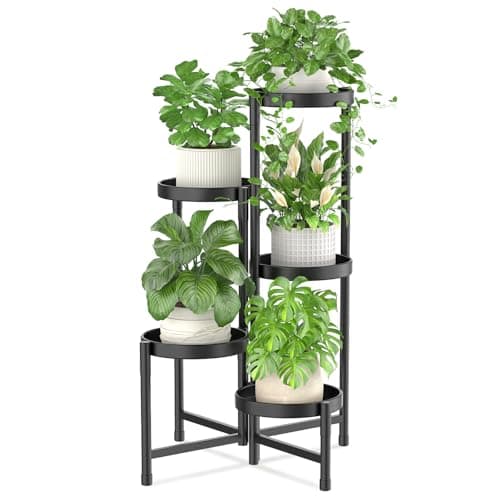
1. The most plants per square foot of floor
iDavosic.ly 5 Tier Metal Corner Plant Stand, folding
A staircase of five small shelves that turns one corner into five plant positions, which is the highest floor efficiency in this roundup.
- What the listing publishes
- 5 staggered tiers on a folding corner frame; no published weight rating
- Against a 10-inch pot
- No weight rating is published for this product, so there is nothing to check. That counts against it here rather than being treated as neutral.
Five positions on roughly a 17 by 17 inch footprint is about 2 square feet of floor for five plants, a little over two plants per square foot, and the best ratio of anything here.
The tiers are sized for 6 to 8 inch pots, not 10 inch ones. An 8-inch pot of saturated mix computes to about 7.5 lb, five of them to roughly 38 lb spread across the frame, which is a different question from 38 lb on one shelf.
The listing publishes no weight rating at all. That is common in this category and it is why this pick sits behind sized-and-rated products in the hanging and caddy roundups, where the numbers exist.
What is good
- Five plant positions on about two square feet of floor
- Folds apartment, which matters if you move every twelve months
- Staggered tiers keep the back plants visible instead of shadowed
What is not
- No published weight rating anywhere on the listing
- Tier depth suits 6 to 8 inch pots, not a 10 inch monstera
- A tall narrow frame in a corner is easy to catch with a vacuum
Skip it if your plants are already in 10 inch pots or bigger. This is a small-pot stand, and putting a 25 lb pot on the top tier of an unrated frame is exactly the guess this site exists to avoid.
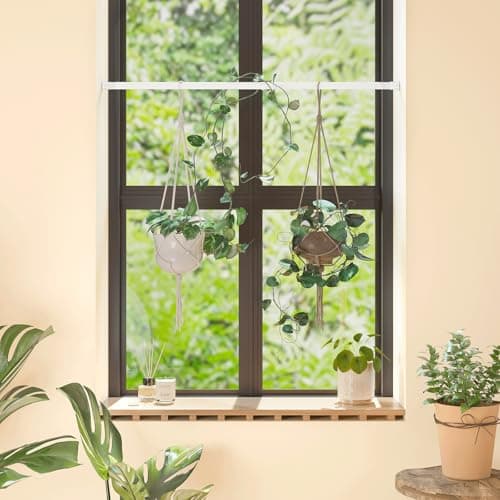
2. Hanging plants in a window with zero fixings
Bamworld Window Plant Hanger, spring tension rods 27 to 51 in
A tension rod across the window reveal, which puts hanging plants in the best light in the apartment without a single hole or adhesive pad.
- What the listing publishes
- Spring tension rods spanning 27 to 51 in; no drilling; anti-slip pads at both ends
- Against a 10-inch pot
- No weight rating is published for this product, so there is nothing to check. That counts against it here rather than being treated as neutral.
This is the most genuinely renter-safe hanging solution on the site. Nothing is stuck to anything, nothing is screwed into anything, and it comes down in ten seconds when you move.
Tension rods hold by friction against two surfaces, and their capacity depends entirely on the span and the surface. That is why no honest tension product publishes a weight rating, and this one does not either.
Keep pots small. Tension failures are progressive: the rod slips a fraction, the friction drops, and it slips again. A 6-inch pot at 3.2 lb of saturated mix is the sensible ceiling here.
What is good
- No fixings of any kind, the cleanest renter solution here
- Puts plants in the window, which is where the light is
- 27 to 51 inches covers almost every apartment window
What is not
- No published weight rating, and tension capacity depends on your surfaces
- Slips progressively rather than failing at once
- Blocks the window it hangs in
Skip it if you want to hang a 10-inch pot. Tension is the wrong mechanism for that load, and a rated 30 lb adhesive ceiling hook is the pick.
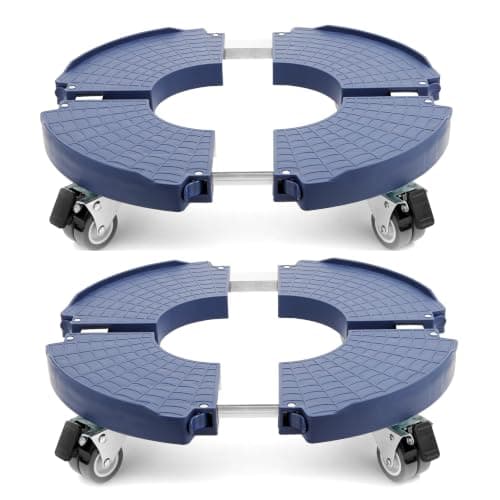
3. The heaviest pot in the apartment
W B D WEIBIDA Plant Caddy with Wheels, 440 lb, adjustable 15 to 21 in
A published rating with an order of magnitude of headroom over anything an apartment actually holds, and adjustable arms so it fits the pot you already own.
#ad · Price as of October 18, 2026. How we are funded
- What the listing publishes
- Published 440 lb capacity; adjustable arms fit 15 to 21 inch pots
- Against a 10-inch pot
- Rated 440 lb against 14.7 lb of saturated mix in a 10-inch pot — 29.9x, clear of the 1.5x margin this site requires.
A 16-inch pot of saturated mix computes to about 60 lb. A 440 lb rating is roughly seven times that, the kind of margin that makes the number boring, and boring is what you want under a floor pot.
The adjustable 15 to 21 inch span is why this beats a fixed-diameter caddy. Pot diameters in this category are not standardized, and a caddy that fits one pot and not the next is a caddy you buy twice.
The rating is for the caddy as a unit on an apartment floor. It is not a claim about rolling a 400 lb load over a threshold, and no caddy listing means it that way.
What is good
- Publishes a real number, which most of this category does not
- Adjustable span fits pots from 15 to 21 inches
- Turns a pot you cannot lift into one you can move to clean behind
What is not
- Wheels lift the pot an inch or two, which matters under a low sill
- Adjustable arms are more parts to assemble than a solid tray
- Casters mark soft vinyl over time
Skip it if your pots are under 12 inches. You are paying for a rating you will never approach, and a 12-inch fixed caddy costs less and rolls the same.
Questions people actually ask
How do you fit a lot of plants in a small apartment?
Where should plants go in a studio apartment?
How do I keep plants from making a small room feel cluttered?
How many plants is too many for a small apartment?
Sources
- University of Illinois Extension: Houseplants — lighting
- Michigan State University Extension: Smart Gardening — growing houseplants indoors
- Cornell University, Greenhouse Management: bulk density of greenhouse media components
- Biology Insights: how much a cubic foot of potting soil weighs, dry and saturated
Product specifications are quoted from each seller's own listing and are the seller's claim, not a measurement of ours.