Plant Stands
How Much Does a Potted Plant Weigh?
The number that is never printed on a plant, a pot or a bag of soil — and the one every weight rating on every shelf and hook needs to be checked against.
By Scooter M., enthusiast · Published · Last updated
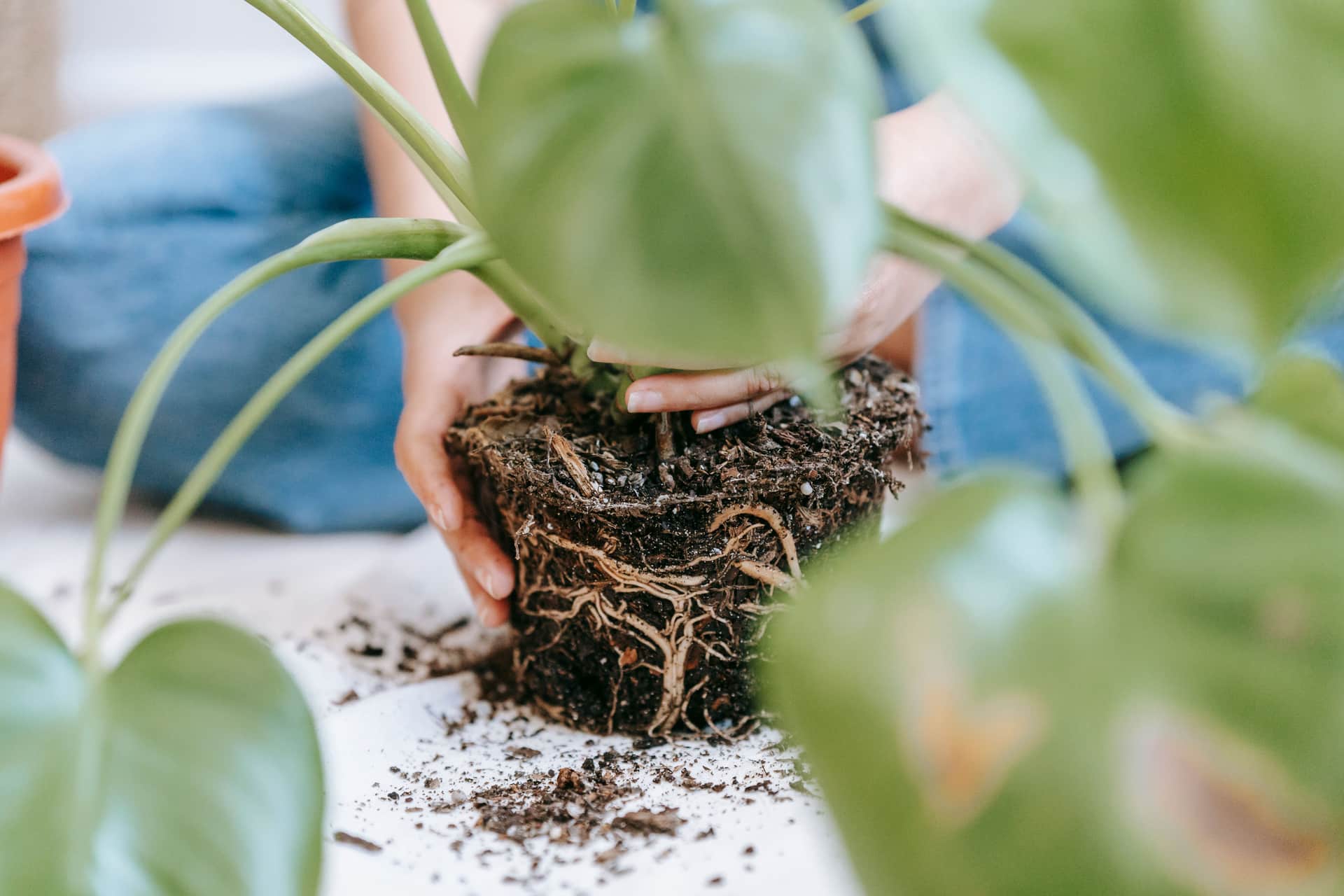
The short answer
A 10-inch pot holds about 0.27 cubic feet of potting mix. Dry, that is roughly 5.9 lb; watered, about 14.7 lb. A 12-inch pot is about 25.5 lb watered and a 16-inch pot about 60 lb. Those figures are the mix alone — the pot and the plant sit on top of them.
Disclosure Pot & Prop earns a commission when you buy through the Amazon links on this page, at no extra cost to you. It does not change which products get recommended or what we say about them, and we have not been given any of them. How this site is funded.
This is the most useful number in the whole category and nobody publishes it. A plant does not come with a weight. A pot lists its diameter. A bag of potting mix lists volume, not density. So the moment you want to know whether a shelf, a hook or a stand can take the plant you are about to put on it, you are missing the only figure that matters — and the usual solution is to lift it, decide it feels fine, and hope.
It is entirely computable. A pot is a known shape, potting mix has a published density range, and water is a physical constant. Below is the arithmetic, the table it produces, and every assumption it rests on — including the ones that make it wrong for certain pots.
The table
Mix only, computed. The last column applies this site's 1.5x safety margin: it is the published rating a shelf or hook should carry before we call the pairing safe.
| Pot size | Mix volume | Dry | Watered | Rating needed |
|---|---|---|---|---|
| 4 in | 0.017 cu ft | 0.4 lb | 0.9 lb | 2 lb |
| 5 in | 0.034 cu ft | 0.7 lb | 1.8 lb | 3 lb |
| 6 in | 0.058 cu ft | 1.3 lb | 3.2 lb | 5 lb |
| 8 in | 0.137 cu ft | 3 lb | 7.5 lb | 12 lb |
| 10 in | 0.268 cu ft | 5.9 lb | 14.7 lb | 23 lb |
| 12 in | 0.463 cu ft | 10.2 lb | 25.5 lb | 39 lb |
| 14 in | 0.735 cu ft | 16.2 lb | 40.5 lb | 61 lb |
| 16 in | 1.098 cu ft | 24.2 lb | 60.4 lb | 91 lb |
How the volume is worked out
A standard-proportion plant pot is a truncated cone — wider at the rim than at the base. Modeling it as a frustum whose base is three quarters of the rim diameter and whose height is 0.85 times the rim diameter, filled to 90 percent of that height, gives a soil volume that depends only on the rim diameter, which is the one dimension every listing publishes.
V = 0.9 x (pi x h / 12) x (D^2 + D x d + d^2), h = 0.85D, d = 0.75D
V = 0.46315 x D^3 cubic inches -> for D = 10 in: 463 cu in = 0.268 cu ft
The 90 percent fill is a soil line about an inch below the rim, which is where anyone who has watered a plant indoors fills to.
Where the density figures come from
Two published ranges and one physical constant. Dry peat and coir potting mixes are commonly cited at roughly 15 to 30 lb per cubic foot; saturated, roughly 40 to 60. Water itself is 62.4 lb per cubic foot, which is a useful sanity check on the top of that range — saturated mix cannot weigh more than water, and 60 is comfortably below 62.4. Cornell's greenhouse media reference gives component bulk densities for the perlite, vermiculite and soil fractions behind those figures.
This site plans at 55 lb per cubic foot saturated and 22 lb per cubic foot dry. Fifty-five is the upper-middle of the published saturated range, and erring high is deliberate: it is the only defensible direction for a load calculation. Understating what a pot weighs is how a shelf ends up on the floor; overstating it costs a reader nothing but a slightly sturdier purchase.
What this model gets wrong
- Squat decorative pots. A wide shallow bowl holds much less than the frustum model says for its rim diameter, so the table runs generous. Good direction for a safety figure, bad for estimating a delivery.
- Tall cylinders. A straight-sided cylinder holds more than the model says, so the table runs light. If your pot is a cylinder, add roughly a third.
- The pot itself. Not included, and it is not negligible: a 12-inch glazed ceramic pot is several pounds empty, and terracotta is similar. Plastic is close to nothing.
- The plant. Also not included. A mature trailing pothos or a small tree adds real weight, and neither is estimable from published data.
- Chunky aroid mixes. Bark, pumice and perlite blends are lighter than peat-based mix, both dry and wet. The table is conservative for those, which again is the right direction.
Why the watered figure is the one that matters
Notice the ratio in the table: watered mix is roughly two and a half times dry mix. That is the whole reason this page exists. You buy a plant dry, you carry it home dry, you put it on a shelf dry, and you form your impression of how heavy it is dry. Then you water it, and it becomes something quite different — and it stays in that state for hours afterwards, which is exactly when the shelf is being asked to do its job.
What to do with the number
- Find your pot's rim diameter and read across the table.
- Take the watered figure, not the dry one.
- Add something for the pot — a few pounds for ceramic or clay at 10 inches and above, nothing meaningful for plastic.
- Compare against the published rating of whatever is holding it. If there is no published rating, that is a finding: you are guessing, and you should be conservative.
- Apply a margin. This site uses 1.5x, which is the last column in the table above.
Every pick, in full
We have not handled any of these. What follows is what each listing publishes, what that means once you put a watered pot on it, and who should buy something else.
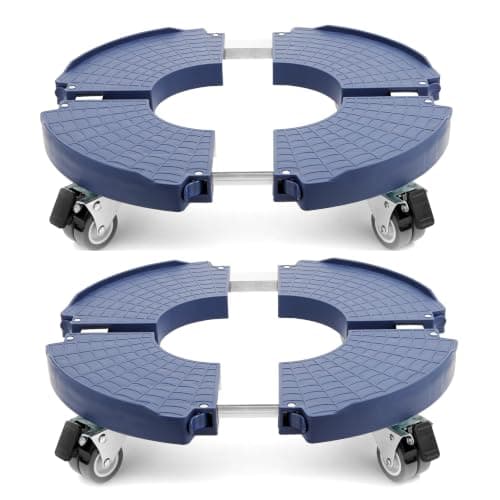
1. The heaviest pot in the apartment
W B D WEIBIDA Plant Caddy with Wheels, 440 lb, adjustable 15 to 21 in
A published rating with an order of magnitude of headroom over anything an apartment actually holds, and adjustable arms so it fits the pot you already own.
#ad · Price as of October 18, 2026. How we are funded
- What the listing publishes
- Published 440 lb capacity; adjustable arms fit 15 to 21 inch pots
- Against a 10-inch pot
- Rated 440 lb against 14.7 lb of saturated mix in a 10-inch pot — 29.9x, clear of the 1.5x margin this site requires.
A 16-inch pot of saturated mix computes to about 60 lb. A 440 lb rating is roughly seven times that, the kind of margin that makes the number boring, and boring is what you want under a floor pot.
The adjustable 15 to 21 inch span is why this beats a fixed-diameter caddy. Pot diameters in this category are not standardized, and a caddy that fits one pot and not the next is a caddy you buy twice.
The rating is for the caddy as a unit on an apartment floor. It is not a claim about rolling a 400 lb load over a threshold, and no caddy listing means it that way.
What is good
- Publishes a real number, which most of this category does not
- Adjustable span fits pots from 15 to 21 inches
- Turns a pot you cannot lift into one you can move to clean behind
What is not
- Wheels lift the pot an inch or two, which matters under a low sill
- Adjustable arms are more parts to assemble than a solid tray
- Casters mark soft vinyl over time
Skip it if your pots are under 12 inches. You are paying for a rating you will never approach, and a 12-inch fixed caddy costs less and rolls the same.
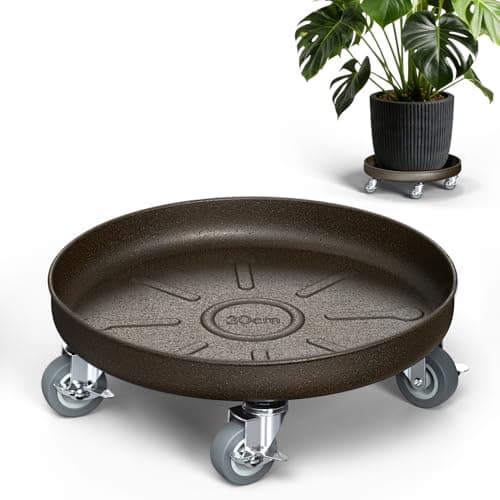
2. A 12-inch pot, which is most apartment floor plants
HOLKIE 12 in Plant Stand with Wheels, 320 lb, with brake
Sized for the pot most apartment floor plants actually live in, with a brake and a tray that catches water rather than letting it onto the floor.
- What the listing publishes
- Published 320 lb total capacity; 12 in tray; brake; doubles as a saucer
- Against a 10-inch pot
- Rated 320 lb against 14.7 lb of saturated mix in a 10-inch pot — 21.8x, clear of the 1.5x margin this site requires.
A 12-inch pot computes to about 25.5 lb of saturated mix, so a 320 lb rating is over twelve times the load. That is the right amount of nothing to worry about.
The saucer function is the quiet win. A caddy that is also a drip tray removes a separate purchase and, more importantly, removes the gap between caddy and saucer where water finds carpet.
12 inches is a fixed size. It is the right fixed size for more apartments than 14 or 21 inches are.
What is good
- Published rating, a brake, and a tray that catches water
- Sized for the pot most apartment plants are already in
- Cheaper than the adjustable large-format caddies
What is not
- Fixed 12 in
- Tray depth is shallow: it catches a spill, not a flood
- Small casters do not like thick rugs
Skip it if you are buying for a floor plant in a 16-inch pot. It will overhang, and an overhanging pot on a caddy tips.
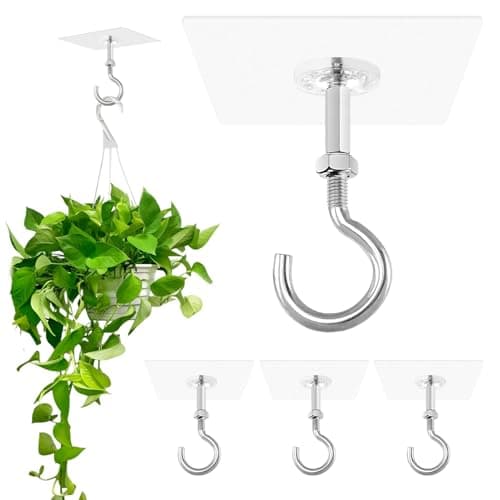
3. The largest hanging pot a renter can hang
NINEFOX Adhesive Ceiling Hooks, 30 lb, 4 pack
The highest published no-drill ceiling rating in this roundup, and the only one here that clears a 10-inch pot at this site's margin.
#ad · Price as of October 18, 2026. How we are funded
- What the listing publishes
- Published 30 lb rating per hook; adhesive mount, no drilling
- Against a 10-inch pot
- Rated 30 lb against 14.7 lb of saturated mix in a 10-inch pot — 2x, clear of the 1.5x margin this site requires.
A 10-inch pot of saturated mix computes to 14.7 lb. At 30 lb published this is 2.0x, past the 1.5x margin this site requires before it calls a pairing safe.
Read the rating as a ceiling rating, because that is what it claims. Adhesive hooks sold for walls are rated in shear, where the load hangs down the face of the adhesive. A ceiling load pulls straight off it, which is the harder direction, and a wall-rated hook on a ceiling is the commonest mistake in this category.
Surface preparation is the whole game with adhesive. Textured or freshly painted ceilings do not hold, and no rating on any listing is a claim about a surface it was not stuck to.
What is good
- 30 lb published, the highest no-drill ceiling figure here
- Clears a 10-inch pot at the 1.5x margin
- Four hooks, so three plants and one you will get wrong
What is not
- Adhesive needs a smooth, clean, cured surface, so a textured ceiling is out
- Removal takes paint with it more often than the packaging suggests
- The rating assumes an ideal application, and yours will not be
Skip it if your ceiling is textured, artexed or freshly painted. No adhesive rating survives that surface, and a tension pole is the renter-safe alternative.
Questions people actually ask
How much does a 10 inch pot of soil weigh?
How much does a bag of potting soil weigh?
Does wet soil weigh twice as much as dry soil?
How much weight can a shelf hold with plants on it?
Sources
- Cornell University, Greenhouse Management: bulk density of greenhouse media components
- Biology Insights: how much a cubic foot of potting soil weighs, dry and saturated
- Clemson HGIC: Indoor Plants — cleaning, fertilizing, containers and light requirements
Product specifications are quoted from each seller's own listing and are the seller's claim, not a measurement of ours.