Planters
The Best Soil Moisture Meters for Houseplants
Most people should not buy one. Here is the free method with the arithmetic behind it, and the specific case where a meter is genuinely the right tool.
By Scooter M., enthusiast · Published
The short answer
For most houseplants, skip it. Lift the pot: a 6-inch pot weighs about 1.9 lb less dry than saturated and a 10-inch pot about 8.8 lb less, and that is a difference you can feel without buying anything. A meter earns its place in one situation — a pot deep enough that the top two inches tell you nothing, or heavy enough that you cannot lift it. In that case buy a long probe, not a 3-in-1, and read it as a comparison between two days rather than as a measurement.
Disclosure Pot & Prop earns a commission when you buy through the Amazon links on this page, at no extra cost to you. It does not change which products get recommended or what we say about them, and we have not been given any of them. How this site is funded.
This site already has a position on moisture meters, and it is not a flattering one. The beginners guide puts them on the short list of things not to buy — alongside fertilizer and a humidifier — until a specific plant gives you a specific reason. This page does not reverse that. It sets out the reason that would justify one, gives the free method first, and then ranks the meters for the readers who genuinely have that reason.
It is worth being clear about what these devices do. Almost all of them are unpowered probes that infer moisture from how readily the soil conducts, and report it as a needle position between dry and wet. That is a comparison, not a measurement. Of the six meters on this page, exactly one publishes what it measures and over what range — and it costs roughly twelve times what the others do.
The free method, and what it is actually worth
A pot full of dry mix and the same pot watered are two noticeably different objects, and the difference is computable from the densities this site publishes. Mix weighs about 22 lb per cubic foot dry and about 55 lb per cubic foot saturated; the gap is water, and the gap is what your hand feels when you lift the pot.
weight swing = pot mix volume x (55 - 22) lb/ft^3
6-inch pot: 0.058 ft^3 x 33 = about 1.9 lb. 10-inch pot: 0.268 ft^3 x 33 = about 8.8 lb. 12-inch pot: 0.463 ft^3 x 33 = about 15.3 lb.
Computed from the dry and saturated planning densities on how we pick. Learn the weight of each pot when you have just watered it and again a week later, and you have a moisture gauge that costs nothing, needs no battery and cannot be fooled by an air pocket.
| Pot size | Dry-to-wet weight swing | Is lifting practical? |
|---|---|---|
| 4 in | About 0.6 lb | Yes — but a finger reaches the roots anyway |
| 6 in | About 1.9 lb | Yes, easily felt in one hand |
| 8 in | About 4.5 lb | Yes, and the difference is obvious |
| 10 in | About 8.8 lb | Yes, with two hands |
| 12 in | About 15.3 lb | Borderline — this is where a meter starts to earn its place |
| 14 in and up | More than 20 lb | No. A floor pot is not lifted to check it |
The other free method is older still: push a finger, or a wooden chopstick, into the mix. A finger reaches about two inches. A chopstick reaches as far as you push it and comes out darkened where the mix is damp. Between weighing and a chopstick, most apartment collections are fully covered.
When a meter genuinely earns its place
There is a real case, and it is narrow. In a large pot the top few inches dry first and dry fastest, so the zone your finger can reach is the least representative part of the pot. A 14-inch pot can read bone dry at the surface with the root ball still wet from last week — and that pot is also far too heavy to lift for comparison. That is the situation a long probe is built for, and it is the only one on this page where buying a tool beats the free methods outright.
- Large floor pots, 12 inches and up, where lifting is impractical and the surface misleads.
- Deep pots relative to the root ball, where the roots sit well below finger depth.
- A plant you have already lost once to rot, where you want a second opinion before watering.
- Many plants on one schedule, where you are trying to stop watering everything on the same day regardless of need.
What these meters do not publish
This site ranks on published figures, and in this category there are almost none. Five of the six meters here publish no accuracy tolerance, no units and no calibration procedure. The dial has ten divisions between dry and wet, and what those divisions correspond to is nowhere stated. That does not make them useless — a repeatable relative reading in the same pot is genuinely informative — but it does mean a number off one of these is not a measurement you could defend.
The exception is instructive. The professional meter on this page publishes a dielectric sensing principle and a stated range of 0 to 100 percent volumetric water content, and its listing explicitly contrasts that with the galvanometric probes the cheap meters use — which pass a current through the soil and are, by its account, affected by salts and fertilizer. Whether or not you buy it, that listing is the only place in this category where the mechanism is named.
Leave-in against probe-and-remove
The two designs here are not variations on a theme; they contradict each other in their own instructions. Every analog meter on this page tells you not to leave it in the soil — one puts a five-minute limit on it in writing, because the metal probe corrodes. The digital meter is designed to do nothing but stay in the pot, checking itself every couple of hours and showing an always-on reading.
So the choice is between a tool you fetch and a tool you install. Fetching disturbs the root ball every time and gives you a reading only when you remember to take one. Installing costs a battery, roughly double the price, and one unit per pot if you want them all monitored. For a single large plant you check often, the leave-in design is the better object; for a shelf of twelve, nobody is buying twelve.
The 3-in-1 problem
The most-sold meter in this category tests moisture, light and pH from one unpowered probe. The moisture function is the same as every other analog meter here. The other two are claims with nothing published behind them: no accuracy figure, no units for the light scale, and no calibration procedure for the pH scale. A soil pH reading is a genuinely useful thing to have and a genuinely hard thing to measure, and a device that does it with no battery and no calibration step should be treated with suspicion rather than bought for the extra functions.
There is also a line in that listing worth reading twice: if the soil is too dry, the indicator will not move. A meter that reads nothing at the exact moment you most want an answer has its blind spot in the wrong place.
Quick picks
Ranked, with the published figure each pick turns on. Tap a row for the full reasoning further down this page.
| # | Product | Best for | Price |
|---|---|---|---|
| 1 | 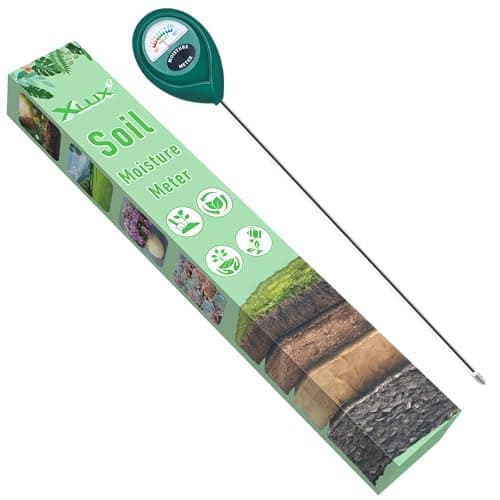 XLUX Long Probe Soil Moisture Meter, 40 cm, battery-freeThe long probe is the only reason to own a meter at all — it reaches the part of a big pot your finger cannot — and this is the rare listing honest enough to publish where its own reading fails. | Deep pots, where the top two inches tell you nothing | $12.73 at Amazon $14.99 · 15% off |
| 2 | 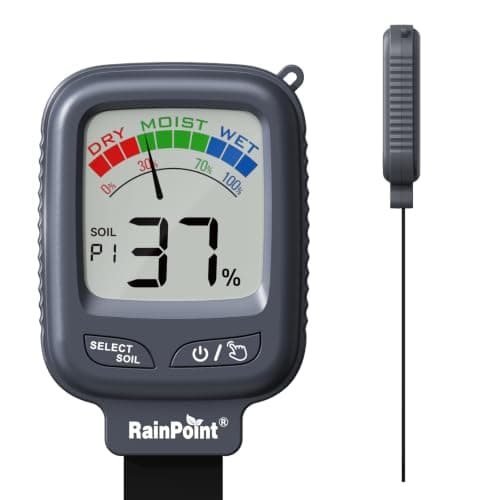 RAINPOINT Large Display Digital Soil Moisture Meter, leave-inThe one design here built to live in the pot rather than be pushed in and pulled out, which quietly solves the problem the analog meters warn you about in their own instructions. | Reading it from across the room without touching the pot | |
| 3 | 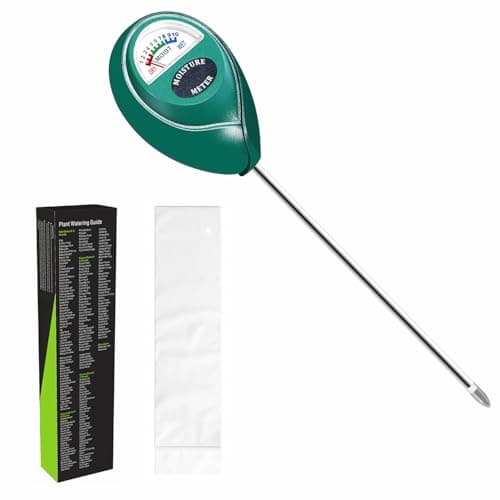 XLUX Soil Moisture Meter, 26 cm, battery-freeThe plain version of the long-probe meter above, at a slightly lower price and a probe short enough that a large floor pot will out-depth it. | The default cheap meter, for pots of ordinary depth | |
| 4 | 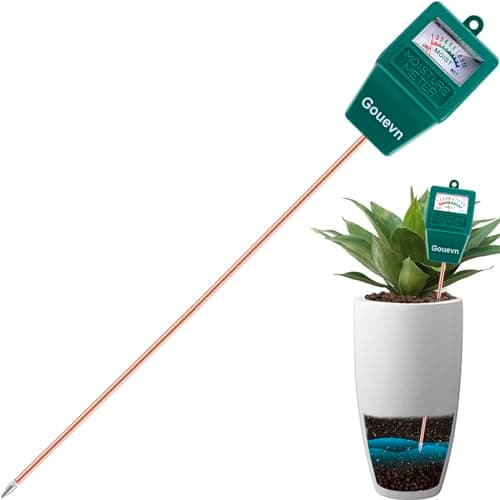 Gouevn Long Probe Soil Moisture Meter, 11.96 in probe, battery-freeThe same long-probe idea as the leader at a lower price, from a listing that publishes the probe length but none of the limitations. | A long probe at the lowest price here | |
| 5 | 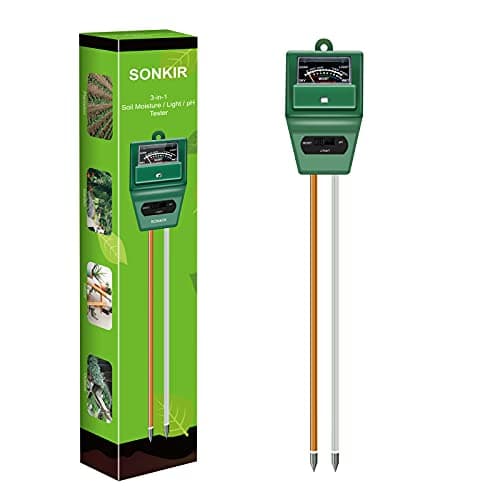 SONKIR MS02 3-in-1 Soil Moisture, Light and pH TesterThe meter everybody owns, and the one that claims the most with the least behind it — a pH reading and a light reading from an unpowered probe, with no published method for either. | Nothing this site can recommend it for over a moisture-only probe | |
| 6 | 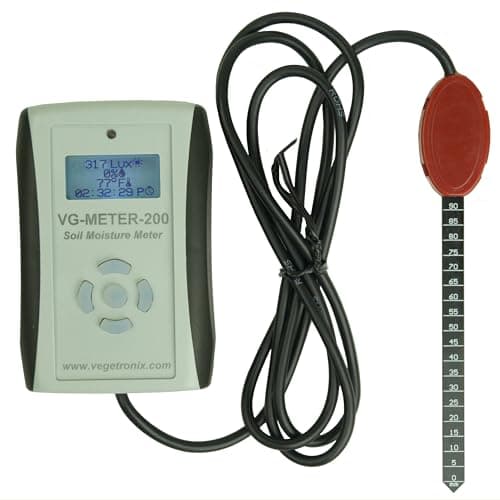 Professional Digital Soil Moisture Meter with dielectric probeThe only meter here that publishes how it measures and over what range — and the clearest possible demonstration that in this category that information costs about twelve times the going rate. | Seeing what a published measurement principle actually costs |
Links to Amazon are affiliate links. Prices and availability are Amazon's and change without notice.
How we ranked these
By probe length first, because reaching the root zone is the only job that justifies the purchase; then by what the listing publishes; then by price. The XLUX long probe leads on both counts — it is long enough for a floor pot and it is the one listing that tells you where its own reading fails. The RAINPOINT digital is second as the only leave-in design, which solves the disturbance problem the analog meters warn about. The standard XLUX and the Gouevn are the cheaper probes, ranked on length and on how much each listing discloses. The SONKIR 3-in-1 is ranked low despite being the most popular meter in the category, because two of its three functions are unsupported claims. The professional dielectric meter is last, not because it is bad — it is the only one publishing a method — but because almost nobody keeping houseplants should spend that on this.
| Your situation | What to do | Why |
|---|---|---|
| Pots 8 in and under | Buy nothing; lift the pot | About 4.5 lb of swing on an 8-inch pot is easy to feel |
| One large floor pot | Long probe, 12 in or more | Too heavy to lift, and the surface misleads |
| A big plant you check constantly | Digital leave-in | No repeated probing of the root ball |
| Orchids, succulents, anything in bark or grit | Buy nothing | The manufacturer says the probe may not read in airy media |
| You want a soil pH number | Not one of these | No 3-in-1 here publishes a method for the pH scale |
| You need a defensible number | The dielectric meter | The only published principle and range — at twelve times the price |
How to use one without being misled
- Push it to the root zone, not into the top inch. The top of the pot is the least representative part of it.
- Read the same spot every time. These are comparative instruments; a reading is only meaningful against the last one from the same place.
- Take it out afterward unless it is the leave-in type. The analog listings say so themselves, and a corroded probe reads nothing.
- Do not trust a zero. In dry, hard or airy mix the needle may simply fail to move, which looks identical to bone dry on the dial.
- Cross-check against the pot's weight for the first few weeks, until you know whether the dial agrees with the plant.
What we deliberately do not recommend
Buying one as a first purchase for a first plant — the beginners guide is right, and a chopstick is free. Buying a 3-in-1 for its pH function. Leaving an analog probe in the pot permanently, which its own listing warns against. Trusting a reading in orchid bark, pumice or a gritty succulent mix. And watering on the dial alone without ever checking it against the weight of the pot or the state of the plant, which is how a meter becomes a more expensive way to make the same mistake.
Every pick, in full
We have not handled any of these. What follows is what each listing publishes, what that means once you put a watered pot on it, and who should buy something else.
1. Deep pots, where the top two inches tell you nothing
XLUX Long Probe Soil Moisture Meter, 40 cm, battery-free
The long probe is the only reason to own a meter at all — it reaches the part of a big pot your finger cannot — and this is the rare listing honest enough to publish where its own reading fails.
- What the listing publishes
- Published 40 cm overall with a probe stated to be 5.5 in (14 cm) longer than regular styles; single probe; battery-free dial with three zones and ten scales; listing states it must not be left in the soil more than 5 minutes, and that loose or airy media may not read correctly
- Against a 10-inch pot
- No weight rating is published for this product, so there is nothing to check. That counts against it here rather than being treated as neutral.
A finger reaches two inches. In a 12-inch pot the top two inches can be bone dry while the root zone is still wet, and that gap is exactly where overwatering hides. A probe long enough to reach the middle of the pot is the one thing a meter does that a free method does not.
The listing publishes something almost nothing else in this category does: a stated limitation. It says the meter is designed for standard potting soil, and that in loose or airy media — it names perlite, pumice, pine bark and orchid mix — the probe may not make sufficient contact, leaving the dial at zero or reading inconsistently. That is worth more than any accuracy claim, and it rules the meter out for orchids and for the gritty mixes this site recommends for succulents.
What it does not publish is an accuracy figure, units, or a calibration method. The dial reads dry to wet on ten arbitrary divisions. Treat it as a comparison between two moments in the same pot, not as a measurement you could quote.
What is good
- Long probe genuinely reaches the root zone of a large pot
- Publishes its own failure mode in loose or airy media
- No batteries, single slim probe, immediate reading
What is not
- No published accuracy figure, units or calibration method
- Its own listing says it may read zero in bark, perlite or orchid mix
- Must not be left in the soil — the listing says no more than 5 minutes
Skip it if your plants are in 6-inch pots. At that size you can lift the pot and feel the difference, which costs nothing and cannot be fooled by an air pocket.
2. Reading it from across the room without touching the pot
RAINPOINT Large Display Digital Soil Moisture Meter, leave-in
The one design here built to live in the pot rather than be pushed in and pulled out, which quietly solves the problem the analog meters warn you about in their own instructions.
#ad · Price as of September 21, 2026. How we are funded
- What the listing publishes
- Published digital readout with a color gauge and a stated moisture percentage; designed to stay in the soil with an always-on display; automatic check every 2 hours or manual on a button press; 0.63 in slim body, 1.1 oz; battery-powered
- Against a 10-inch pot
- No weight rating is published for this product, so there is nothing to check. That counts against it here rather than being treated as neutral.
Every analog meter on this page tells you not to leave it in the soil. This one is built to do nothing else: it sits in the pot, checks itself every couple of hours, and shows the result on an always-on screen. If you want a glanceable answer rather than a chore, that is a genuine difference in kind, not in degree.
It also shows a percentage rather than a position on a dial. That reads as more precise, and it is worth being clear-eyed about why it might not be — the listing gives a percentage but no accuracy tolerance, no units definition and no calibration procedure, so the number is still a relative one dressed up in decimals.
The trade against the analog meters is a battery and a price roughly double theirs. In exchange you stop disturbing the root ball every time you want to know something, which for a plant you check often is a real gain.
What is good
- Designed to stay in the pot, so the roots are not disturbed repeatedly
- Always-on display with an automatic check every 2 hours
- Publishes its physical dimensions and weight, which most here do not
What is not
- A percentage with no published accuracy tolerance is still a relative reading
- Needs a battery, unlike every analog meter on this page
- One meter per pot if you want continuous monitoring, which gets expensive
Skip it if you own one plant and walk past it daily. The information this buys you is information you already have by looking.
3. The default cheap meter, for pots of ordinary depth
XLUX Soil Moisture Meter, 26 cm, battery-free
The plain version of the long-probe meter above, at a slightly lower price and a probe short enough that a large floor pot will out-depth it.
#ad · Price as of September 21, 2026. How we are funded
- What the listing publishes
- Published 26 cm overall, 47 g; single 304 stainless probe; battery-free dial with ten scales across dry, moist and wet; listing states soil use only
- Against a 10-inch pot
- No weight rating is published for this product, so there is nothing to check. That counts against it here rather than being treated as neutral.
This is the meter most people picture when they picture a moisture meter: a green dial, a single steel probe, no battery. For a 6 to 8-inch pot it reaches far enough to tell you something your finger could not.
At 26 cm overall the probe itself is shorter than the long version, and the useful length is shorter still once the dial housing is accounted for. In a 12-inch pot that is a problem, because the reading you get is from the zone that dries first rather than the zone the roots are in.
The listing leans on its rating count rather than on a specification. That is not evidence of accuracy; it is evidence of sales. Nothing here publishes tolerance, units or a way to calibrate, so the honest use is comparative — same pot, same spot, two different days.
What is good
- Cheapest route to a probe that reaches past finger depth
- Stainless probe and no battery to replace
- Publishes its overall length and weight
What is not
- Probe too short for large floor pots, which is where a meter is most useful
- No published accuracy, units or calibration
- Sold on rating count rather than on any specification
Skip it if your biggest pot is 12 inches or more. Buy the long-probe version instead; the extra few dollars is the entire point of the tool.
4. A long probe at the lowest price here
Gouevn Long Probe Soil Moisture Meter, 11.96 in probe, battery-free
The same long-probe idea as the leader at a lower price, from a listing that publishes the probe length but none of the limitations.
#ad · Price as of September 21, 2026. How we are funded
- What the listing publishes
- Published 11.96 in probe on a 15.23 in body; single probe; battery-free large dial with immediate reading; listing states soil only, not to be left in the soil for long, and not for extremely hard soil
- Against a 10-inch pot
- No weight rating is published for this product, so there is nothing to check. That counts against it here rather than being treated as neutral.
Nearly twelve inches of probe is enough for the large pots this tool is actually for, and the single-probe design pulls out without dragging half the root ball with it. On specification alone it does the same job as the meter at the top of this page.
What it does not do is tell you where it fails. The XLUX long-probe listing names the media its meter cannot read — perlite, pumice, bark, orchid mix — and this one does not raise the subject. The limitation is a property of how these meters work, not of one brand, so assume it applies here too.
The published cautions it does give are the usual ones and worth following: soil only, not left in the pot, not forced into hard soil. A bent probe reads nothing.
What is good
- Publishes a specific probe length — 11.96 in — rather than an overall size
- Cheapest long probe on this page
- Single probe, no battery, immediate reading
What is not
- Silent about the airy-media limitation its competitor publishes
- No accuracy figure, units or calibration method
- Same do-not-leave-in-soil restriction as every analog meter here
Skip it if you want the failure modes documented. The XLUX long probe costs a little more and tells you when not to trust it, which on this page counts for a lot.
5. Nothing this site can recommend it for over a moisture-only probe
SONKIR MS02 3-in-1 Soil Moisture, Light and pH Tester
The meter everybody owns, and the one that claims the most with the least behind it — a pH reading and a light reading from an unpowered probe, with no published method for either.
#ad · Price as of September 21, 2026. How we are funded
- What the listing publishes
- Published 3-in-1 switch for soil moisture, soil pH and sunlight level; 11.5 in body; battery-free; listing states results in a few minutes and that the indicator will not move if the soil is too dry
- Against a 10-inch pot
- No weight rating is published for this product, so there is nothing to check. That counts against it here rather than being treated as neutral.
The moisture half of this is the same unpowered probe as every other analog meter here, and it works the same way: a relative reading between dry and wet. If that is all you want, the moisture-only meters on this page cost about the same and put a longer probe in the pot.
The other two functions are where the caution belongs. The listing claims a soil pH value and a sunlight level from a device with no battery, and publishes no accuracy figure, no units for the light scale, and no calibration procedure for the pH scale. This site's standing rule is that a claim with no published method cannot be checked, and three claims with no published method are not better than one.
There is a note in its own listing worth reading twice: if the soil is too dry the indicator will not move. A meter that reads nothing at the exact moment you most want an answer is a meter with a blind spot where the question is.
What is good
- Cheap, widely available and needs no battery
- The moisture function works the same way as the single-purpose meters
- Publishes its body length
What is not
- Claims pH and light with no published accuracy, units or calibration
- Its own listing says the indicator will not move in very dry soil
- Shorter usable probe than the dedicated long-probe meters at a similar price
Skip it if you are buying it for the pH function. Nothing in the listing explains how an unpowered probe arrives at a pH number, and a soil test kit that names its method is the honest alternative.
6. Seeing what a published measurement principle actually costs
Professional Digital Soil Moisture Meter with dielectric probe
The only meter here that publishes how it measures and over what range — and the clearest possible demonstration that in this category that information costs about twelve times the going rate.
#ad · Price as of September 21, 2026. How we are funded
- What the listing publishes
- Published dielectric sensor stated to be insensitive to soil salts, fertilizers and pH, with a range of 0 to 100% VWC; non-metallic probe on a 4 ft cable; backlit graphical display showing moisture, temperature and light; 2 AA batteries; stated designed and made in the USA
- Against a 10-inch pot
- No weight rating is published for this product, so there is nothing to check. That counts against it here rather than being treated as neutral.
Every other meter on this page reports a position on a dial. This one publishes a measurement principle, a dielectric sensor, and a stated range of 0 to 100 percent volumetric water content. It also explains what it is not: the listing contrasts itself directly with the galvanometric probes the cheap meters use, which pass a current through the soil and are affected by salts and fertilizer.
That is the argument this page exists to make, and it cuts both ways. It is genuinely the only listing in the category that gives you something checkable. It is also roughly twelve times the price of a probe that will tell a houseplant owner the same practical thing — water it, or leave it another few days.
Two things to note before anyone is tempted. The listing calls the product VG-METER-200 in one bullet and VG-METER-20 in another, and the catalog carries no brand name for it at all. For a product sold on precision, that is an odd amount of slack in its own copy.
What is good
- Publishes a measurement principle and a stated 0 to 100% VWC range
- Non-metallic probe that does not corrode, on a 4 ft cable
- Reports temperature and light on the same backlit display
What is not
- Roughly twelve times the price of the meters most readers should consider
- Its own bullets give two different model numbers, and the catalog lists no brand
- Needs batteries, and is far more meter than an apartment collection requires
Skip it if you keep houseplants. This is a tool for someone who needs a number they can defend, and an apartment grower deciding whether to water a monstera today is not that person.
Questions people actually ask
Are soil moisture meters accurate?
Do I need a moisture meter for houseplants?
Why does my moisture meter always read dry?
Can you leave a moisture meter in the soil?
Are 3-in-1 soil testers worth it?
What is the best way to tell when a plant needs water?
Sources
- Cornell University, Greenhouse Management: bulk density of greenhouse media components
- Biology Insights: how much a cubic foot of potting soil weighs, dry and saturated
- Clemson HGIC: Indoor Plants — watering
- Michigan State University Extension: Smart Gardening — growing houseplants indoors
Product specifications are quoted from each seller's own listing and are the seller's claim, not a measurement of ours.