Planters
The Best Pots for an Aloe Vera
An aloe is the houseplant that falls over rather than dying quietly. The right pot is wide, shallow, heavy, and has a hole.
By Scooter M., enthusiast · Published
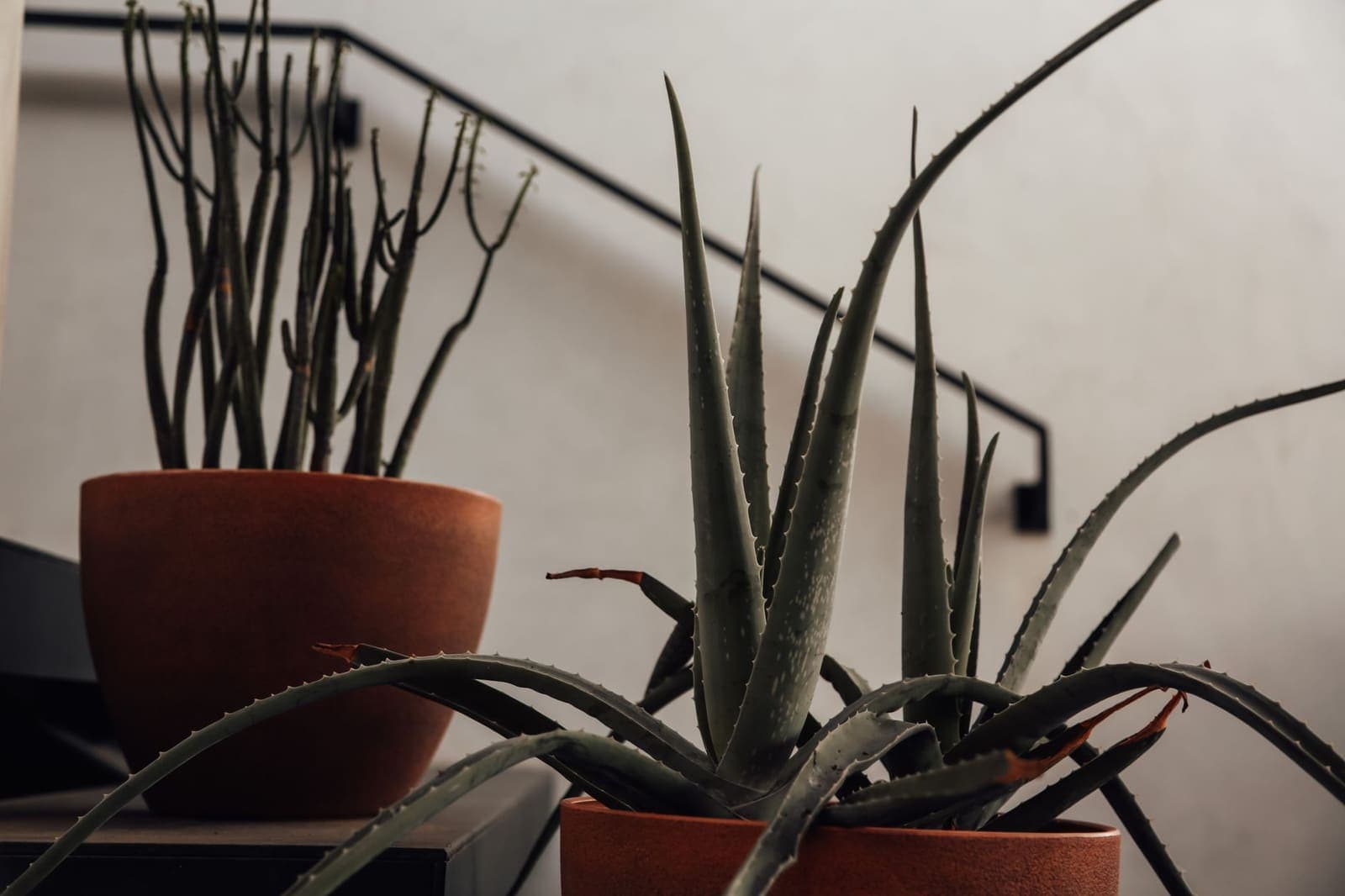
The short answer
Put an aloe in a pot that is wider than it is deep, with a drainage hole, in unglazed terracotta. A 6-inch pot suits a single small rosette, 8 inches a plant with a few offsets, and 10 inches a mature one — go up one size at a time. Terracotta matters twice here: it dries the mix fastest, and its own weight is what stops a top-heavy plant tipping. A 12-inch clay pot that publishes 12.3 lb empty is a different object from a plastic pot of the same size.
Disclosure Pot & Prop earns a commission when you buy through the Amazon links on this page, at no extra cost to you. It does not change which products get recommended or what we say about them, and we have not been given any of them. How this site is funded.
Most houseplant pot advice is about water. For an aloe it is about water and balance, and the balance half is the one nobody writes down. A mature aloe vera carries a wide crown of thick, heavy leaves on a very short stem, and those leaves splay outward until the plant is considerably wider than the pot holding it. Put that in a tall, narrow, lightweight pot and it will go over — onto a windowsill, off a shelf, or slowly, by leaning until the whole thing pivots on its rim.
The rest of the brief is what you would expect from a succulent, and it points the same way. Aloe roots are shallow and spreading rather than deep, and the plant stores its own water, so it wants a container that dries out completely between waterings. Wide, shallow, fast-drying and heavy — those four are one pot, and this page is about which ones actually are it.
What size pot an aloe vera needs
One size up at a time, which for pots means about two inches of extra diameter, and only when the plant has filled the one it is in. That is the standard extension guidance on containers and it matters more than usual here, because an oversized pot for a succulent is not merely wasteful — it is a reservoir of wet mix sitting around roots that are built to be dry. Volume rises with the cube of diameter, so the jump is always bigger than it looks.
volume ratio = (D2 / D1)^3
6 in to 8 in: (8/6)^3 = 2.4 times the mix. 6 in to 10 in: (10/6)^3 = 4.6 times the mix — more than four times the wet soil around a root ball that has not grown at all.
Pot volume on this site is 0.46315 x D^3 cubic inches throughout. The pot size chart works through every step.
| Your plant | Pot diameter | Why |
|---|---|---|
| A single rosette from a 4 in nursery pot | 6 in | One size up; the smallest step that gives the roots room |
| An established plant with two or three offsets | 8 in | Width for the offsets, which spread sideways rather than down |
| A mature plant, leaves wider than the pot rim | 10 in | The size where the crown stops overhanging the base |
| A large old plant that has filled a 10 in pot | 12 in | Floor or a strong shelf only — see the weight table below |
| Pups you have separated | 4 to 5 in | A small root ball in a big pot is the classic way to rot one |
Why an aloe tips, and what the pot can do about it
A plant tips when its center of gravity moves outside the footprint of its base. An aloe works against you on both halves of that: the leaves are heavy and they reach outward and upward, which raises and widens the center of gravity, while the pots sold for succulents are often small and light. Nothing in a listing measures tipping directly, and this site is not going to pretend otherwise by inventing a stability rating. What can be checked is the mass sitting at floor level, and that comes from two numbers.
planted weight = empty pot weight + saturated mix weight
A 12-inch pot holds 0.463 ft^3 of mix, which at the saturated planning density of 55 lb/ft^3 is 25.5 lb. The INGOFIN clay pot publishes an item weight of about 12.3 lb empty. Planted and watered: 25.5 + 12.3 = about 37.8 lb, with the clay portion sitting lowest of all.
The mix figure is computed from the densities on the methodology page; the 12.3 lb is the listing's own published item weight. A plastic pot of the same diameter contributes a small fraction of that, so all of its ballast has to come from the mix — and the mix is lightest exactly when the plant is driest.
That last sentence is the practical point and it is easy to miss. A succulent in a plastic pot is at its most tippable at the end of a dry spell, which for an aloe is most of the time. A clay pot keeps its ballast whether the mix is wet or bone dry, and that is a real, checkable advantage rather than a marketing one.
| Pot size | Mix volume | Dry | Watered | Rating needed |
|---|---|---|---|---|
| 4 in | 0.017 cu ft | 0.4 lb | 0.9 lb | 2 lb |
| 6 in | 0.058 cu ft | 1.3 lb | 3.2 lb | 5 lb |
| 8 in | 0.137 cu ft | 3 lb | 7.5 lb | 12 lb |
| 10 in | 0.268 cu ft | 5.9 lb | 14.7 lb | 23 lb |
| 12 in | 0.463 cu ft | 10.2 lb | 25.5 lb | 39 lb |
Shallow beats deep, and by more than you would think
Aloe roots are shallow and spreading. In a pot deeper than the root system, the bottom third holds mix that no root ever reaches, and mix that no root is drinking from does not dry — it just sits, cold and wet, under the part of the pot that does dry. The plant looks fine for a season and then collapses at the base, and the owner concludes they watered too much when the real problem was geometry.
So depth is a criterion in its own right, and a pot that publishes it is worth more than one that does not. A shallow pot at 10 inches across and under 5 deep holds roughly half the mix of a standard 10-inch pot of the same diameter, which halves the reservoir and doubles how fast the whole thing dries. That is the single most useful change you can make to an aloe's container, and it costs nothing extra.
Terracotta, which wins twice here
Unglazed clay is porous: water and air move through the pot wall, so the mix dries from the sides as well as from the surface. For most houseplants that is a trade — faster drying means more frequent watering — and the material comparison sets out when it is worth it. For an aloe it is close to a free win, because the plant's own preference is to dry out fully and it carries enough water in its leaves to sit dry for weeks.
The second win is the one this page adds: clay is heavy. Terracotta gives you the fastest drying rate and the most ballast in the same purchase, which is why the top of this list is clay and stays clay until the sizes get small enough that tipping stops being the risk.
Quick picks
Ranked, with the published figure each pick turns on. Tap a row for the full reasoning further down this page.
| # | Product | Best for | Price |
|---|---|---|---|
| 1 | 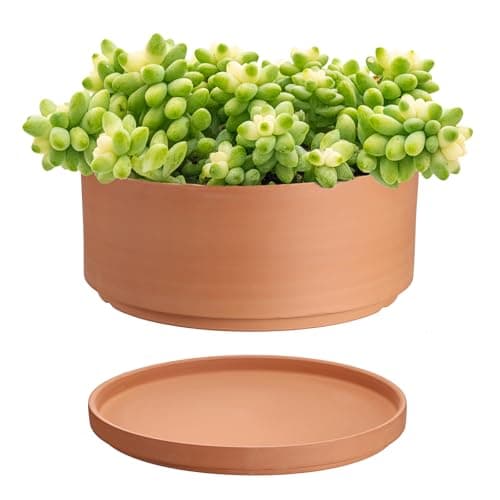 JUXYES 10 in Shallow Terracotta Pot with Drainage and SaucerWide, shallow and unglazed — the three properties an aloe's roots and its top-heavy leaves each ask for separately, in one pot. | The shape an aloe actually wants | |
| 2 | 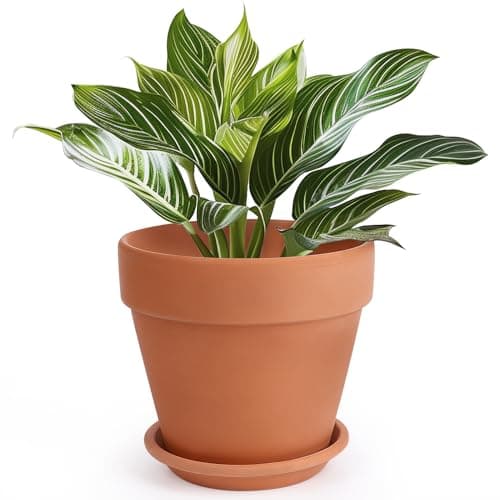 INGOFIN 10 in Terracotta Pot with SaucerTerracotta at the size where overwatering does the most damage, because a 10-inch pot of wet mix takes a long time to dry from the top alone. | A large plant that keeps rotting in plastic | |
| 3 | 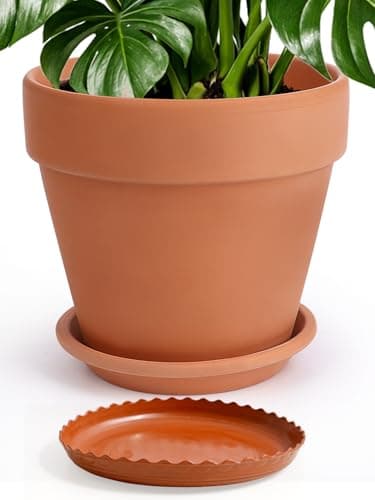 INGOFIN 12 in Terracotta Pot with SaucerThe only pot on this page that publishes its own empty weight, which for a plant that tips rather than rots is the number worth paying for. | A mature aloe that has outgrown 10 inches | |
| 4 | 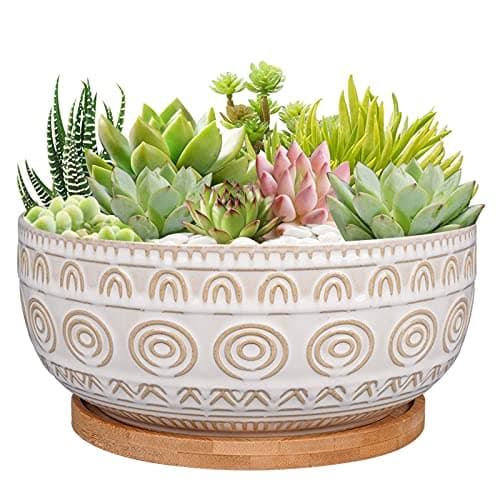 Eightpot 8 in Shallow Ceramic Succulent Pot with Drainage and SaucerShallow rather than deep, which is the correct shape for shallow-rooted plants and the reason succulents die in standard pots. | A succulent arrangement that does not rot | |
| 5 | 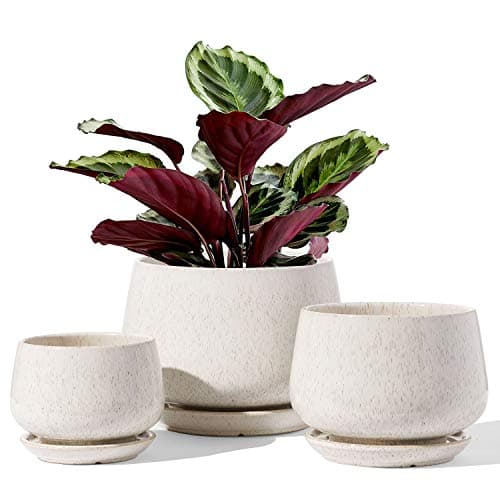 LE TAUCI Ceramic Plant Pots with Drainage and Saucer, set of 3Three graduated sizes with a real hole and a matched saucer in each, which is a lower bar than it sounds and one most decorative ceramic fails. | Three sizes that actually drain | |
| 6 | 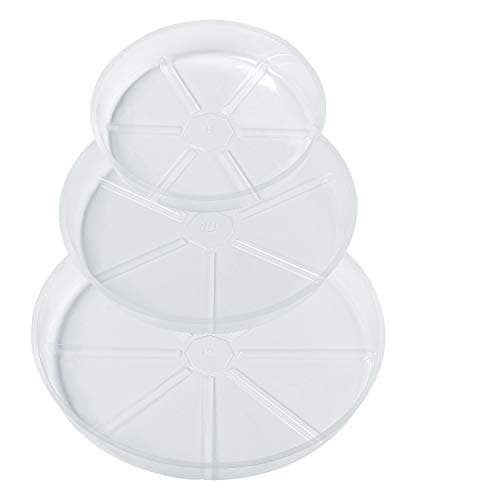 Idyllize Clear Plant Saucers, 6, 8 and 10 in, 15 packFifteen saucers in the three sizes that cover almost every pot in a normal apartment, which is a cheaper fix for a floor than a new pot is. | Fixing the pots you already own | $16.99 at Amazon $17.99 · 6% off |
| 7 | 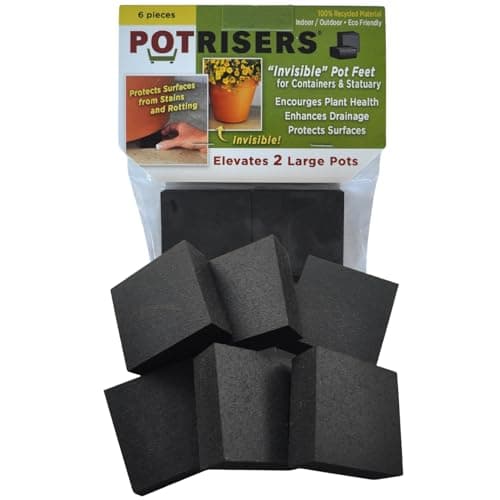 POTRISERS Invisible Pot Feet and Plant Risers, 2 in wide, 6 packThree quarters of an inch of lift, which is not a plant stand at all and solves a problem no plant stand solves: the pot base sitting in its own drainage. | Airflow under a pot with no height cost |
Links to Amazon are affiliate links. Prices and availability are Amazon's and change without notice.
How we ranked these for an aloe
Shape first, then material, then whether the listing publishes anything about its own weight. The JUXYES pot leads because it is the only one here that is genuinely shallow and genuinely clay — 10 inches across and under 5 deep, unglazed, with a hole and a saucer. The two INGOFIN pots follow on material and size, with the 12-inch ranked for the mature plants that need it and marked up for publishing its empty weight, which almost no planter listing does. The Eightpot bowl is the ceramic alternative at 8 inches for anyone who does not want clay. The three-piece set is there for pups, and the last two picks are not pots at all — they are the saucer and the feet that decide whether any of the above actually drains.
| Situation | Pick | Why |
|---|---|---|
| Mature plant, leaves overhanging the rim | 10 in shallow terracotta | Wide and shallow in the material that dries fastest |
| Mature plant, you want a deeper classic pot | 10 in terracotta with saucer | Same clay, standard profile, saucer included |
| Large old plant that filled a 10 in pot | 12 in terracotta | The only pick that publishes its own weight, at about 12.3 lb |
| Medium plant, clay is not your taste | 8 in shallow ceramic | Shallow bowl profile with a hole and a saucer |
| Pups you separated this spring | 4.1 / 5.1 / 6.5 in set | Three small sizes, each with a matched saucer |
| Any of the above, on a surface you care about | Clear saucers, plus pot feet | Clear shows standing water; feet stop the pot wicking it back |
Watering, and the number that makes it concrete
The rule for an aloe is to soak it thoroughly and then leave it completely alone until the mix is dry all the way through — for most apartments that is weeks rather than days, and longer in winter. Both halves of that need a drainage hole: you cannot soak a pot that has no way to drain, and you cannot let one dry out if it is holding a hidden pool at the bottom.
How much water is a soak? It falls out of the same density figures used everywhere on this site. The gap between dry mix and saturated mix is 33 lb per cubic foot, which divided by the density of water gives the volume a pot takes up going from bone dry to fully wet: about 870 ml for a 6-inch pot, about 2 liters for an 8-inch, and about 4 liters for a 10-inch. That is an upper bound rather than a dose, but it is the right scale — and it explains why a splash from a mug does nothing for a mature aloe except wet the top inch.
Pups, and the pot they need
A healthy aloe produces offsets around its base, and separating them is the easiest propagation on this site — no rooting hormone, no water glass, no waiting. Twist or cut a pup away with whatever roots come with it, let the cut surface dry for a day or two so it forms a callus, then pot it into something small. Small is the whole instruction: a 4 or 5-inch pot for a pup with a modest root ball. A pup in a big pot is surrounded by mix it cannot use, which stays wet, and the most common way to lose one is to be generous with it.
This is also why the three-piece set is on a page about large pots. Anyone repotting a mature aloe is about to have pups to deal with, and the pots for those are a different purchase at a different size.
What we deliberately do not recommend
Pots with no drainage hole, at any size, for a plant this prone to rot — if the pot you love has no hole, keep the aloe in a holed nursery pot and drop it inside, which the drainage guide explains at length. Tall, narrow pots, which are the worst possible shape for a shallow-rooted plant with a heavy crown. Self-watering pots, which keep the mix damp and are the opposite of this plant's brief. A layer of gravel in the bottom, which does not improve drainage and raises the wet zone closer to the roots. And going up two sizes at once because the plant looks like it needs the room.
Every pick, in full
We have not handled any of these. What follows is what each listing publishes, what that means once you put a watered pot on it, and who should buy something else.
1. The shape an aloe actually wants
JUXYES 10 in Shallow Terracotta Pot with Drainage and Saucer
Wide, shallow and unglazed — the three properties an aloe's roots and its top-heavy leaves each ask for separately, in one pot.
#ad · Price as of September 14, 2026. How we are funded
- What the listing publishes
- Published about 10 in across by 4.8 in deep (25.4 by 25.4 by 12.2 cm); unglazed terracotta; drainage hole and matching saucer; listing states a substantial base that resists toppling
- Against a 10-inch pot
- No weight rating is published for this product, so there is nothing to check. That counts against it here rather than being treated as neutral.
Almost every pot sold for a large succulent is deeper than it is wide, which is exactly backwards for this plant. An aloe's roots run shallow and outward, so depth adds mix that no root reaches and that stays wet for weeks after a watering. Ten inches across and under five deep puts the volume where the roots are.
Unglazed clay is the other half. Terracotta passes water and air through its wall, so a pot dries from the sides as well as the top — and drying fully between waterings is the single thing an aloe most wants from its container.
The listing makes a stability claim of its own, that the base is substantial enough to resist toppling. It publishes no weight to check that against, which is the one figure missing here. Clay at this size is still far heavier than the plastic equivalent, and that is the part that matters for a plant that leans.
What is good
- Publishes real dimensions — about 10 in across by 4.8 in deep
- Shallow profile matches a shallow, spreading root system
- Unglazed clay dries the mix from the wall as well as the surface
What is not
- No published weight, so the listing's own stability claim cannot be checked
- Unglazed clay stains and grows a white mineral bloom over time
- Shallow pots dry fast, which means more frequent watering in a warm room
Skip it if your aloe is still a single small rosette. A 10-inch pot around a 4-inch root ball is a lot of wet mix going nowhere, and a 6-inch pot is the right step.
2. A large plant that keeps rotting in plastic
INGOFIN 10 in Terracotta Pot with Saucer
Terracotta at the size where overwatering does the most damage, because a 10-inch pot of wet mix takes a long time to dry from the top alone.
#ad · Price as of September 14, 2026. How we are funded
- What the listing publishes
- 10 in unglazed clay with drainage hole and saucer
- Against a 10-inch pot
- No weight rating is published for this product, so there is nothing to check. That counts against it here rather than being treated as neutral.
A 10-inch pot of saturated mix computes to about 14.7 lb, and unglazed clay adds several pounds of its own. This is a floor or a low sturdy shelf, not a tiered frame.
The larger the pot, the longer the middle of it stays wet, and the more the porous wall earns its keep. The material advantage that is marginal at 4 inches is substantial at 10.
Clay at this size is fragile in exactly one way that matters: the rim chips if it is set down hard on tile.
What is good
- The porous wall matters most at large pot sizes
- Saucer included at a size where they are expensive alone
- Heavy enough to anchor a top-heavy plant
What is not
- Heavy before the mix goes in
- Chips on tile
- Needs watering noticeably more often than a glazed pot the same size
Skip it if the pot is going on a shelf. At roughly 15 lb of saturated mix plus several pounds of clay, this belongs on the floor unless the shelf publishes a number.
3. A mature aloe that has outgrown 10 inches
INGOFIN 12 in Terracotta Pot with Saucer
The only pot on this page that publishes its own empty weight, which for a plant that tips rather than rots is the number worth paying for.
#ad · Price as of September 14, 2026. How we are funded
- What the listing publishes
- Published 12 in opening by 10.6 in tall; item weight published at about 12.3 lb empty; one-piece fired clay with a drainage hole; saucers included
- Against a 10-inch pot
- No weight rating is published for this product, so there is nothing to check. That counts against it here rather than being treated as neutral.
Twelve pounds of clay before any mix goes in is the whole argument. A mature aloe carries a wide crown of heavy leaves on a short stem, and what keeps that upright is mass low down. A plastic pot of the same diameter weighs a small fraction of this and relies entirely on the mix for ballast.
It is the same INGOFIN clay as the 10-inch pot already ranked on this site, one size up, so the drying behavior is a known quantity rather than a new variable.
Twelve inches is also where this stops being a pot you carry. Filled and watered it is a floor object — see the weight table on this page before deciding the windowsill can take it.
What is good
- Publishes its empty weight, which almost no planter listing does
- Unglazed clay, so it dries at the rate an aloe wants
- Drainage hole and saucers included at a size where both are often sold separately
What is not
- About 12.3 lb before a gram of mix goes in — heavy to move and easy to chip
- 10.6 in tall is deeper than an aloe's roots need, so the lower mix does little
- The most expensive pot on this page by a clear margin
Skip it if the plant fits a 10-inch pot. Going two sizes up at once leaves a ring of permanently wet mix around the roots, and this pot is heavy enough that you will not want to redo it.
4. A succulent arrangement that does not rot
Eightpot 8 in Shallow Ceramic Succulent Pot with Drainage and Saucer
Shallow rather than deep, which is the correct shape for shallow-rooted plants and the reason succulents die in standard pots.
#ad · Price as of September 14, 2026. How we are funded
- What the listing publishes
- 8 in diameter, shallow bowl profile, drainage hole and saucer
- Against a 10-inch pot
- No weight rating is published for this product, so there is nothing to check. That counts against it here rather than being treated as neutral.
Succulent roots occupy the top few inches. In a standard-depth 8-inch pot the bottom half is mix that never dries and never gets used, which is exactly the condition rot needs.
A shallow bowl also weighs far less than the frustum model predicts for its diameter, because the model assumes standard proportions. For a bowl, take the computed figure as an upper bound.
The drainage hole is the other half. Shallow plus draining is a system; shallow with no hole is a puddle.
What is good
- The correct depth for shallow-rooted plants
- Weighs less than a standard pot the same width
- Hole and saucer included
What is not
- Wrong for anything deep-rooted
- Dries fast enough to need attention in summer
- Ceramic bowls chip at the rim
Skip it if you are potting a pothos, a monstera or anything else that puts roots down. A shallow bowl starves them.
5. Three sizes that actually drain
LE TAUCI Ceramic Plant Pots with Drainage and Saucer, set of 3
Three graduated sizes with a real hole and a matched saucer in each, which is a lower bar than it sounds and one most decorative ceramic fails.
#ad · Price as of September 14, 2026. How we are funded
- What the listing publishes
- 4.1, 5.1 and 6.5 in; drainage hole and a matched saucer on every pot
- Against a 10-inch pot
- No weight rating is published for this product, so there is nothing to check. That counts against it here rather than being treated as neutral.
Saturated mix in these three sizes computes to about 0.9, 1.8 and 3.7 lb, light enough that any shelf holds them and the interesting question is drainage rather than load.
A matched saucer is not decoration. Buying a saucer separately means guessing a diameter, and a saucer an inch too small overflows onto whatever is underneath.
Graduated sets are how you pot up a plant without a second order. A rooted cutting goes in the 4-inch, moves to the 5-inch in a season and the 6.5-inch after that.
What is good
- Every pot has a hole and a matching saucer
- Three sizes cover a potting-up sequence
- Glazed inside, so they do not wick like bare terracotta
What is not
- Nothing here fits a plant bigger than a small pothos
- Ceramic chips if it goes over
- Glazed pots dry slower than terracotta, which suits some plants and kills others
Skip it if you overwater. A glazed, non-porous pot is the least forgiving container for that habit, and terracotta is the fix.
6. Fixing the pots you already own
Idyllize Clear Plant Saucers, 6, 8 and 10 in, 15 pack
Fifteen saucers in the three sizes that cover almost every pot in a normal apartment, which is a cheaper fix for a floor than a new pot is.
- What the listing publishes
- Published five each of 6, 8 and 10 in; clear plastic, stated lightweight and durable
- Against a 10-inch pot
- No weight rating is published for this product, so there is nothing to check. That counts against it here rather than being treated as neutral.
The commonest reason a plant lives in a pot with no drainage is that the owner has no saucer for it. Fifteen saucers removes that reason for a whole collection at once.
Clear saucers show standing water, which is the thing you actually need to see. An opaque saucer with two inches of water in it looks exactly like an empty one.
A saucer is only half the answer. A pot sitting flat in its own drainage wicks it back up, so pair these with pot feet.
What is good
- Covers three common pot sizes in one order
- Clear, so standing water is visible
- Cheaper than replacing a single pot
What is not
- Thin plastic cracks if a heavy pot is dragged across it
- Clear plastic clouds over a couple of years
- Does not solve wicking on its own
Skip it if all your pots are already in cachepots. A cachepot is a saucer with sides, and stacking a saucer inside it just hides the water.
7. Airflow under a pot with no height cost
POTRISERS Invisible Pot Feet and Plant Risers, 2 in wide, 6 pack
Three quarters of an inch of lift, which is not a plant stand at all and solves a problem no plant stand solves: the pot base sitting in its own drainage.
#ad · Price as of September 14, 2026. How we are funded
- What the listing publishes
- 2 in wide by 3/4 in tall feet; lifts the pot base clear of its saucer
- Against a 10-inch pot
- No weight rating is published for this product, so there is nothing to check. That counts against it here rather than being treated as neutral.
A pot standing apartment in a saucer wicks the water it just drained straight back up. Feet break that contact, which is the difference between drainage that works and a saucer that is a reservoir.
It also protects the floor. Terracotta sitting wet on wood for a year leaves a ring that does not come out, and a few cents of plastic prevents it.
Six feet is two or three pots. Buy per pot, not per apartment.
What is good
- Fixes the wicking problem that drainage holes alone do not
- Keeps wet pot bases off wood floors
- Costs and weighs almost nothing
What is not
- Six feet only covers two or three pots
- Raises the pot enough to matter under a tight sill
- Not a substitute for a saucer
Skip it if your pots are already in cachepots with a gap at the bottom. You have the airflow, and feet just make the pot taller.
Questions people actually ask
What size pot does an aloe vera need?
Do aloe vera plants like deep or shallow pots?
Is terracotta good for aloe vera?
Why does my aloe vera keep falling over?
Does an aloe vera pot need a drainage hole?
What pot do I put aloe pups in?
Sources
- Cornell University, Greenhouse Management: bulk density of greenhouse media components
- Biology Insights: how much a cubic foot of potting soil weighs, dry and saturated
- Clemson HGIC: Indoor Plants — cleaning, fertilizing, containers and light requirements
- Clemson HGIC: Indoor Plants — watering
- University of Georgia Extension B1318: Growing Indoor Plants with Success
Product specifications are quoted from each seller's own listing and are the seller's claim, not a measurement of ours.