Planters
The Best Pots for a Jade Plant
Every succulent guide tells you to buy a shallow bowl. A jade is a tree that falls over, and it needs the opposite pot.
By Scooter M., enthusiast · Published
The short answer
Buy unglazed terracotta with a drainage hole, in a cylinder or straight-sided profile rather than a shallow bowl, and size it to the plant you have rather than the one you want. Clemson's jade guidance is specific on the reason: jades grow into small trees up to five feet tall indoors, and when the plant becomes older and top-heavy you move it to a large, heavy pot to prevent tipping over. That is a different brief from every other succulent on this site, where shallow and wide is correct. An 8-inch unglazed cylinder is the pot most established jades should be in; go to 10 inches only when the plant is genuinely tall, because over-potting a succulent is the one mistake that is hard to undo.
Disclosure Pot & Prop earns a commission when you buy through the Amazon links on this page, at no extra cost to you. It does not change which products get recommended or what we say about them, and we have not been given any of them. How this site is funded.
A jade plant is sold as a succulent and filed with the succulents, and almost all of the care advice that follows from that is right: full sun, let it dry out, fast-draining mix, do not drown it. The pot advice is the exception, and it is wrong in a way that only shows up years later when the plant is three feet tall and goes over sideways.
This site's succulent pot page tells you to buy a pot wider than it is deep, and for an echeveria or a haworthia that is correct — those roots spread sideways in the top couple of inches and a deep pot leaves a column of permanently wet mix below them. A jade is not that plant. Clemson describes it growing into a small tree or shrub up to five feet tall indoors, and adds the instruction nobody repeats: when the plant becomes older and top-heavy, move it to a large, heavy pot to prevent tipping over.
A five-foot plant on a seven-inch base
The tipping problem is worth looking at numerically, because the numbers explain why the answer is a bigger pot rather than a propped-up stem. A standard plant pot is a truncated cone whose base is narrower than its rim — this site models the base at three quarters of the rim diameter, and that model is reproducible from the dimensions on any listing.
base diameter = 0.75 x rim diameter
an 8-inch pot stands on about 6.0 inches; a 10-inch pot on about 7.5 inches; a 12-inch pot on about 9.0 inches
Which against Clemson's five-foot mature height means a jade in a 10-inch pot is a 60-inch plant on a 7.5-inch footprint — a ratio of about 1 to 8. The same plant in a 12-inch pot sits at about 1 to 6.7. Neither figure is a safety rating; the point is that the footprint is the only variable you control, and it changes slowly with pot size.
The second variable is ballast, and that one is calculable exactly. Everything a pot weighs below the rim resists the canopy above it, and the mix is most of that weight once it is watered.
| Pot size | Mix volume | Dry | Watered | Rating needed |
|---|---|---|---|---|
| 6 in | 0.058 cu ft | 1.3 lb | 3.2 lb | 5 lb |
| 8 in | 0.137 cu ft | 3 lb | 7.5 lb | 12 lb |
| 10 in | 0.268 cu ft | 5.9 lb | 14.7 lb | 23 lb |
| 12 in | 0.463 cu ft | 10.2 lb | 25.5 lb | 39 lb |
That is the case for clay over plastic in one line: a plastic pot adds almost nothing to the ballast column, and an unglazed clay pot of the same size adds a useful fraction of it. It is also the case against moving a top-heavy jade into a lightweight decorative sleeve, however good it looks.
Unglazed clay, for a reason that is not aesthetic
Clemson's watering guidance for a jade has two halves that pull in opposite directions: keep the soil moist but not wet while the plant is actively growing in spring and summer, and let the soil dry between waterings during the winter. Getting both right by hand means changing your habits twice a year.
Unglazed terracotta does part of that for you. Water leaves through the wall as well as the surface, so the mix dries faster and more evenly than in a glazed or plastic pot of the same size — which makes the winter half of the instruction close to automatic and the summer half slightly more work. Given that Clemson names root rot from a mix that does not drain quickly, or from overly frequent watering, as the main failure, erring on the drying side is the right error. The full material comparison is here.
| Material | Drying | Ballast | Verdict for a jade |
|---|---|---|---|
| Unglazed terracotta | Fastest — through the wall | Good, and grows with size | The default; what every pick here is |
| Glazed ceramic | Slow; surface only | Best of the three | Acceptable for a very tall plant if you water carefully |
| Plastic nursery pot | Slow; surface only | Almost none | Fine for a young plant; wrong under a tall one |
| Decorative pot with no hole | No drainage at all | Varies | Never, for this plant above all others |
Size it to the plant, not the plan
Over-potting is the specific mistake this site warns about on the pot size chart, and a jade makes it unusually tempting, because you know it is going to get big and the stability argument above points at a wider base. Resist it, for a reason that comes straight from Clemson: jades can live quite happily for years while root-bound, and if repotting is necessary you do it as new growth starts.
A plant that tolerates being root-bound has no need of spare room, and spare room in a succulent pot is a volume of mix with no roots drinking from it — which stays wet for weeks after the surface looks dry, and is the root-rot condition described above. The right sequence is to go up one size at a time, as the plant earns it.
- A rooted leaf or a small cutting: 4 to 5 inches. The smallest pot in a mixed set, and it will live there a year or more.
- A young plant under a foot tall: 6 inches, and a shallow bonsai-style pot is genuinely fine at this stage because the plant is still wider than it is tall.
- An established plant, one to three feet: 8 inches, in a cylinder rather than a bowl. This is where most jades should be and where most of them are under-potted.
- A tall, woody, visibly top-heavy plant: 10 inches or more, which is the stage Clemson's large-heavy-pot instruction is written for.
- Any stage: check the hole. A jade in a sealed pot is the fastest route to root rot in this entire site.
The light requirement decides where the pot goes
Worth including because it changes the purchase. Clemson states that jade plants do best where they get four or more hours a day of direct sunlight, and names the full sun or bright filtered light of a south-facing window. That is a demanding specification in an apartment, and it is considerably more light than most of the plants this site covers want.
Two consequences follow. First, the pot is going on or beside a south-facing window, which is where the floor is usually most constrained — an argument for a round pot with a modest footprint over a wide bowl. Second, if you do not have that window, you will find out by measuring rather than by watching the plant stretch for a year; a light meter reads the four-hour question directly, and Illinois Extension's direct-light band is 1,500 foot-candles.
Quick picks
Ranked, with the published figure each pick turns on. Tap a row for the full reasoning further down this page.
| # | Product | Best for | Price |
|---|---|---|---|
| 1 | 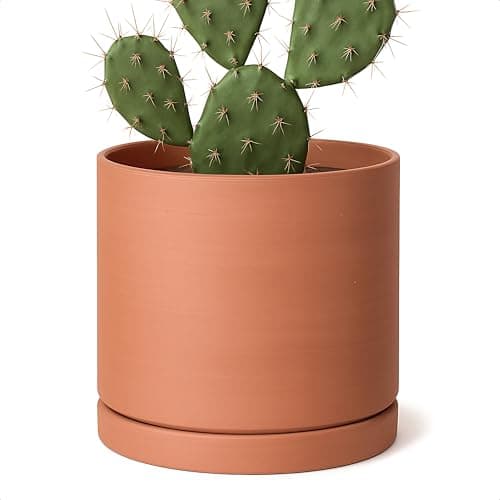 D'vine Dev Terracotta Cylinder Pot with Saucer, 8 in, unglazedA cylinder instead of a bowl, which is the one shape change that buys a top-heavy succulent some depth to root into. | A jade tall enough to worry about | $44.99 at Amazon $55.99 · 20% off |
| 2 | 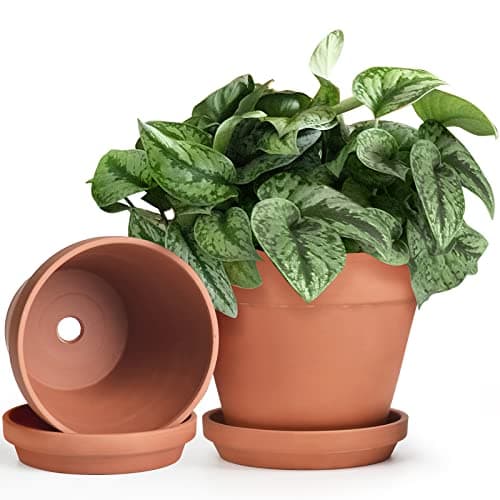 INGOFIN Terracotta Pots with Saucers, 8 in, 2 packThe same published 8-inch size as the cylinder, in a pair, from the brand whose terracotta already runs through this site. | Two jades, or one jade and its backup | |
| 3 | 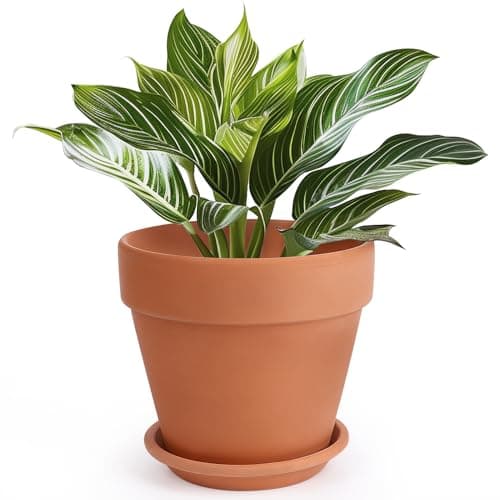 INGOFIN 10 in Terracotta Pot with SaucerTerracotta at the size where overwatering does the most damage, because a 10-inch pot of wet mix takes a long time to dry from the top alone. | A large plant that keeps rotting in plastic | |
| 4 | 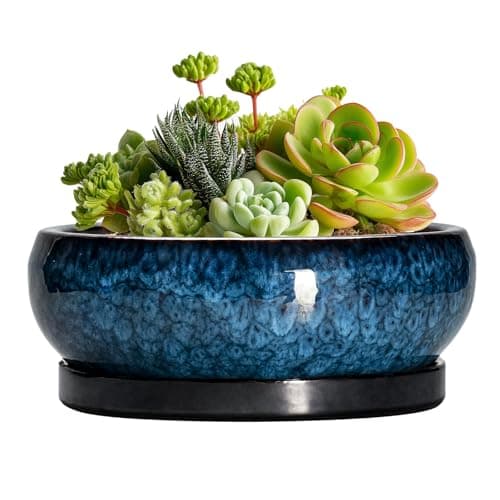 EPFamily 6 in Shallow Bonsai Pot with Drainage and SaucerDesk-scale and shallow, with the saucer that a shallow pot needs more than a deep one does, because it drains faster and harder. | A single specimen on a desk | |
| 5 | 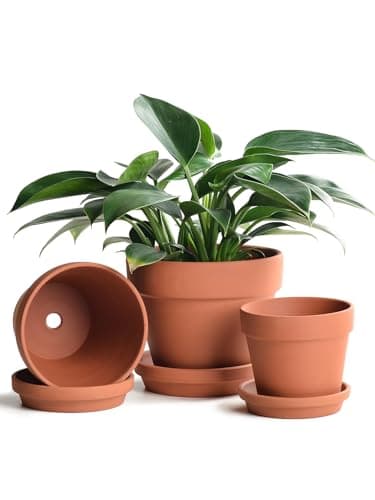 INGOFIN Terracotta Pots with Saucers, 5, 6 and 7 inPorous clay, the only pot material that actively removes water from the mix, and the reason succulents live longer in terracotta than in anything else. | Plants that must dry out between waterings |
Links to Amazon are affiliate links. Prices and availability are Amazon's and change without notice.
How we ranked these
On profile first, then on material, then on how well the size suits the stage of plant most people are repotting. The 8-inch unglazed cylinder leads because it is the only pot here whose shape is chosen for a tree rather than a rosette — straight sides give the root ball depth to anchor in, and the 8-inch size is where an established jade should be. The 8-inch pair is second at a lower price per pot in a bowl profile, which is the right trade if your jade is still wider than it is tall or if you have more than one. The 10-inch terracotta is third and is the pot Clemson's large-heavy-pot instruction actually describes, held there only because most readers' jades are not yet big enough for it. The 6-inch bonsai pot is fourth and is the correct pot for a young plant, with the honest note that it will be outgrown. The mixed terracotta set is last and is the propagation purchase: jade drops leaves that root themselves, so anyone who owns one for long owns several.
| Your plant | Buy | Why |
|---|---|---|
| Established, 1-3 ft, woody at the base | 8 in unglazed cylinder | Depth to anchor; clay dries it; the size most jades need |
| Two or more jades to repot | 8 in terracotta pair | Same size, lower price per pot |
| Tall and visibly top-heavy | 10 in terracotta | The large, heavy pot the published guidance calls for |
| Young, under a foot, wider than tall | 6 in shallow bonsai pot | Right now, and it will be outgrown |
| Rooting fallen leaves | Mixed terracotta set | Small pots, drainage, and jade propagates itself |
| Want a decorative pot with no hole | Keep the clay pot and drop it in | The cachepot route; never plant a jade in a sealed pot |
What we deliberately do not recommend
A shallow succulent bowl for a plant that is going to be three feet tall, which is the standard recommendation and the reason this page exists. A self-watering pot, for a plant whose published guidance includes letting the soil dry between waterings — the comparison is here. Any pot with no drainage hole, for the plant on this site least able to survive one. Going up two sizes at once because you know it will get big. A lightweight plastic sleeve under a tall woody specimen. And repotting in the middle of winter: Clemson's timing is as new growth starts, and the same page says to allow the soil to become dry after repotting and to wait four months before feeding a repotted plant.
Every pick, in full
We have not handled any of these. What follows is what each listing publishes, what that means once you put a watered pot on it, and who should buy something else.
1. A jade tall enough to worry about
D'vine Dev Terracotta Cylinder Pot with Saucer, 8 in, unglazed
A cylinder instead of a bowl, which is the one shape change that buys a top-heavy succulent some depth to root into.
- What the listing publishes
- Published 8 in; cylinder profile; unglazed porous terracotta; drainage hole and saucer
- Against a 10-inch pot
- No weight rating is published for this product, so there is nothing to check. That counts against it here rather than being treated as neutral.
Every other terracotta pot on this site is a shallow bowl, chosen because rosette succulents root sideways in the top few inches. A jade is a different plant: Clemson describes it growing into a small tree up to five feet tall indoors, and a tree needs a root ball with some depth under it.
Unglazed clay is the material half of the same argument. It loses water through the wall, which is how you get the dry-between-waterings cycle Clemson prescribes for a jade in winter without having to be disciplined about it.
It is a single pot at a price where the other listings here are multipacks, which is the cost of buying the right shape in this category.
What is good
- Cylinder profile gives real rooting depth under a top-heavy plant
- Unglazed clay dries the mix through the wall, not just from the top
- Published drainage hole and a matched saucer
What is not
- Expensive for one 8-inch pot
- Unglazed terracotta grows a white salt crust on the outside over time
- Clay is breakable, and an 8-inch clay pot full of wet mix is a two-hand lift
Skip it if your jade is a rooted cutting or a young plant under a foot tall. Over-potting a succulent is the specific mistake this site warns about, and a 5 or 6-inch pot is the right first home.
2. Two jades, or one jade and its backup
INGOFIN Terracotta Pots with Saucers, 8 in, 2 pack
The same published 8-inch size as the cylinder, in a pair, from the brand whose terracotta already runs through this site.
#ad · Price as of October 18, 2026. How we are funded
- What the listing publishes
- Published 8 in, set of 2; clay with drainage hole and tray
- Against a 10-inch pot
- No weight rating is published for this product, so there is nothing to check. That counts against it here rather than being treated as neutral.
Jade propagates itself whether you intend it to or not — a dropped leaf roots on the surface of the mix — so anyone who owns one for a few years owns several. Buying 8-inch pots in pairs is the cheapest way to be ready for that.
This is the same brand as the terracotta sets already recommended on the succulent and aloe pages, which is a consistency point rather than an endorsement: the listings publish a size, a drainage hole and a saucer, and that is the full specification available in this category.
A bowl profile rather than a cylinder, so it suits a jade that is still wider than it is tall.
What is good
- Two matched 8-inch pots for less than one cylinder
- Published drainage hole and saucer on both
- Porous clay, same drying behavior as the rest of the terracotta here
What is not
- Shallower profile than a cylinder, so less anchorage for a tall plant
- The listing publishes no wall thickness or weight
- Terracotta chips, and two pots is two chances
Skip it if you own one large jade and nothing else. One cylinder in the right shape beats two bowls in the wrong one.
3. A large plant that keeps rotting in plastic
INGOFIN 10 in Terracotta Pot with Saucer
Terracotta at the size where overwatering does the most damage, because a 10-inch pot of wet mix takes a long time to dry from the top alone.
#ad · Price as of October 18, 2026. How we are funded
- What the listing publishes
- 10 in unglazed clay with drainage hole and saucer
- Against a 10-inch pot
- No weight rating is published for this product, so there is nothing to check. That counts against it here rather than being treated as neutral.
A 10-inch pot of saturated mix computes to about 14.7 lb, and unglazed clay adds several pounds of its own. This is a floor or a low sturdy shelf, not a tiered frame.
The larger the pot, the longer the middle of it stays wet, and the more the porous wall earns its keep. The material advantage that is marginal at 4 inches is substantial at 10.
Clay at this size is fragile in exactly one way that matters: the rim chips if it is set down hard on tile.
What is good
- The porous wall matters most at large pot sizes
- Saucer included at a size where they are expensive alone
- Heavy enough to anchor a top-heavy plant
What is not
- Heavy before the mix goes in
- Chips on tile
- Needs watering noticeably more often than a glazed pot the same size
Skip it if the pot is going on a shelf. At roughly 15 lb of saturated mix plus several pounds of clay, this belongs on the floor unless the shelf publishes a number.
4. A single specimen on a desk
EPFamily 6 in Shallow Bonsai Pot with Drainage and Saucer
Desk-scale and shallow, with the saucer that a shallow pot needs more than a deep one does, because it drains faster and harder.
#ad · Price as of October 18, 2026. How we are funded
- What the listing publishes
- 6 in shallow ceramic with drainage hole and saucer
- Against a 10-inch pot
- No weight rating is published for this product, so there is nothing to check. That counts against it here rather than being treated as neutral.
A shallow pot passes water through quickly, which is the point and also why it needs a saucer that can take a sudden volume rather than a slow drip.
At 6 inches and shallow, the saturated load is well under 3 lb. This is a pot you can put anywhere.
Bonsai-profile pots are the right shape for cuttings that have just rooted, which is where the propagation half of this site hands off to the planter half.
What is good
- The right shape for rooted cuttings and small specimens
- Saucer sized for a fast drain
- Light enough for a windowsill riser
What is not
- Too small for anything that grows
- Shallow pots dry out over a long weekend
- One pot per order
Skip it if the plant already fills a 6-inch nursery pot. A shallow 6-inch holds less mix than a standard one, so this is a step backwards.
5. Plants that must dry out between waterings
INGOFIN Terracotta Pots with Saucers, 5, 6 and 7 in
Porous clay, the only pot material that actively removes water from the mix, and the reason succulents live longer in terracotta than in anything else.
#ad · Price as of October 18, 2026. How we are funded
- What the listing publishes
- 5, 6 and 7 in unglazed clay, drainage hole and saucer per pot
- Against a 10-inch pot
- No weight rating is published for this product, so there is nothing to check. That counts against it here rather than being treated as neutral.
Unglazed terracotta breathes through the wall, so the mix dries from the sides as well as the top. For a plant that rots when wet that is a feature you cannot get from a plastic pot with a bigger hole.
It also means the pot itself is damp. Terracotta sitting directly on wood leaves a ring, which is what the pot feet elsewhere in this section exist for.
Clay adds real weight for its size. On a shelf with no published rating, a set of three terracotta pots is meaningfully heavier than the same set in plastic.
What is good
- Dries the mix from the sides, not just the top
- Three sizes for potting up
- A heavy base resists being knocked over
What is not
- Damp clay marks wood floors and shelves
- Heavier than plastic at the same size
- Dries so fast that thirsty plants need watering twice as often
Skip it if you travel or forget to water. Terracotta is the least forgiving material for an under-waterer, and glazed ceramic is the fix.
Questions people actually ask
What kind of pot is best for a jade plant?
What size pot does a jade plant need?
Do jade plants need a deep or shallow pot?
Should a jade plant pot have drainage holes?
Why does my jade plant keep falling over?
When should I repot a jade plant?
Is terracotta or ceramic better for a jade plant?
Sources
- Clemson HGIC: Jade Plant — light, watering, soil mix and repotting
- Clemson HGIC: Indoor Plants — cleaning, fertilizing, containers and light requirements
- Cornell University, Greenhouse Management: bulk density of greenhouse media components
- Biology Insights: how much a cubic foot of potting soil weighs, dry and saturated
Product specifications are quoted from each seller's own listing and are the seller's claim, not a measurement of ours.