Planters
The Best Planters for Succulents
Succulents die from depth as often as from watering. A shallow pot with a hole solves most of what goes wrong.
By Scooter M., enthusiast · Published · Last updated
The short answer
Buy a shallow pot with a drainage hole, wider than it is deep, in terracotta or unsealed ceramic. Succulent roots are shallow and spreading, so a deep pot holds a column of mix nothing is drinking from — which stays wet, and wet is the one thing these plants cannot survive. One exception worth knowing: a jade is a tree rather than a rosette, reaches five feet indoors and needs depth and ballast instead, so [it gets its own pots](/planters/best-pots-for-jade-plants).
Disclosure Pot & Prop earns a commission when you buy through the Amazon links on this page, at no extra cost to you. It does not change which products get recommended or what we say about them, and we have not been given any of them. How this site is funded.
The standard advice for succulents is about watering: less often, less water, let it dry. All true, and all much easier to follow if the pot is right, because a deep pot makes correct watering nearly impossible. Succulent roots spread sideways in the top few inches. Put that root system in a 6-inch-deep pot and everything below it is mix with no roots in it, which nothing is drinking from and which therefore stays wet for weeks after the surface looks bone dry.
So the pot does most of the work. Shallow, wide, with a hole — and preferably in a material that helps rather than hinders, which is the argument laid out in terracotta against ceramic against plastic. How these picks were chosen.
Quick picks
Ranked, with the published figure each pick turns on. Tap a row for the full reasoning further down this page.
| # | Product | Best for | Price |
|---|---|---|---|
| 1 | 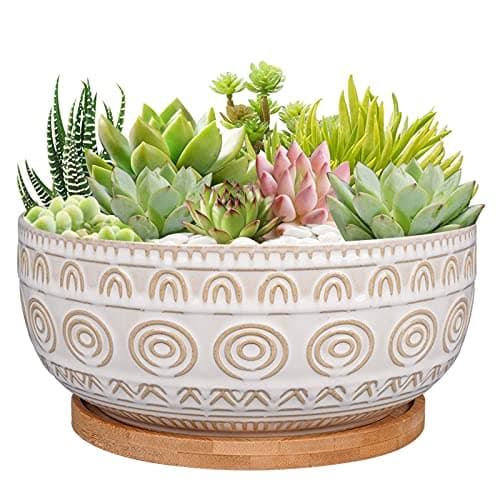 Eightpot 8 in Shallow Ceramic Succulent Pot with Drainage and SaucerShallow rather than deep, which is the correct shape for shallow-rooted plants and the reason succulents die in standard pots. | A succulent arrangement that does not rot | |
| 2 | 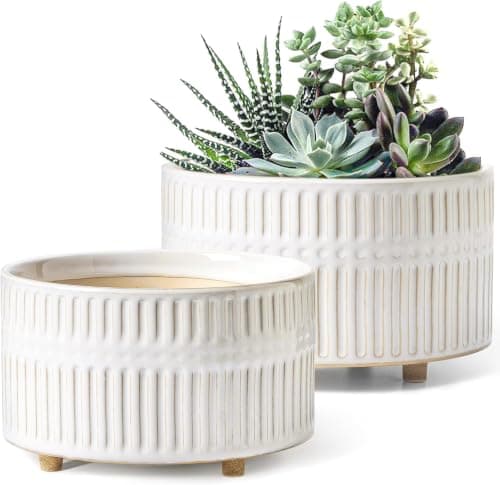 LE TAUCI Shallow Succulent Pots with Drainage, 6.5 and 8 in, set of 2The same shallow-bowl argument in two sizes, matte-finished, which is the pairing an arrangement usually needs rather than one bowl. | Two shallow bowls that match | $30.99 at Amazon $32.99 · 6% off |
| 3 | 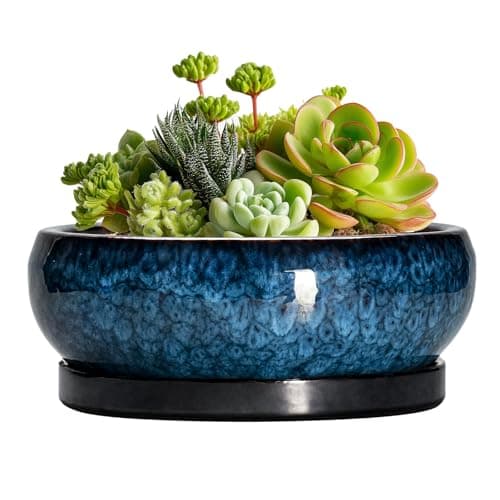 EPFamily 6 in Shallow Bonsai Pot with Drainage and SaucerDesk-scale and shallow, with the saucer that a shallow pot needs more than a deep one does, because it drains faster and harder. | A single specimen on a desk | |
| 4 | 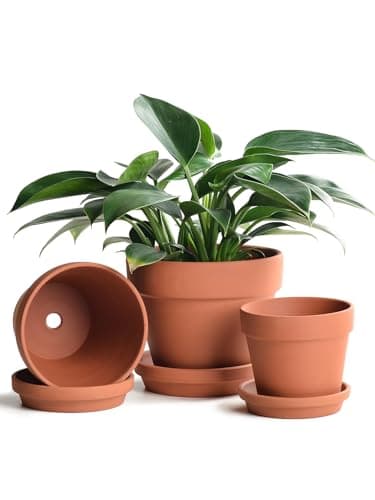 INGOFIN Terracotta Pots with Saucers, 5, 6 and 7 inPorous clay, the only pot material that actively removes water from the mix, and the reason succulents live longer in terracotta than in anything else. | Plants that must dry out between waterings |
Links to Amazon are affiliate links. Prices and availability are Amazon's and change without notice.
What we looked at, in order
- Is it shallower than it is wide? This is the whole category in one question. A tall cylinder is the wrong shape no matter how good the drainage is.
- Drainage hole and saucer. Non-negotiable here more than anywhere else on the site.
- Does the width suit an arrangement? Succulents look best and grow well in groups, and a wide shallow bowl is what makes that possible in one pot.
- Material. Unglazed clay and unsealed ceramic dry faster, which is the direction of error you want with these plants.
The shape rule, with the arithmetic
Volume in a pot scales with depth just as directly as it does with width, so a pot twice as deep holds twice the mix at the same diameter — and for a plant whose roots occupy only the top two inches, all of that extra volume is dead weight that stays wet. The weight side is worth seeing too, because succulent arrangements often end up on windowsills and small shelves where the rating is unknown.
| Pot size | Mix volume | Dry | Watered | Rating needed |
|---|---|---|---|---|
| 4 in | 0.017 cu ft | 0.4 lb | 0.9 lb | 2 lb |
| 5 in | 0.034 cu ft | 0.7 lb | 1.8 lb | 3 lb |
| 6 in | 0.058 cu ft | 1.3 lb | 3.2 lb | 5 lb |
| 8 in | 0.137 cu ft | 3 lb | 7.5 lb | 12 lb |
What we do not recommend
Glass terrariums and closed vessels, which have no drainage and no airflow and are the most reliable way to kill a succulent that has been given as a gift. Deep cylindrical pots, for the reason above. And self-watering pots, whose entire mechanism is designed to prevent the dry-down these plants require — that is not a preference, it is a direct conflict between what the pot does and what the plant needs.
Every pick, in full
We have not handled any of these. What follows is what each listing publishes, what that means once you put a watered pot on it, and who should buy something else.
1. A succulent arrangement that does not rot
Eightpot 8 in Shallow Ceramic Succulent Pot with Drainage and Saucer
Shallow rather than deep, which is the correct shape for shallow-rooted plants and the reason succulents die in standard pots.
#ad · Price as of October 18, 2026. How we are funded
- What the listing publishes
- 8 in diameter, shallow bowl profile, drainage hole and saucer
- Against a 10-inch pot
- No weight rating is published for this product, so there is nothing to check. That counts against it here rather than being treated as neutral.
Succulent roots occupy the top few inches. In a standard-depth 8-inch pot the bottom half is mix that never dries and never gets used, which is exactly the condition rot needs.
A shallow bowl also weighs far less than the frustum model predicts for its diameter, because the model assumes standard proportions. For a bowl, take the computed figure as an upper bound.
The drainage hole is the other half. Shallow plus draining is a system; shallow with no hole is a puddle.
What is good
- The correct depth for shallow-rooted plants
- Weighs less than a standard pot the same width
- Hole and saucer included
What is not
- Wrong for anything deep-rooted
- Dries fast enough to need attention in summer
- Ceramic bowls chip at the rim
Skip it if you are potting a pothos, a monstera or anything else that puts roots down. A shallow bowl starves them.
2. Two shallow bowls that match
LE TAUCI Shallow Succulent Pots with Drainage, 6.5 and 8 in, set of 2
The same shallow-bowl argument in two sizes, matte-finished, which is the pairing an arrangement usually needs rather than one bowl.
- What the listing publishes
- 6.5 and 8 in shallow ceramic bowls with drainage holes
- Against a 10-inch pot
- No weight rating is published for this product, so there is nothing to check. That counts against it here rather than being treated as neutral.
Two bowls let you split a crowded arrangement without the second pot looking like an afterthought. Succulent arrangements almost always get split within a year.
Matte glaze is less porous than terracotta, but the shallow profile compensates, so the drying speed lands closer to clay than to a deep glazed pot.
Both sizes are light. Even at the model's upper bound an 8-inch pot is 7.5 lb of mix, so shelf placement is not a load question.
What is good
- Two matched sizes for splitting arrangements
- A shallow profile suits the plants it is sold for
- Light enough for any shelf here
What is not
- Saucers are not the headline feature, so check what ships
- Matte glaze marks with hard water
- Wrong shape for deep-rooted plants
Skip it if you only have one succulent. A single bowl is cheaper, and this set exists for arrangements.
3. A single specimen on a desk
EPFamily 6 in Shallow Bonsai Pot with Drainage and Saucer
Desk-scale and shallow, with the saucer that a shallow pot needs more than a deep one does, because it drains faster and harder.
#ad · Price as of October 18, 2026. How we are funded
- What the listing publishes
- 6 in shallow ceramic with drainage hole and saucer
- Against a 10-inch pot
- No weight rating is published for this product, so there is nothing to check. That counts against it here rather than being treated as neutral.
A shallow pot passes water through quickly, which is the point and also why it needs a saucer that can take a sudden volume rather than a slow drip.
At 6 inches and shallow, the saturated load is well under 3 lb. This is a pot you can put anywhere.
Bonsai-profile pots are the right shape for cuttings that have just rooted, which is where the propagation half of this site hands off to the planter half.
What is good
- The right shape for rooted cuttings and small specimens
- Saucer sized for a fast drain
- Light enough for a windowsill riser
What is not
- Too small for anything that grows
- Shallow pots dry out over a long weekend
- One pot per order
Skip it if the plant already fills a 6-inch nursery pot. A shallow 6-inch holds less mix than a standard one, so this is a step backwards.
4. Plants that must dry out between waterings
INGOFIN Terracotta Pots with Saucers, 5, 6 and 7 in
Porous clay, the only pot material that actively removes water from the mix, and the reason succulents live longer in terracotta than in anything else.
#ad · Price as of October 18, 2026. How we are funded
- What the listing publishes
- 5, 6 and 7 in unglazed clay, drainage hole and saucer per pot
- Against a 10-inch pot
- No weight rating is published for this product, so there is nothing to check. That counts against it here rather than being treated as neutral.
Unglazed terracotta breathes through the wall, so the mix dries from the sides as well as the top. For a plant that rots when wet that is a feature you cannot get from a plastic pot with a bigger hole.
It also means the pot itself is damp. Terracotta sitting directly on wood leaves a ring, which is what the pot feet elsewhere in this section exist for.
Clay adds real weight for its size. On a shelf with no published rating, a set of three terracotta pots is meaningfully heavier than the same set in plastic.
What is good
- Dries the mix from the sides, not just the top
- Three sizes for potting up
- A heavy base resists being knocked over
What is not
- Damp clay marks wood floors and shelves
- Heavier than plastic at the same size
- Dries so fast that thirsty plants need watering twice as often
Skip it if you travel or forget to water. Terracotta is the least forgiving material for an under-waterer, and glazed ceramic is the fix.
Questions people actually ask
How deep should a succulent pot be?
Can succulents live in pots without drainage holes?
Should succulents share a pot?
Is terracotta necessary for succulents?
Sources
- Cornell University, Greenhouse Management: bulk density of greenhouse media components
- Biology Insights: how much a cubic foot of potting soil weighs, dry and saturated
- Clemson HGIC: Indoor Plants — cleaning, fertilizing, containers and light requirements
- University of Georgia Extension B1318: Growing Indoor Plants with Success
Product specifications are quoted from each seller's own listing and are the seller's claim, not a measurement of ours.