Planters
What Size Pot Does My Plant Need?
One size up, when the roots say so. Both halves of that sentence are where people go wrong.
By Scooter M., enthusiast · Published · Last updated
The short answer
Go up one size — about two inches of diameter — and only when the plant is genuinely rootbound: roots circling the base, emerging from the drainage hole, or the pot drying out much faster than it used to. A pot two or three sizes up holds mix that no root reaches, and that mix stays wet.
Disclosure Pot & Prop earns a commission when you buy through the Amazon links on this page, at no extra cost to you. It does not change which products get recommended or what we say about them, and we have not been given any of them. How this site is funded.
Two questions get conflated here: what size pot, and when. The size answer is simple and almost always the same — one step up, roughly two inches of extra diameter. The timing answer is where the interesting part is, because most plants are repotted far more often than they need to be, usually in spring, usually because it feels like the season for it.
When repotting is actually due
- Roots emerging from the drainage hole, or visible circling the bottom of the root ball when you slide the plant out.
- The pot dries out much faster than it used to. More roots and less mix means less water held per watering, and this is often the earliest reliable signal.
- Water runs straight through without wetting the mix, which usually means the root ball has become a dense mass water channels around.
- The plant is top heavy and tips, which is a stability problem rather than a root problem but is a legitimate reason to size up.
- Not because it is spring. A plant with room in its pot does not benefit from a bigger one, and repotting is a disturbance with a cost.
The chart
| Situation | Pot diameter | Why |
|---|---|---|
| Freshly rooted cutting | 4 in | Small enough that the mix dries between waterings |
| Young plant, one or two leaves' growth | 5 to 6 in | The standard apartment-dwelling houseplant size |
| Established, rootbound in a 6 in | 8 in | One step; about 7.5 lb watered |
| Established, rootbound in an 8 in | 10 in | About 14.7 lb watered — still liftable |
| Large plant, rootbound in a 10 in | 12 in | 25.5 lb watered; put it on a caddy |
| Statement floor plant | 14 to 16 in | 40 to 60 lb watered; a two-person move |
| Succulent or cactus, any age | Shallow, wide, one step up at most | Depth is the enemy for these |
What a size step costs in weight
Pot volume scales with the cube of the diameter, so each step up is a bigger jump than it looks. This is the reason the one-size rule is about handling as much as it is about horticulture: a 10-inch pot is something you can carry to the sink, and a 12-inch pot mostly is not.
| Pot size | Mix volume | Dry | Watered | Rating needed |
|---|---|---|---|---|
| 4 in | 0.017 cu ft | 0.4 lb | 0.9 lb | 2 lb |
| 5 in | 0.034 cu ft | 0.7 lb | 1.8 lb | 3 lb |
| 6 in | 0.058 cu ft | 1.3 lb | 3.2 lb | 5 lb |
| 8 in | 0.137 cu ft | 3 lb | 7.5 lb | 12 lb |
| 10 in | 0.268 cu ft | 5.9 lb | 14.7 lb | 23 lb |
| 12 in | 0.463 cu ft | 10.2 lb | 25.5 lb | 39 lb |
| 14 in | 0.735 cu ft | 16.2 lb | 40.5 lb | 61 lb |
| 16 in | 1.098 cu ft | 24.2 lb | 60.4 lb | 91 lb |
Why over-potting is the specific mistake
A root ball moved into a much larger pot is surrounded by mix that contains no roots. Nothing is drawing water out of that mix, so it dries only by evaporation from the surface, which is slow and mostly affects the top inch. The result is a permanently damp outer zone against a root ball that is being watered on the schedule the plant needed in its old pot. Roots meeting that zone as they grow outward meet saturated, airless material — and that is where rot starts.
The same logic explains why succulents want shallow pots. Their roots occupy the top few inches, so depth is exactly the dimension that adds unreached mix. The succulent roundup covers what to buy instead.
Every pick, in full
We have not handled any of these. What follows is what each listing publishes, what that means once you put a watered pot on it, and who should buy something else.
1. The default shelf pot
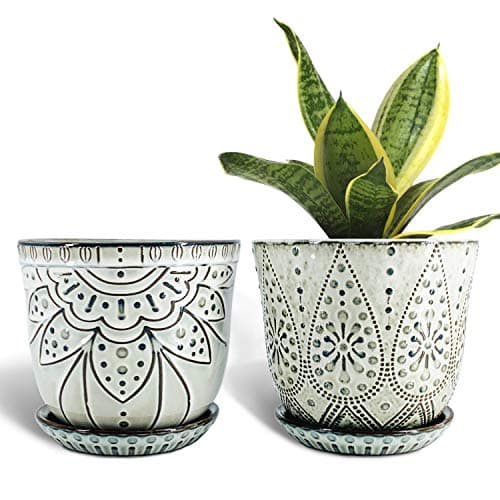
Gepege 6 in Ceramic Plant Pots with Drainage and Saucers
The size most houseplants are sold in and the size most shelves are built for, with the hole that the decorative version of the same pot leaves out.
#ad · Price as of October 18, 2026. How we are funded
- What the listing publishes
- 6 in ceramic with drainage hole and saucer
- Against a 10-inch pot
- No weight rating is published for this product, so there is nothing to check. That counts against it here rather than being treated as neutral.
A 6-inch pot of saturated mix computes to about 3.2 lb. Any stand on this site holds it, which is why 6 inches is where you can buy on looks rather than on arithmetic.
It is also the size where the no-drainage-hole trap is most common, because 6-inch pots are sold as decor as often as they are sold as pots.
Nursery plants usually arrive in a plastic 6-inch. Dropping that pot straight into a ceramic cachepot is a legitimate alternative to repotting, as long as you lift it to water.
What is good
- The correct default size for most houseplants
- Hole and saucer included
- Light enough for any shelf here
What is not
- Outgrown within a year by anything vigorous
- Glazed ceramic holds moisture longer than plastic
- One pot per order at this price point
Skip it if your plant came in a 6-inch nursery pot and is root-bound. You need the next size up, not the same size in ceramic.
2. A floor plant in something that is not plastic
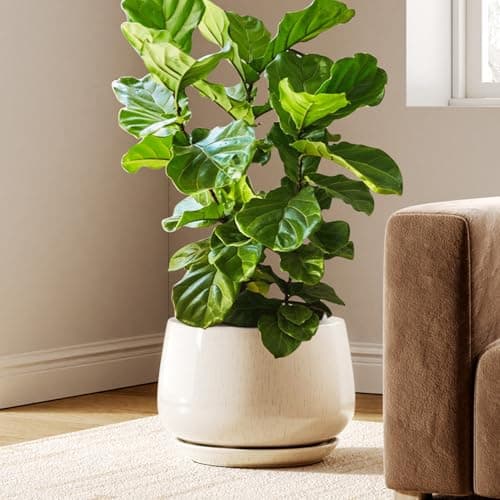
LE TAUCI 12 in Ceramic Planter with Drainage and Saucer
A 12-inch glazed pot with a hole and a saucer, which is the size where the weight conversation starts and most people have not had it.
- What the listing publishes
- 12 in ceramic, drainage hole and saucer included
- Against a 10-inch pot
- No weight rating is published for this product, so there is nothing to check. That counts against it here rather than being treated as neutral.
12 inches of saturated mix computes to about 25.5 lb before the pot itself, and a glazed ceramic pot this size is not light empty. This is a floor pot, not a shelf pot, and putting it on an unrated tiered stand is the mistake this site is built around.
It is also the size at which you stop moving the plant. A rated caddy underneath is the difference between cleaning behind it twice a year and never.
The saucer is included, which at 12 inches is worth real money. Large saucers are priced oddly high when bought alone.
What is good
- Drainage hole and saucer at a size where both are usually extra
- Glazed, so it does not sweat onto the floor
- Heavy enough not to be knocked over
What is not
- About 25.5 lb of saturated mix before the pot's own weight, so floor only
- Ceramic at this size is genuinely fragile in a move
- Slow-drying for plants that want to dry out
Skip it if you were planning to put it on a tiered stand. None of the tiered stands here publish a weight rating, and this is the pot that finds out.
3. A large plant that keeps rotting in plastic
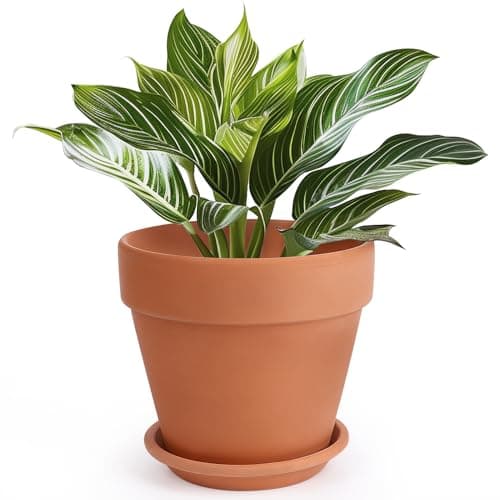
INGOFIN 10 in Terracotta Pot with Saucer
Terracotta at the size where overwatering does the most damage, because a 10-inch pot of wet mix takes a long time to dry from the top alone.
#ad · Price as of October 18, 2026. How we are funded
- What the listing publishes
- 10 in unglazed clay with drainage hole and saucer
- Against a 10-inch pot
- No weight rating is published for this product, so there is nothing to check. That counts against it here rather than being treated as neutral.
A 10-inch pot of saturated mix computes to about 14.7 lb, and unglazed clay adds several pounds of its own. This is a floor or a low sturdy shelf, not a tiered frame.
The larger the pot, the longer the middle of it stays wet, and the more the porous wall earns its keep. The material advantage that is marginal at 4 inches is substantial at 10.
Clay at this size is fragile in exactly one way that matters: the rim chips if it is set down hard on tile.
What is good
- The porous wall matters most at large pot sizes
- Saucer included at a size where they are expensive alone
- Heavy enough to anchor a top-heavy plant
What is not
- Heavy before the mix goes in
- Chips on tile
- Needs watering noticeably more often than a glazed pot the same size
Skip it if the pot is going on a shelf. At roughly 15 lb of saturated mix plus several pounds of clay, this belongs on the floor unless the shelf publishes a number.
Questions people actually ask
What size pot does a monstera need?
How often should I repot houseplants?
Is a bigger pot better for a plant?
Can I put a small plant in a big decorative pot?
Sources
- Cornell University, Greenhouse Management: bulk density of greenhouse media components
- Biology Insights: how much a cubic foot of potting soil weighs, dry and saturated
- Clemson HGIC: Indoor Plants — cleaning, fertilizing, containers and light requirements
- University of Georgia Extension B1318: Growing Indoor Plants with Success
Product specifications are quoted from each seller's own listing and are the seller's claim, not a measurement of ours.