Planters
Nursery Pot Size Chart
Sorted by the one dimension you can measure yourself, because the gallon labels this trade uses do not mean what they say.
By Scooter M., enthusiast · Published · Last updated
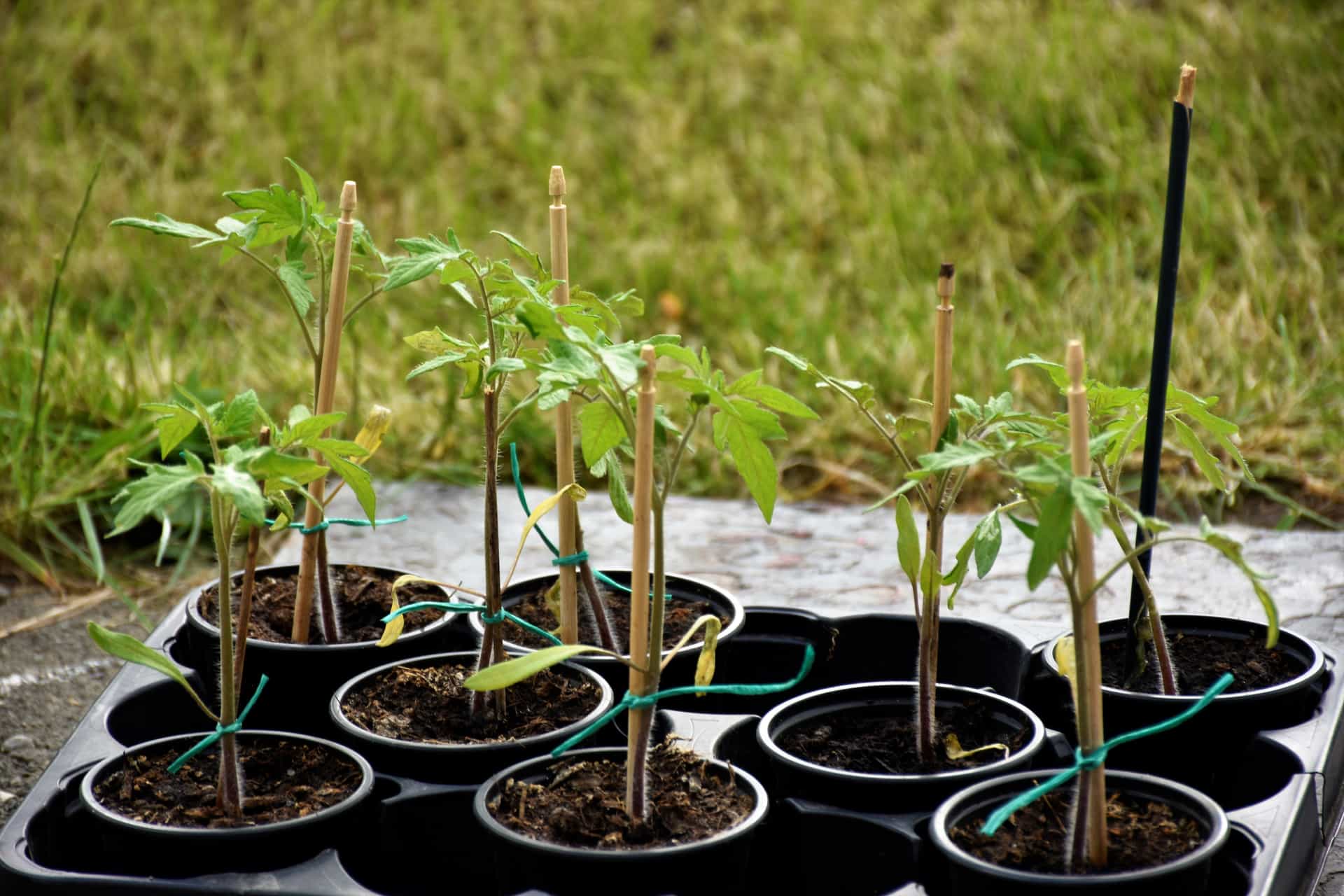
The short answer
Measure the rim diameter in inches — that is the only nursery pot dimension that is consistent across suppliers. A trade gallon is not a US gallon and varies between growers, so a 1-gallon pot from one nursery is not the same volume as a 1-gallon pot from another. The table below converts diameter into computed soil volume and watered weight.
Disclosure Pot & Prop earns a commission when you buy through the Amazon links on this page, at no extra cost to you. It does not change which products get recommended or what we say about them, and we have not been given any of them. How this site is funded.
Nursery pots are labeled in trade gallons, and a trade gallon is a marketing convention rather than a unit. It does not equal a US liquid gallon, it varies between growers, and the same nominal size can differ noticeably between two pots sitting side by side on a bench. That is not a scandal — the trade uses these labels among people who know what their own supplier means by them — but it makes the label useless to a buyer trying to work out whether a plant will fit a pot.
Diameter is not like that. A rim diameter is a measurement anyone can take with a ruler and it means the same thing everywhere. So this chart is organized by diameter, with everything else computed from it using the same pot model the rest of the site uses.
The chart
| Pot size | Mix volume | Dry | Watered | Rating needed |
|---|---|---|---|---|
| 4 in | 0.017 cu ft | 0.4 lb | 0.9 lb | 2 lb |
| 5 in | 0.034 cu ft | 0.7 lb | 1.8 lb | 3 lb |
| 6 in | 0.058 cu ft | 1.3 lb | 3.2 lb | 5 lb |
| 8 in | 0.137 cu ft | 3 lb | 7.5 lb | 12 lb |
| 10 in | 0.268 cu ft | 5.9 lb | 14.7 lb | 23 lb |
| 12 in | 0.463 cu ft | 10.2 lb | 25.5 lb | 39 lb |
| 14 in | 0.735 cu ft | 16.2 lb | 40.5 lb | 61 lb |
| 16 in | 1.098 cu ft | 24.2 lb | 60.4 lb | 91 lb |
What each size is usually for
| Diameter | Typically holds | Notes |
|---|---|---|
| 4 in | A rooted cutting, a small succulent | The right first pot after propagation |
| 5 to 6 in | A young houseplant, most supermarket plants | The most common size in an apartment |
| 8 in | An established plant after one or two repots | Still liftable when watered |
| 10 in | A large plant with a developed root system | About 14.7 lb watered — the top of easy lifting |
| 12 in | A floor plant | 25.5 lb watered; consider a caddy |
| 14 in and up | A statement plant | 40 lb and above; a two-person move |
The rule for going up a size
One size at a time, roughly two inches of extra diameter. The temptation is to jump two or three sizes to save doing it again, and the cost is a ring of wet mix around the root ball that no root reaches for months. That mix stays saturated, it holds no air, and it is where root rot starts. There is also a weight consequence people underestimate, because volume scales with the cube of the diameter.
volume ratio = (D2 / D1)^3
8 in to 12 in: (12/8)^3 = 3.4 — three and a half times the soil, not one and a half
The same jump takes the watered weight from about 7.5 lb to about 25.5 lb.
Why clear nursery pots are worth the small premium
A clear plastic nursery pot lets you see the root ball: whether roots have reached the sides, whether the bottom is staying wet, whether anything is discoloured. For a plant you have just potted up from a propagation station, that is a genuine diagnostic and not a novelty — it turns the repotting question from a guess into an observation. Drop it inside a decorative cachepot and nobody sees the plastic anyway.
Every pick, in full
We have not handled any of these. What follows is what each listing publishes, what that means once you put a watered pot on it, and who should buy something else.
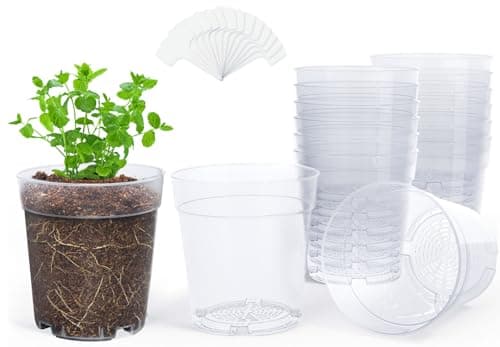
1. Watching roots instead of guessing
homenote 6.7 in Clear Plastic Nursery Pots with Drainage, 15 pack
Clear walls, which turn the one variable you cannot otherwise check, what the roots are doing, into something you can just look at.
#ad · Price as of October 18, 2026. How we are funded
- What the listing publishes
- 6.7 in clear plastic with drainage holes, 15 per pack
- Against a 10-inch pot
- No weight rating is published for this product, so there is nothing to check. That counts against it here rather than being treated as neutral.
The reason to use a clear nursery pot inside an opaque cachepot is diagnostic: you can see root growth, you can see when water has actually reached the bottom, and you can see rot before the leaves tell you.
Fifteen pots is a whole shelf and a propagation run's worth of potting-up, at a per-pot price no ceramic reaches.
They are not attractive. They are meant to sit inside something else, which is also the arrangement that keeps a decorative pot with no drainage hole from killing a plant.
What is good
- Root visibility that no other pot format gives you
- Fifteen pots at nursery pricing
- The correct inner pot for a decorative cachepot with no hole
What is not
- Ugly on their own
- Algae grows on the inside of a clear pot in a bright window
- Thin plastic flexes when you lift a wet one
Skip it if you want the pot to be the visible object. These are working pots and they look it.
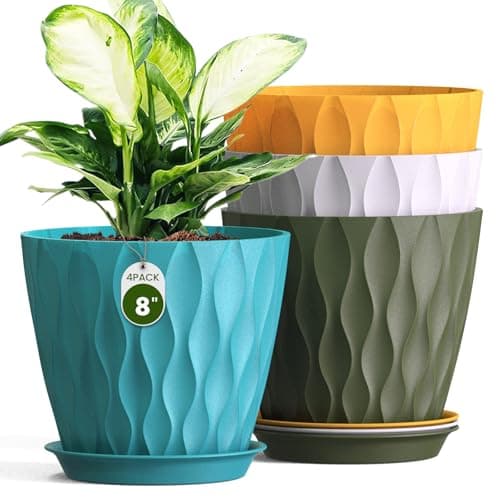
2. Four matching pots on a shelf that is not rated
Areutxbis 8 in Plastic Planters with Drainage and Saucers, 4 pack
Plastic at 8 inches, which is the size where the material choice stops being cosmetic and starts being a load decision.
#ad · Price as of October 18, 2026. How we are funded
- What the listing publishes
- 8 in plastic, drainage holes and saucers, four per pack
- Against a 10-inch pot
- No weight rating is published for this product, so there is nothing to check. That counts against it here rather than being treated as neutral.
An 8-inch pot of saturated mix computes to about 7.5 lb. In plastic the pot adds ounces; in glazed ceramic it can add several pounds, and on an unrated tiered stand with four of them that difference is the whole safety margin.
Four matching pots is also how a shelf stops looking like a collection of separate shopping trips.
Plastic dries slower at the walls than terracotta and faster than glaze, which puts it in the middle of the moisture range and makes it the safest default if you are not sure.
What is good
- Adds almost nothing to the computed load
- Four matching pots and saucers
- Middle of the road for drying speed
What is not
- Light enough to be knocked over by a cat
- Plastic goes brittle in a sunny window over years
- Looks like what it is
Skip it if the pots are going somewhere visible and the look matters more than the load. A ceramic set is the answer, and 8 inches is still light enough to get away with it.
Questions people actually ask
What size is a 1 gallon nursery pot?
How do I know what size pot my plant needs?
Are nursery pots good enough to keep plants in permanently?
How much does a 12 inch nursery pot weigh when full?
Sources
- Cornell University, Greenhouse Management: bulk density of greenhouse media components
- Biology Insights: how much a cubic foot of potting soil weighs, dry and saturated
- Clemson HGIC: Indoor Plants — cleaning, fertilizing, containers and light requirements
Product specifications are quoted from each seller's own listing and are the seller's claim, not a measurement of ours.