Hanging
How to Hang Plants Without Drilling
Five methods, each with a published number attached and an honest account of where it fails.
By Scooter M., enthusiast · Published · Last updated
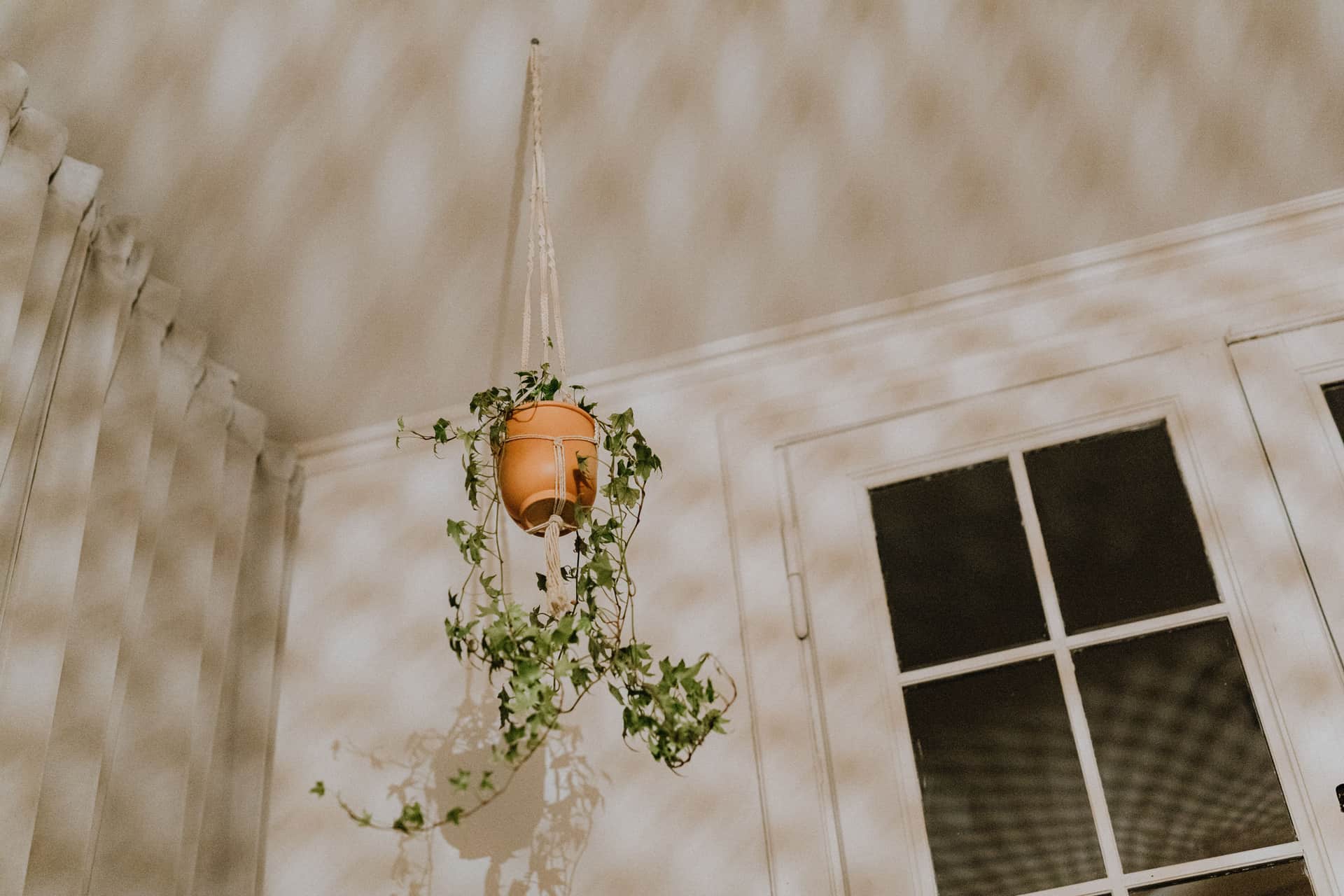
The short answer
Adhesive ceiling hooks for most positions, sized to the pot: 25 lb or more for a 10-inch pot, 11 lb for a 6-inch one. A spring tension rod where the window has a reveal. An over-door rack where you can spare a door. A magnet where there is genuine steel. And a floor-standing tension pole where none of the above applies.
Disclosure Pot & Prop earns a commission when you buy through the Amazon links on this page, at no extra cost to you. It does not change which products get recommended or what we say about them, and we have not been given any of them. How this site is funded.
You are not allowed to drill, and you would like a plant in the air. That is a solvable problem with five distinct solutions, each of which is genuinely right in a different situation. What follows is each method, what it holds, and where it lets you down — followed by the application steps that decide whether an adhesive hook is still up in six months.
Method one: adhesive ceiling hooks
The default, because it is the only method that reaches the middle of a ceiling. The good ones publish real numbers — 11, 25 and 30 lb per hook among the products researched here — and those numbers are checkable against what your pot weighs. A 10-inch pot is 14.7 lb of watered mix and needs 23 lb of rating at this site's margin. The constraint is the surface: smooth, clean, fully cured paint, and nothing textured.
Method two: a spring tension rod across a window reveal
If your window sits in a recess, a spring tension rod across it is the strongest and most reversible option available. It works by compression between two solid surfaces — the same mechanism that holds up a shower rail carrying a soaked curtain — and it does not care what the paint is like or how old it is. It also puts plants in the best light in the apartment. The limitation is obvious: no recess, no rod.
Method three: an over-door rack
Hooks over the top of an interior door, no fixings at all. It is the ugliest of the five and the most overlooked: a door you rarely close is a free vertical structure in an apartment with no spare wall. Watch the door clearance and do not put anything glass at head height.
Method four: magnets, where there is steel
A neodymium hook publishes far higher numbers than adhesive — up to 170 lb of pull — but that figure applies to thick, apartment, clean steel loaded straight-on. Hanging loads a magnet sideways instead, where holding force is a fraction of the pull rating, and most apartments have very little real steel above waist height. The full comparison is here. Where a steel radiator bracket or door frame does exist, it is excellent and leaves nothing behind.
Method five: a floor-standing tension pole
Not hanging from the ceiling so much as hanging from your own structure. A floor-to-ceiling pole with hanging arms puts pots in the air with no adhesive and no fixing, and it does it without spending any floor on a base. It needs a solid ceiling to press against and it needs re-tensioning after the first week as carpet compresses.
Getting an adhesive hook to stay up
- Weigh the job first. Look up your pot size in the load guide and buy a hook rated above the figure in the last column. Do this before buying the hook, not after.
- Clean the spot with rubbing alcohol. Not a household spray — those leave a residue designed to repel water, and adhesive bonds to the residue rather than the paint.
- Check the paint age. Fully cured means weeks. This is the single most common reason a hook lets go a month later, and it takes paint with it when it does.
- Press hard for 30 seconds, then leave it an hour. Adhesive systems build strength over time rather than instantly.
- Hang the plant dry. Water it over a sink, let it drain fully, then hang it. A freshly watered pot is at its heaviest exactly when you are handling it under the hook.
- Check it in a week. A lifted corner or a slight tilt is peel starting, and peel is the warning you get.
Which method for which apartment
| Situation | Method |
|---|---|
| Middle of a ceiling | Adhesive ceiling hook |
| Window with a recess | Spring tension rod |
| Textured or wallpapered walls | Tension pole or over-door rack |
| Freshly painted apartment | Tension products only, for now |
| Steel radiator or door frame | Magnetic hook |
| Nothing overhead at all | Floor-standing tension pole |
| Pot is 12 inches or larger | Do not hang it — floor or caddy |
Every pick, in full
We have not handled any of these. What follows is what each listing publishes, what that means once you put a watered pot on it, and who should buy something else.
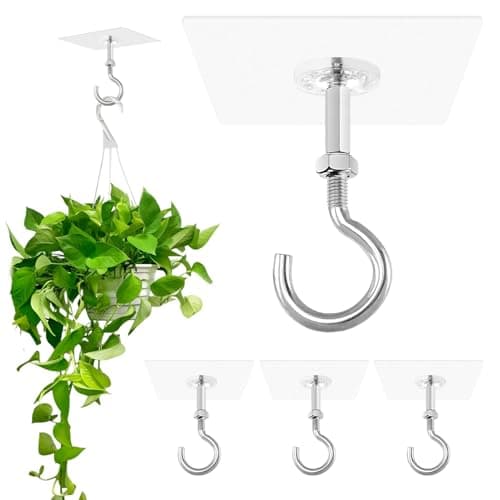
1. The largest hanging pot a renter can hang
NINEFOX Adhesive Ceiling Hooks, 30 lb, 4 pack
The highest published no-drill ceiling rating in this roundup, and the only one here that clears a 10-inch pot at this site's margin.
#ad · Price as of October 18, 2026. How we are funded
- What the listing publishes
- Published 30 lb rating per hook; adhesive mount, no drilling
- Against a 10-inch pot
- Rated 30 lb against 14.7 lb of saturated mix in a 10-inch pot — 2x, clear of the 1.5x margin this site requires.
A 10-inch pot of saturated mix computes to 14.7 lb. At 30 lb published this is 2.0x, past the 1.5x margin this site requires before it calls a pairing safe.
Read the rating as a ceiling rating, because that is what it claims. Adhesive hooks sold for walls are rated in shear, where the load hangs down the face of the adhesive. A ceiling load pulls straight off it, which is the harder direction, and a wall-rated hook on a ceiling is the commonest mistake in this category.
Surface preparation is the whole game with adhesive. Textured or freshly painted ceilings do not hold, and no rating on any listing is a claim about a surface it was not stuck to.
What is good
- 30 lb published, the highest no-drill ceiling figure here
- Clears a 10-inch pot at the 1.5x margin
- Four hooks, so three plants and one you will get wrong
What is not
- Adhesive needs a smooth, clean, cured surface, so a textured ceiling is out
- Removal takes paint with it more often than the packaging suggests
- The rating assumes an ideal application, and yours will not be
Skip it if your ceiling is textured, artexed or freshly painted. No adhesive rating survives that surface, and a tension pole is the renter-safe alternative.
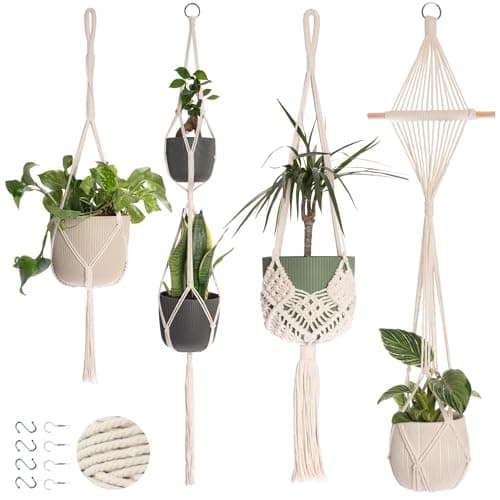
2. Hanging four plants and getting the hooks in the box
Nook Theory Macrame Plant Hangers with Hooks, 4 pack
Hangers with hooks included, which sounds trivial until you have bought hangers and discovered the hooks are the part with the weight rating.
#ad · Price as of October 18, 2026. How we are funded
- What the listing publishes
- Four macrame hangers supplied with eight hooks; cotton cord
- Against a 10-inch pot
- No weight rating is published for this product, so there is nothing to check. That counts against it here rather than being treated as neutral.
The hanger is almost never the weak link. Cotton macrame cord carries far more than the ceiling fixing above it, so the number that matters is on the hook rather than on the knot.
The included hooks are not the rated ceiling hooks elsewhere in this section, so treat them as a starting point and swap them for a published-rating hook if the pot is over 6 inches.
Cotton cord does stretch, and it stretches most in a humid room. A macrame hanger that sat level in January hangs an inch lower by July.
What is good
- Four hangers for the price hangers usually cost
- Hooks included
- Cotton cord is the strongest link in the chain
What is not
- The supplied hooks publish no rating
- Cotton stretches in humidity
- Macrame hides the pot, which is either the point or the problem
Skip it if you are hanging a large pot. Swap the supplied hooks for the 30 lb rated adhesive hooks, because that is where the load actually terminates.
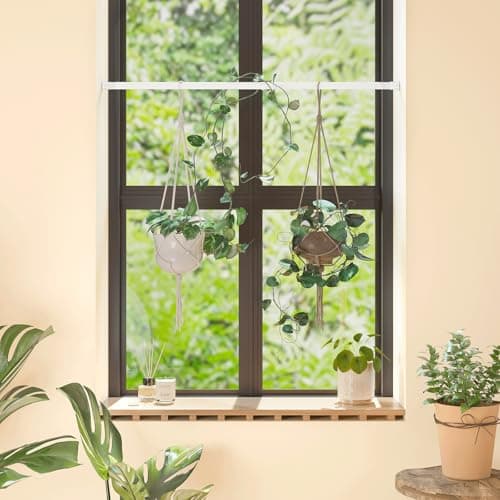
3. Hanging plants in a window with zero fixings
Bamworld Window Plant Hanger, spring tension rods 27 to 51 in
A tension rod across the window reveal, which puts hanging plants in the best light in the apartment without a single hole or adhesive pad.
- What the listing publishes
- Spring tension rods spanning 27 to 51 in; no drilling; anti-slip pads at both ends
- Against a 10-inch pot
- No weight rating is published for this product, so there is nothing to check. That counts against it here rather than being treated as neutral.
This is the most genuinely renter-safe hanging solution on the site. Nothing is stuck to anything, nothing is screwed into anything, and it comes down in ten seconds when you move.
Tension rods hold by friction against two surfaces, and their capacity depends entirely on the span and the surface. That is why no honest tension product publishes a weight rating, and this one does not either.
Keep pots small. Tension failures are progressive: the rod slips a fraction, the friction drops, and it slips again. A 6-inch pot at 3.2 lb of saturated mix is the sensible ceiling here.
What is good
- No fixings of any kind, the cleanest renter solution here
- Puts plants in the window, which is where the light is
- 27 to 51 inches covers almost every apartment window
What is not
- No published weight rating, and tension capacity depends on your surfaces
- Slips progressively rather than failing at once
- Blocks the window it hangs in
Skip it if you want to hang a 10-inch pot. Tension is the wrong mechanism for that load, and a rated 30 lb adhesive ceiling hook is the pick.
Questions people actually ask
How do you hang plants without damaging walls?
What can I hang plants from if I cannot use the ceiling?
How heavy a plant can I hang without drilling?
Do renters have to take hanging hooks down when they leave?
Sources
- Cornell University, Greenhouse Management: bulk density of greenhouse media components
- Biology Insights: how much a cubic foot of potting soil weighs, dry and saturated
- Clemson HGIC: Indoor Plants — cleaning, fertilizing, containers and light requirements
Product specifications are quoted from each seller's own listing and are the seller's claim, not a measurement of ours.