Hanging
Tension Rod or Adhesive Hook?
Both hang a plant without a drill. They fail in completely different ways, and only one of them can go in the middle of a ceiling.
By Scooter M., enthusiast · Published · Last updated
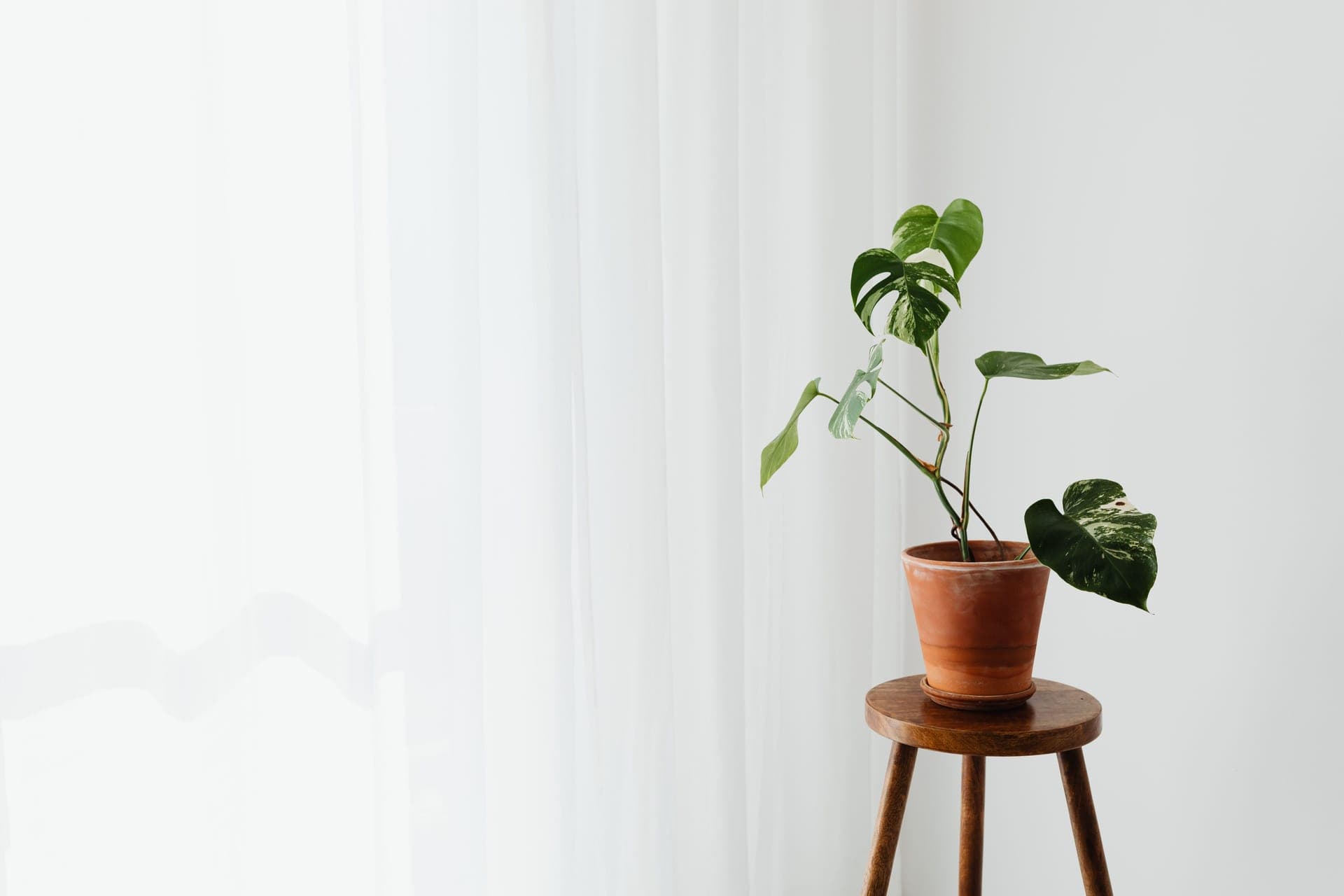
The short answer
Use a tension rod where you have two opposing surfaces — a window reveal, an alcove, floor to ceiling. It carries more, leaves nothing behind and does not care what the paint is like. Use an adhesive hook everywhere else, especially the middle of a ceiling, which no tension product can reach. If both fit, the rod is the safer choice in a rented apartment.
Disclosure Pot & Prop earns a commission when you buy through the Amazon links on this page, at no extra cost to you. It does not change which products get recommended or what we say about them, and we have not been given any of them. How this site is funded.
These are the two ways to hang something in an apartment you are not allowed to modify, and they are not variations on a theme. A tension rod works by compression: it pushes outward against two surfaces and friction does the rest, which is the same principle as a shower rail holding a soaked curtain. An adhesive hook works by bonding to the top layer of a painted surface, which means its strength is limited by the paint rather than by the adhesive.
That difference decides everything downstream — where each one can go, how much it holds, how it fails and what it costs you at the end of a tenancy. Both are ranked in the no-drill hanger roundup with their published numbers.
The two side by side
| Tension rod or pole | Adhesive hook | |
|---|---|---|
| Needs | Two opposing solid surfaces | Smooth, clean, fully cured paint |
| Can go mid-ceiling | No | Yes — its main advantage |
| Typical published load | Not usually published | 11 to 30 lb per ceiling hook |
| Leaves a mark | Nothing | Nothing if removed correctly |
| Fails by | Slipping, usually slowly | Peeling, usually suddenly |
| Affected by paint age | No | Yes, significantly |
| Reusable elsewhere | Yes, indefinitely | No — new strips each time |
| Cost | Higher up front | Low, but recurring |
How each one fails, which is the real difference
A tension rod fails gradually. It creeps, sags a fraction of an inch, and gives you warning — which is why the practical advice for a pole is simply to check it after a week and then seasonally. An adhesive hook fails by peel, and peel is quiet until it is not. The pad lifts at a corner, the hook tilts a degree or two, and then it lets go all at once.
That asymmetry is the reason to prefer the rod where both fit, and it is also the reason for the one recommendation on this site that does not come from arithmetic: do not hang a plant over a bed or a sofa on adhesive, whatever the rating says. A slow failure over furniture is a nuisance. A sudden one is not.
Where each one wins
- Window reveal — rod, easily. It puts plants in the best light in the apartment, carries more than suction, and comes out in seconds when you move.
- Middle of a ceiling — adhesive, because nothing else reaches. This is the case that keeps adhesive hooks on the list at all.
- Alcove or chimney breast recess — rod. Two opposing walls is exactly what it wants, and alcoves are usually wasted space.
- Textured wall or old wallpaper — rod, or nothing. Adhesive ratings assume smooth cured paint and neither of those is that.
- A doorway you can spare — over-door rack, which is a third option and beats both when it applies.
- A freshly painted apartment — rod, and wait weeks before trusting adhesive to anything. New paint is the single most common cause of an adhesive hook that lets go a month later.
Every pick, in full
We have not handled any of these. What follows is what each listing publishes, what that means once you put a watered pot on it, and who should buy something else.
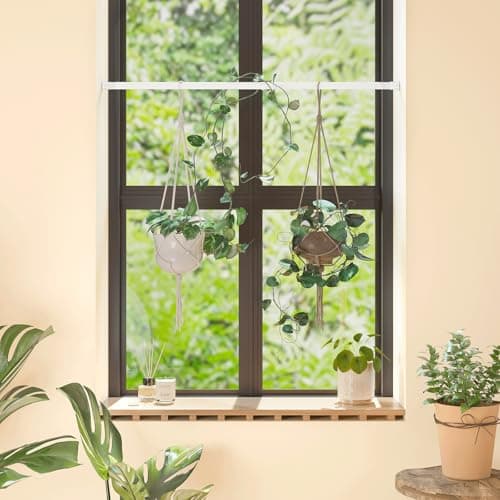
1. Hanging plants in a window with zero fixings
Bamworld Window Plant Hanger, spring tension rods 27 to 51 in
A tension rod across the window reveal, which puts hanging plants in the best light in the apartment without a single hole or adhesive pad.
- What the listing publishes
- Spring tension rods spanning 27 to 51 in; no drilling; anti-slip pads at both ends
- Against a 10-inch pot
- No weight rating is published for this product, so there is nothing to check. That counts against it here rather than being treated as neutral.
This is the most genuinely renter-safe hanging solution on the site. Nothing is stuck to anything, nothing is screwed into anything, and it comes down in ten seconds when you move.
Tension rods hold by friction against two surfaces, and their capacity depends entirely on the span and the surface. That is why no honest tension product publishes a weight rating, and this one does not either.
Keep pots small. Tension failures are progressive: the rod slips a fraction, the friction drops, and it slips again. A 6-inch pot at 3.2 lb of saturated mix is the sensible ceiling here.
What is good
- No fixings of any kind, the cleanest renter solution here
- Puts plants in the window, which is where the light is
- 27 to 51 inches covers almost every apartment window
What is not
- No published weight rating, and tension capacity depends on your surfaces
- Slips progressively rather than failing at once
- Blocks the window it hangs in
Skip it if you want to hang a 10-inch pot. Tension is the wrong mechanism for that load, and a rated 30 lb adhesive ceiling hook is the pick.
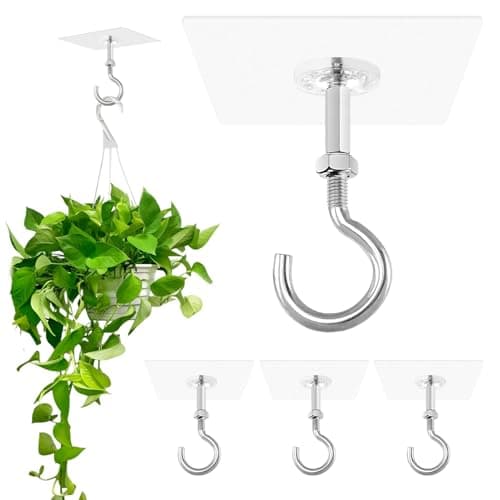
2. The largest hanging pot a renter can hang
NINEFOX Adhesive Ceiling Hooks, 30 lb, 4 pack
The highest published no-drill ceiling rating in this roundup, and the only one here that clears a 10-inch pot at this site's margin.
#ad · Price as of October 18, 2026. How we are funded
- What the listing publishes
- Published 30 lb rating per hook; adhesive mount, no drilling
- Against a 10-inch pot
- Rated 30 lb against 14.7 lb of saturated mix in a 10-inch pot — 2x, clear of the 1.5x margin this site requires.
A 10-inch pot of saturated mix computes to 14.7 lb. At 30 lb published this is 2.0x, past the 1.5x margin this site requires before it calls a pairing safe.
Read the rating as a ceiling rating, because that is what it claims. Adhesive hooks sold for walls are rated in shear, where the load hangs down the face of the adhesive. A ceiling load pulls straight off it, which is the harder direction, and a wall-rated hook on a ceiling is the commonest mistake in this category.
Surface preparation is the whole game with adhesive. Textured or freshly painted ceilings do not hold, and no rating on any listing is a claim about a surface it was not stuck to.
What is good
- 30 lb published, the highest no-drill ceiling figure here
- Clears a 10-inch pot at the 1.5x margin
- Four hooks, so three plants and one you will get wrong
What is not
- Adhesive needs a smooth, clean, cured surface, so a textured ceiling is out
- Removal takes paint with it more often than the packaging suggests
- The rating assumes an ideal application, and yours will not be
Skip it if your ceiling is textured, artexed or freshly painted. No adhesive rating survives that surface, and a tension pole is the renter-safe alternative.
Questions people actually ask
Can a tension rod hold a hanging plant?
Which is better for a rented apartment?
How far apart can tension rod supports be?
Do adhesive hooks work on a ceiling as well as a wall?
Sources
- Cornell University, Greenhouse Management: bulk density of greenhouse media components
- Biology Insights: how much a cubic foot of potting soil weighs, dry and saturated
- Clemson HGIC: Indoor Plants — cleaning, fertilizing, containers and light requirements
Product specifications are quoted from each seller's own listing and are the seller's claim, not a measurement of ours.