Hanging
The Best Tension Rod Plant Stands
Plant density that costs you no floor and no fixings, because it is the only product in the category that uses the ceiling as structure.
By Scooter M., enthusiast · Published

The short answer
Measure your floor-to-ceiling height first and buy a pole whose published range comfortably covers it — that single number rules out most of the category for anyone with 9 or 10 foot ceilings. A pole gives you six to eight plant positions on a little over a square foot of floor, which beats any tiered corner frame on this site, and it leaves absolutely nothing behind when you move out.
Disclosure Pot & Prop earns a commission when you buy through the Amazon links on this page, at no extra cost to you. It does not change which products get recommended or what we say about them, and we have not been given any of them. How this site is funded.
Every other way of getting plants off the floor in a rented apartment involves a compromise with the building. An adhesive hook needs cured paint. A wall shelf needs screws. A suction shelf needs clean glass and a stable temperature. A tension pole needs none of those things — it presses between the floor and the ceiling, holds itself up by friction and compression, and comes down in about a minute leaving no mark at all.
That is why it reaches a density no tiered corner frame can. Every freestanding stand needs a base wide enough that it will not tip, and that base is precisely the floor you were trying not to spend. A pole braced against the ceiling does not need one. Six positions across the 13.2-inch span of the pole here works out around 5.1 plants per square foot; the best tiered corner frame manages 3. The footprint arithmetic is here.
Measure the ceiling before anything else
This is the specification that decides whether the product works at all, and it is the one people check last. Standard modern apartment ceilings run about 8 feet; older buildings and converted spaces run 9, 10 or higher. Most tension poles publish a range that tops out around 9 feet, which quietly excludes a lot of the apartments where a pole would be most useful.
| Floor to ceiling | What to look for |
|---|---|
| Under 8 ft | Almost any pole; check the minimum, not the maximum |
| 8 to 9 ft | The standard range — most of the category fits |
| 9 to 10.5 ft | Only poles publishing an extended range, such as the 3.6 to 10.5 ft one here |
| Over 10.5 ft | No pole here covers it; use a freestanding stand instead |
| Sloped or suspended ceiling | None of them — a pole needs a solid, level surface to push against |
Check the minimum as well as the maximum. A pole with a 5 to 10 foot range in a room with a 7 foot ceiling is being used near the bottom of its travel, where the spring has least useful tension.
Quick picks
Ranked, with the published figure each pick turns on. Tap a row for the full reasoning further down this page.
| # | Product | Best for | Price |
|---|---|---|---|
| 1 | 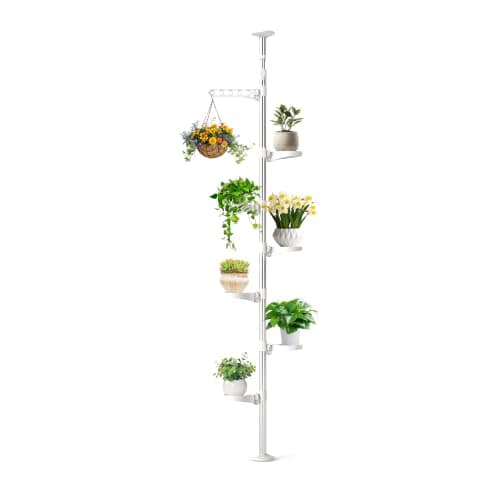 BAOYOUNI Plant Stand, 7-tier tension pole with 6 trays and a hook, 7.5 to 9.5 ftSix tray positions plus a hook in a little over a square foot of floor, held up by pressure between your floor and your ceiling rather than by a base. | A vertical plant column with no fixings at all | |
| 2 | 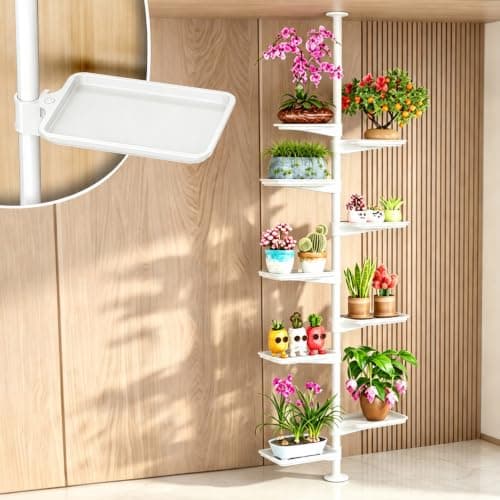 VIBRFURE Tension Rod Plant Stand, floor to ceiling, 3.6 to 10.5 ft, 8 traysThe widest published height range in this category, which is the specification that decides whether a tension pole fits your room at all. | Tall rooms and awkward ceiling heights | |
| 3 | 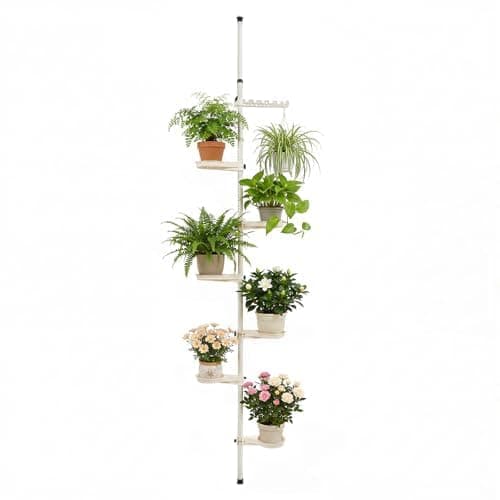 7-Layer Tension Rod Plant Stand, 8.5 to 10.2 ft, 6 trays and a hanging rodThe only pole here that publishes a per-tier weight rating and a tray diameter, and the only one whose published range starts above a standard eight-foot ceiling. | A high ceiling, and figures you can check | |
| 4 | 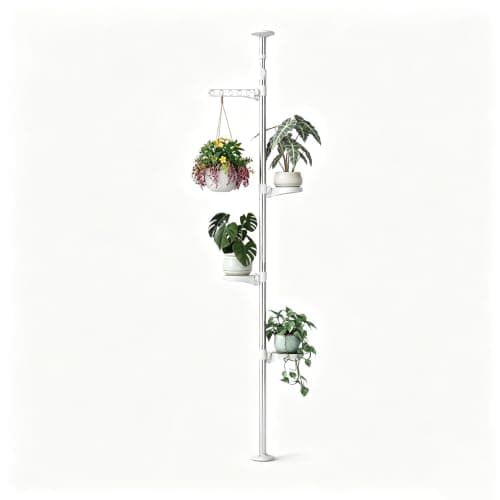 BAOYOUNI Tension Rod Plant Stand, 3 trays and 1 armTrays and a hanging arm on the same pole, which lets one fixing-free installation carry both potted and hanging plants. | A window that has to stay usable | $40.80 at Amazon $42.95 · 5% off |
| 5 | 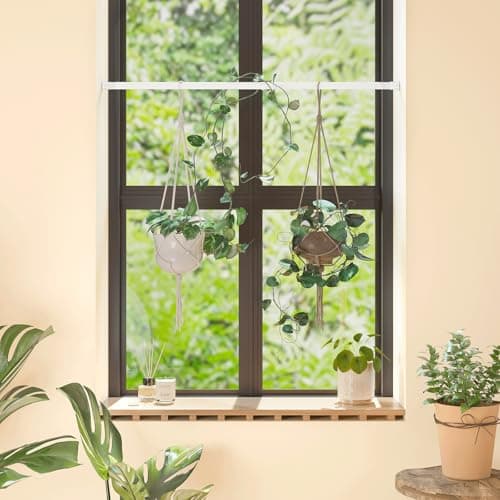 Bamworld Window Plant Hanger, spring tension rods 27 to 51 inA tension rod across the window reveal, which puts hanging plants in the best light in the apartment without a single hole or adhesive pad. | Hanging plants in a window with zero fixings | $11.99 at Amazon $12.99 · 8% off |
Links to Amazon are affiliate links. Prices and availability are Amazon's and change without notice.
How a tension pole fails, and how to stop it
Tension products fail gradually rather than suddenly, which is their main safety advantage over adhesive. A pole creeps: it settles a fraction of an inch, the tension drops, and it starts to lean. That gives you warning, and it is why the maintenance advice for a pole is simply to look at it.
- Re-tension it after the first week. Carpet compresses under the foot and a pole that was tight on day one is often slack by day seven. This is normal and it is the single most important step.
- Load it evenly around the pole, not all on one face. A pole is designed to be in compression; a one-sided load introduces a bending moment the joint was not designed for.
- Heaviest pots on the lowest trays. Same rule as every stand on this site, and more important here because the structure is a single column.
- Check the ceiling. A pole pushes upward with real force. Solid plaster or concrete is fine; a suspended tile grid or a thin panel with nothing behind it is not.
- Look at it seasonally. Timber floors move with humidity, and so does the gap the pole is spanning.
What a pole can actually carry
Only one of the five products here publishes a weight rating: the 7-layer pole, at 22.05 lb per tier. The other four publish nothing at all, which is the same gap this site keeps documenting across furniture-shaped plant products, and it is a genuine limitation rather than a detail. Either way the practical rule does not change — size the pots to the trays rather than to the pole, because the trays are what runs out first.
| Pot size | Mix volume | Dry | Watered | Rating needed |
|---|---|---|---|---|
| 4 in | 0.017 cu ft | 0.4 lb | 0.9 lb | 2 lb |
| 5 in | 0.034 cu ft | 0.7 lb | 1.8 lb | 3 lb |
| 6 in | 0.058 cu ft | 1.3 lb | 3.2 lb | 5 lb |
| 8 in | 0.137 cu ft | 3 lb | 7.5 lb | 12 lb |
The trays run out of room long before the pole runs out of strength, which is the reassuring version of having no published number — and the one published figure on this page bears it out, at 22.05 lb a tier against 3.2 lb for a 6-inch pot. A six-tier pole loaded with 6-inch pots is carrying under 20 lb of mix in total.
Window rods are a different product with the same mechanism
A spring tension rod across a window reveal uses the same compression principle horizontally, and it solves a different problem: it hangs plants in the brightest position in the apartment without a single fixing. It needs a recess with two opposing surfaces — a flush window gives it nothing to push against — and where it fits it carries considerably more than a suction shelf on the same glass. The comparison with adhesive is here.
What we deliberately do not recommend
Tension poles under suspended ceilings, which is the one genuinely unsafe use of this product — a tile grid is not a structural surface and a pole will push through it. We also do not recommend a pole on deep pile carpet without a hard pad under the foot, because the foot sinks, the tension bleeds away and you are re-tightening it weekly. And we do not recommend hanging anything heavy from a pole's extension arm at full height, where the leverage on a column already near the top of its travel is at its worst.
Every pick, in full
We have not handled any of these. What follows is what each listing publishes, what that means once you put a watered pot on it, and who should buy something else.
1. A vertical plant column with no fixings at all
BAOYOUNI Plant Stand, 7-tier tension pole with 6 trays and a hook, 7.5 to 9.5 ft
Six tray positions plus a hook in a little over a square foot of floor, held up by pressure between your floor and your ceiling rather than by a base.
#ad · Price as of October 21, 2026. How we are funded
- What the listing publishes
- Published six trays plus a hook; 7 ft 6 in to 9 ft 6 in adjustable height; 13.2 in hanger span; trays and hook both rotate 360 degrees and adjust for height; stainless steel composite pipe; no published weight rating
- Against a 10-inch pot
- No weight rating is published for this product, so there is nothing to check. That counts against it here rather than being treated as neutral.
Six positions across the published 13.2-inch span is about 5.1 plants per square foot, well clear of the 3 that the best tiered corner frame here manages — and it gets there without a base, which is the floor a freestanding stand spends just to stay upright.
A tension pole loads your ceiling in compression rather than tension, so it does not care whether there is a joist above it. It does care whether your ceiling is solid, and a suspended or lath ceiling is not the surface for this. The published range starts at 7 ft 6 in, so check it against a standard 8-foot ceiling before buying.
No published weight rating, and again that is honest for a tension product. Keep the pots small and symmetrical, because an asymmetric load is what makes a pole walk out of position.
What is good
- Six tray positions plus a hook, so potted and trailing plants share one pole
- No fixings, so no deposit risk
- Trays and hook both rotate 360 degrees and set their own height
What is not
- No published weight rating
- Needs a solid ceiling, not suspended and not lath
- Asymmetric loading makes the pole drift
Skip it if your ceiling is a suspended grid or an artexed lath ceiling. A tension pole needs something firm to push against and neither of those is.
2. Tall rooms and awkward ceiling heights
VIBRFURE Tension Rod Plant Stand, floor to ceiling, 3.6 to 10.5 ft, 8 trays
The widest published height range in this category, which is the specification that decides whether a tension pole fits your room at all.
#ad · Price as of October 21, 2026. How we are funded
- What the listing publishes
- Published 3.6 to 10.5 ft adjustable height; 8 trays; 360-degree rotating trays; no published weight rating
- Against a 10-inch pot
- No weight rating is published for this product, so there is nothing to check. That counts against it here rather than being treated as neutral.
A tension pole is only useful if it actually spans your floor-to-ceiling distance, and most listings publish a narrow range that quietly excludes older apartments with high ceilings. 3.6 to 10.5 ft covers almost everything, including the 9 and 10 ft ceilings that defeat the standard poles.
Eight trays is more positions than any other pole here, and the trays rotate, which matters more than it sounds: it lets you turn a plant toward the window without lifting it off a pole you would rather not disturb.
No weight rating is published, which is the norm in this category and still a mark against it. Keep pots small and low.
What is good
- The widest published height range here, 3.6 to 10.5 ft
- 8 tray positions, rotating
- Tool-free, leaves no fixing behind
What is not
- No published weight capacity
- A long pole at full extension is less rigid than a short one
- Trays are sized for small pots
Skip it if your ceiling is a suspended tile grid or a thin panel. A tension pole pushes upward with real force and needs something solid to push against.
3. A high ceiling, and figures you can check
7-Layer Tension Rod Plant Stand, 8.5 to 10.2 ft, 6 trays and a hanging rod
The only pole here that publishes a per-tier weight rating and a tray diameter, and the only one whose published range starts above a standard eight-foot ceiling.
#ad · Price as of October 21, 2026. How we are funded
- What the listing publishes
- Published 22.05 lb per tier; 7 tiers as 6 trays plus a hanging rod; 6.3 in tray inner diameter; published 8.53 to 10.17 ft adjustable height
- Against a 10-inch pot
- Rated 22.05 lb against 14.7 lb of saturated mix in a 10-inch pot — 1.5x, clear of the 1.5x margin this site requires.
This is the one product on this page you can hold to a number. The listing publishes 10 kg, or 22.05 lb, per tier, and a 6.3-inch tray inner diameter; the other four poles publish neither figure, which is the gap the rest of this page works around.
The tray is the real limit, not the rating. A 10-inch pot clears this site's 1.5x margin against 22.05 lb with nothing to spare, and it will not physically fit a 6.3-inch tray in any case — so size pots to the published diameter and the weight stops being the question. A 6-inch pot at about 3.2 lb of watered mix leaves the rating almost untouched.
The catch is the bottom of the range rather than the top. The published travel starts at 8.53 ft, so this is the one pole here that a standard eight-foot apartment ceiling rules out rather than a high one. Measure the gap before buying it.
What is good
- Publishes 22.05 lb per tier, the only capacity figure on this page
- Publishes a 6.3 in tray diameter, so pot fit is checkable before buying
- Six trays plus a hanging rod, with every tray height set independently
What is not
- The published range starts at 8.53 ft, so a standard 8 ft ceiling is out
- 6.3 in trays, so the trays run out of room long before the rating does
- Needs a solid, level ceiling, like every pole here
Skip it if your floor-to-ceiling height is under about 8.5 feet. This is the one pole on this page whose published range starts above a standard apartment ceiling, and nothing about it adjusts lower.
4. A window that has to stay usable
BAOYOUNI Tension Rod Plant Stand, 3 trays and 1 arm
Trays and a hanging arm on the same pole, which lets one fixing-free installation carry both potted and hanging plants.
- What the listing publishes
- Tension pole with three trays and a hanging arm, sill-width
- Against a 10-inch pot
- No weight rating is published for this product, so there is nothing to check. That counts against it here rather than being treated as neutral.
The hanging arm is the part that matters. Most tension products give you shelves; an arm means a trailing plant can hang free instead of draping over a tray edge.
Four positions on about half a square foot is roughly 7 plants per square foot, nearly as dense as the six-tier pole in a shorter, less imposing form.
As with every tension product here, no weight rating is published and none should be trusted if it were. Small pots only.
What is good
- Trays and a hanging arm in one fixing-free unit
- Sill-width, so the window still opens
- Roughly 7 plants per square foot
What is not
- No published weight rating
- Small trays take 4 to 6 inch pots only
- Tension poles need a firm floor and ceiling
Skip it if you want a full plant wall. This is a single narrow column, and the six-tier pole is the bigger version of the same idea.
5. Hanging plants in a window with zero fixings
Bamworld Window Plant Hanger, spring tension rods 27 to 51 in
A tension rod across the window reveal, which puts hanging plants in the best light in the apartment without a single hole or adhesive pad.
- What the listing publishes
- Spring tension rods spanning 27 to 51 in; no drilling; anti-slip pads at both ends
- Against a 10-inch pot
- No weight rating is published for this product, so there is nothing to check. That counts against it here rather than being treated as neutral.
This is the most genuinely renter-safe hanging solution on the site. Nothing is stuck to anything, nothing is screwed into anything, and it comes down in ten seconds when you move.
Tension rods hold by friction against two surfaces, and their capacity depends entirely on the span and the surface. That is why no honest tension product publishes a weight rating, and this one does not either.
Keep pots small. Tension failures are progressive: the rod slips a fraction, the friction drops, and it slips again. A 6-inch pot at 3.2 lb of saturated mix is the sensible ceiling here.
What is good
- No fixings of any kind, the cleanest renter solution here
- Puts plants in the window, which is where the light is
- 27 to 51 inches covers almost every apartment window
What is not
- No published weight rating, and tension capacity depends on your surfaces
- Slips progressively rather than failing at once
- Blocks the window it hangs in
Skip it if you want to hang a 10-inch pot. Tension is the wrong mechanism for that load, and a rated 30 lb adhesive ceiling hook is the pick.
Questions people actually ask
Are tension rod plant stands safe?
How much weight can a tension pole plant stand hold?
Will a tension pole damage the ceiling or floor?
What ceiling height do I need for a tension pole plant stand?
Can a tension rod hold hanging plants as well as potted ones?
Sources
- Cornell University, Greenhouse Management: bulk density of greenhouse media components
- Biology Insights: how much a cubic foot of potting soil weighs, dry and saturated
- Clemson HGIC: Indoor Plants — cleaning, fertilizing, containers and light requirements
- University of Illinois Extension: Houseplants — lighting
Product specifications are quoted from each seller's own listing and are the seller's claim, not a measurement of ours.