Plant Stands
Footprint, Slots and Plants per Square Foot
In an apartment, floor is the currency. This is what each stand shape charges for a plant position, computed from published dimensions.
By Scooter M., enthusiast · Published · Last updated
The short answer
Tiered corner frames deliver roughly 2 to 3 plant positions per square foot of floor, ladder shelves about 3.4, a floor-to-ceiling tension pole as much as 8.6, and a pedestal exactly 1. If floor is your binding constraint, that is the ranking, and everything else about a stand is a tiebreak.
Disclosure Pot & Prop earns a commission when you buy through the Amazon links on this page, at no extra cost to you. It does not change which products get recommended or what we say about them, and we have not been given any of them. How this site is funded.
Plant stand listings compete on tier count, height and finish. None of them publish the figure that decides whether a stand is worth its space in a small apartment: how many plants it holds per square foot of floor it occupies. It is trivially computable from the dimensions every listing does publish, and it changes the ranking completely — a six-tier stand with four inches between shelves has six positions for cuttings and none for houseplants, and a tall pedestal that photographs beautifully holds exactly one plant on a square foot of floor.
positions / ((width in x depth in) / 144)
5-tier corner frame, 17 x 17 in base, 5 positions: 5 / (289/144) = 5 / 2.01 = 2.5
Two and a half plants for every square foot of floor. Compare that with a single-position pedestal: one plant on one square foot.
What each shape charges
| Shape | Typical footprint | Positions | Plants / sq ft |
|---|---|---|---|
| Floor-to-ceiling tension pole | 10 x 10 in | 6 | 8.6 |
| Leaning ladder shelf | 24 x 14 in | 8 | 3.4 |
| Narrow tiered display | 16 x 11 in | 5 | 4.1 |
| Corner frame, 5 tier | 17 x 17 in | 5 | 2.5 |
| Corner frame, 3 tier | 16 x 12 in | 3 | 2.3 |
| Small 2-tier stand | 12 x 12 in | 2 | 2.0 |
| Plant caddy | 12 x 12 in | 1 | 1.0 |
| Pedestal | 12 x 12 in | 1 | 1.0 |
Why the tension pole wins, and what it costs
The tension pole is the outlier and the reason is structural rather than clever: it is the only product in this category that uses the ceiling. Everything else has to be stable standing on its own base, which means the base has to be wide enough to resist tipping, which is precisely the floor you are trying not to spend. A pole braced against the ceiling does not need a wide base at all.
What it costs is pot size. Those six positions are small trays sized for 6-inch pots, so the density figure is real but the plants are limited. A 5-tier corner frame at 2.5 plants per square foot takes 8-inch pots on every tier, which is a different collection. Density is the metric, not the whole answer.
The measurements to take before you buy
- The floor area you are willing to give up, in inches, both dimensions. Corner spaces are usually more generous than they feel.
- Height available, including anything above — a windowsill, a radiator shelf, a sloped ceiling.
- Your largest pot's rim diameter. A tier that fits an 8-inch pot but not its 9-inch saucer means lifting every plant to water it, and plants that have to be lifted get watered less.
- Tier spacing against plant height. This is the specification most often missing from a listing and most often the reason a stand disappoints. A tier with six inches of clearance holds a succulent, not a pothos.
The trap in the tier count
More tiers in the same height means less space between them, and a stand advertising seven tiers in 65 inches is offering roughly nine inches per tier before the shelf thickness is counted. That is fine for succulents and cuttings and useless for anything that grows upward. When comparing two stands of the same height, the one with fewer tiers is frequently the more useful product — which is the opposite of how they are marketed.
Every pick, in full
We have not handled any of these. What follows is what each listing publishes, what that means once you put a watered pot on it, and who should buy something else.
1. The most plants per square foot of floor
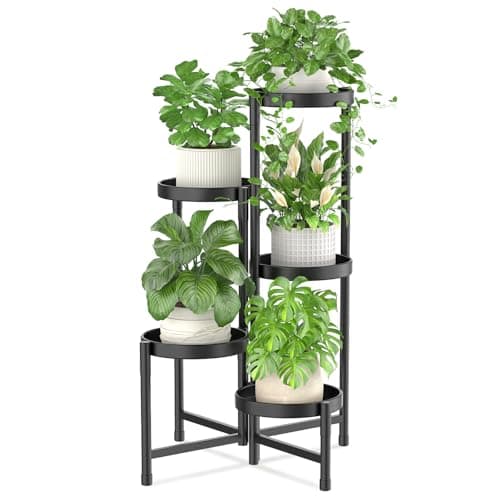
iDavosic.ly 5 Tier Metal Corner Plant Stand, folding
A staircase of five small shelves that turns one corner into five plant positions, which is the highest floor efficiency in this roundup.
- What the listing publishes
- 5 staggered tiers on a folding corner frame; no published weight rating
- Against a 10-inch pot
- No weight rating is published for this product, so there is nothing to check. That counts against it here rather than being treated as neutral.
Five positions on roughly a 17 by 17 inch footprint is about 2 square feet of floor for five plants, a little over two plants per square foot, and the best ratio of anything here.
The tiers are sized for 6 to 8 inch pots, not 10 inch ones. An 8-inch pot of saturated mix computes to about 7.5 lb, five of them to roughly 38 lb spread across the frame, which is a different question from 38 lb on one shelf.
The listing publishes no weight rating at all. That is common in this category and it is why this pick sits behind sized-and-rated products in the hanging and caddy roundups, where the numbers exist.
What is good
- Five plant positions on about two square feet of floor
- Folds apartment, which matters if you move every twelve months
- Staggered tiers keep the back plants visible instead of shadowed
What is not
- No published weight rating anywhere on the listing
- Tier depth suits 6 to 8 inch pots, not a 10 inch monstera
- A tall narrow frame in a corner is easy to catch with a vacuum
Skip it if your plants are already in 10 inch pots or bigger. This is a small-pot stand, and putting a 25 lb pot on the top tier of an unrated frame is exactly the guess this site exists to avoid.
2. A vertical plant column with no fixings at all
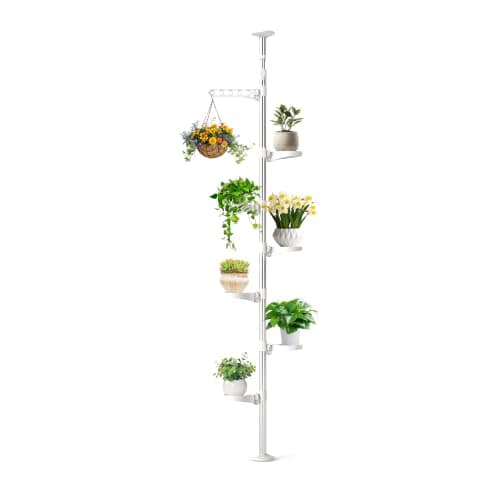
BAOYOUNI Plant Stand, 7-tier tension pole with 6 trays and a hook, 7.5 to 9.5 ft
Six tray positions plus a hook in a little over a square foot of floor, held up by pressure between your floor and your ceiling rather than by a base.
#ad · Price as of October 18, 2026. How we are funded
- What the listing publishes
- Published six trays plus a hook; 7 ft 6 in to 9 ft 6 in adjustable height; 13.2 in hanger span; trays and hook both rotate 360 degrees and adjust for height; stainless steel composite pipe; no published weight rating
- Against a 10-inch pot
- No weight rating is published for this product, so there is nothing to check. That counts against it here rather than being treated as neutral.
Six positions across the published 13.2-inch span is about 5.1 plants per square foot, well clear of the 3 that the best tiered corner frame here manages — and it gets there without a base, which is the floor a freestanding stand spends just to stay upright.
A tension pole loads your ceiling in compression rather than tension, so it does not care whether there is a joist above it. It does care whether your ceiling is solid, and a suspended or lath ceiling is not the surface for this. The published range starts at 7 ft 6 in, so check it against a standard 8-foot ceiling before buying.
No published weight rating, and again that is honest for a tension product. Keep the pots small and symmetrical, because an asymmetric load is what makes a pole walk out of position.
What is good
- Six tray positions plus a hook, so potted and trailing plants share one pole
- No fixings, so no deposit risk
- Trays and hook both rotate 360 degrees and set their own height
What is not
- No published weight rating
- Needs a solid ceiling, not suspended and not lath
- Asymmetric loading makes the pole drift
Skip it if your ceiling is a suspended grid or an artexed lath ceiling. A tension pole needs something firm to push against and neither of those is.
3. A narrow gap beside a sofa or radiator
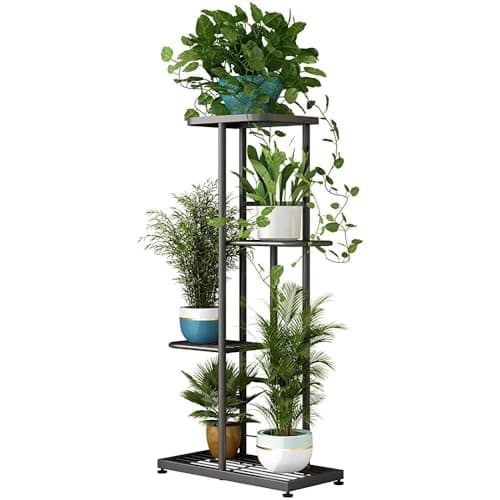
LINZINAR 4 Tier Metal Flower Pot Display Shelf, 5 pots
Ring holders rather than apartment shelves, so the pot drops through and sits lower. On a stand this narrow that is a real gain in stability.
#ad · Price as of October 18, 2026. How we are funded
- What the listing publishes
- 4 tiers holding 5 pots; ring-style holders sized to the pot rim
- Against a 10-inch pot
- No weight rating is published for this product, so there is nothing to check. That counts against it here rather than being treated as neutral.
A ring holder captures the pot instead of balancing it. On a narrow frame that is the difference between a knock tipping a plant and a knock moving the stand.
The trade is that the ring diameter is the pot size. A pot narrower than the ring falls through; a pot wider sits on the rim and defeats the point. Measure before buying.
Roughly 16 by 11 inches is about 1.2 square feet for five positions, a little over four plants per square foot. That is the tightest ratio here, at the cost of only fitting one pot size.
What is good
- Ring holders drop the pot's center of gravity into the frame
- Narrow enough for the gap most apartments have and cannot use
- Five positions on a little over one square foot
What is not
- No published weight rating
- The rings only fit a narrow band of pot diameters
- Nowhere for a saucer, so watering means lifting each pot out
Skip it if your pots are a mix of sizes. Ring stands are the least forgiving format in this category, and a collection that grows by acquisition will not fit them.
Questions people actually ask
How many plants can a plant stand hold?
How much floor space does a plant stand take?
What is the most space-efficient plant stand?
Is a taller plant stand better in a small apartment?
Sources
- Cornell University, Greenhouse Management: bulk density of greenhouse media components
- Biology Insights: how much a cubic foot of potting soil weighs, dry and saturated
- University of Illinois Extension: Houseplants — lighting
Product specifications are quoted from each seller's own listing and are the seller's claim, not a measurement of ours.