Planters
Do Planters Need Drainage Holes?
Yes. And the reason is more specific than 'plants do not like wet feet' — it is about where the air goes.
By Scooter M., enthusiast · Published · Last updated
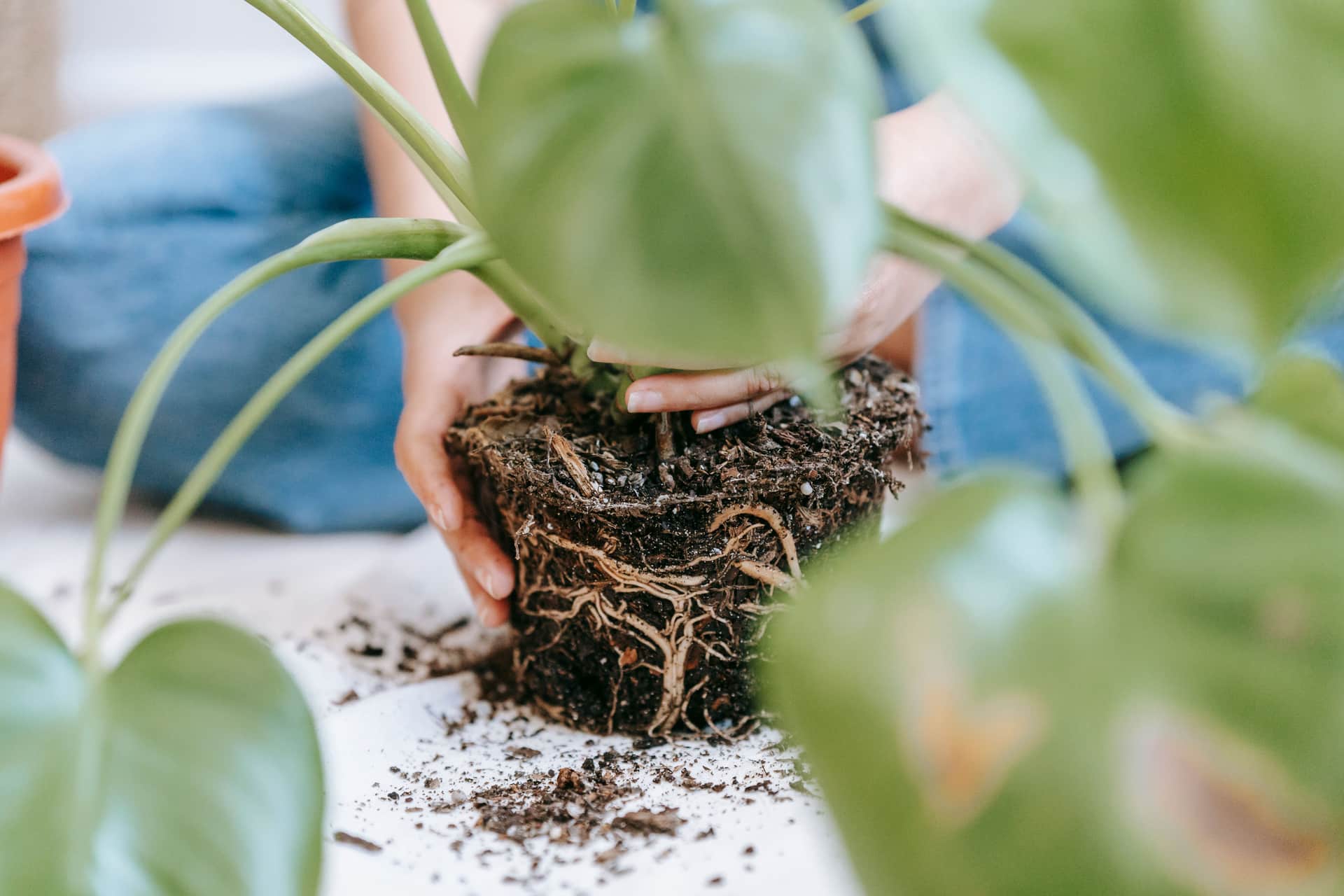
The short answer
Yes. Without a hole, water collects in the bottom of the pot where you cannot see it, that zone stays permanently saturated, roots in it suffocate and rot. If you own a pot with no hole, keep the plant in a plastic nursery pot inside it and lift it out to water — that is the whole fix and it costs almost nothing.
Disclosure Pot & Prop earns a commission when you buy through the Amazon links on this page, at no extra cost to you. It does not change which products get recommended or what we say about them, and we have not been given any of them. How this site is funded.
The advice is universal and the explanation usually is not, which is why people quietly ignore it. Here is the mechanism. Potting mix holds water in the spaces between its particles, and it holds air in the same spaces. Roots need both — they respire, which means they need oxygen, and mix that is fully saturated has no air in it at all. In a pot with a hole, gravity pulls the excess out and air follows it in. In a pot without one, the excess has nowhere to go and simply sits at the bottom.
That saturated zone is invisible from the top. The surface looks dry, so you water again, and the zone grows. The roots living in it die, and dead roots in wet mix rot, and the rot spreads upward into roots that were fine. By the time the plant looks unwell above the soil line, most of the root system below it is already gone. Extension guidance on indoor containers is unambiguous about this, and it is the single most common way a houseplant dies indoors.
Why a layer of gravel does not fix it
This is the most persistent myth in container gardening and it is worth being precise about, because it sounds so reasonable. Putting gravel in the bottom of a holeless pot does not create drainage — there is still nowhere for water to leave. What it does is raise the saturated zone: water does not move freely from a fine material into a coarse one, so the mix above the gravel holds more water than it otherwise would before any of it descends. You end up with a wetter root zone and less soil volume. It is worse, not better.
The fix that costs nothing
Do not drill the pot and do not throw it away. Keep the plant in a plastic nursery pot with holes and drop that inside the decorative one. To water, lift the inner pot out, water it over a sink, let it drain fully, and put it back. The decorative pot becomes a sleeve — which is exactly what every garden center does with everything it sells, and why nursery pots are worth buying deliberately rather than treating as packaging.
- Match the nursery pot to the cachepot so the rim sits just below the top and the plant looks planted rather than perched.
- Check for standing water in the outer pot after watering. If the inner pot did not drain fully before it went back, tip it out.
- Put something under the inner pot — pot feet, a jar lid, a few stones — if the cachepot is deep enough that runoff could pool. Air under the base is the point.
- Use clear nursery pots if you want to watch the roots. They cost the same as opaque ones and they turn a guess into an observation.
When can you get away with no drainage?
Honestly: when you are prepared to water by volume, measuring exactly what the pot can take without pooling, and to accept a shorter life for the plant. Some people do this successfully with small pots and drought-tolerant plants, and it works because the volumes are small enough to judge. It is a technique with no margin for error, and there is no reason to adopt it when a nursery pot inside the same vessel gives you all of the look and none of the risk.
Every pick, in full
We have not handled any of these. What follows is what each listing publishes, what that means once you put a watered pot on it, and who should buy something else.
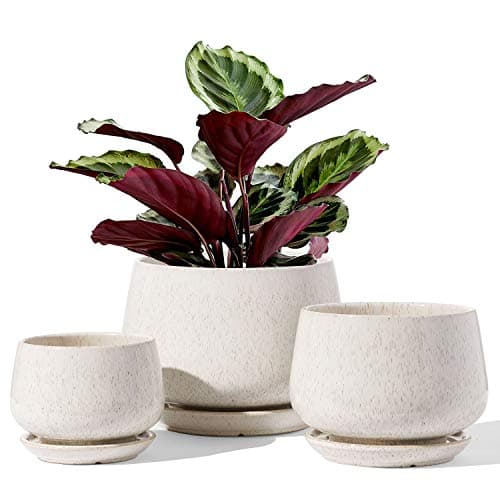
1. Three sizes that actually drain
LE TAUCI Ceramic Plant Pots with Drainage and Saucer, set of 3
Three graduated sizes with a real hole and a matched saucer in each, which is a lower bar than it sounds and one most decorative ceramic fails.
- What the listing publishes
- 4.1, 5.1 and 6.5 in; drainage hole and a matched saucer on every pot
- Against a 10-inch pot
- No weight rating is published for this product, so there is nothing to check. That counts against it here rather than being treated as neutral.
Saturated mix in these three sizes computes to about 0.9, 1.8 and 3.7 lb, light enough that any shelf holds them and the interesting question is drainage rather than load.
A matched saucer is not decoration. Buying a saucer separately means guessing a diameter, and a saucer an inch too small overflows onto whatever is underneath.
Graduated sets are how you pot up a plant without a second order. A rooted cutting goes in the 4-inch, moves to the 5-inch in a season and the 6.5-inch after that.
What is good
- Every pot has a hole and a matching saucer
- Three sizes cover a potting-up sequence
- Glazed inside, so they do not wick like bare terracotta
What is not
- Nothing here fits a plant bigger than a small pothos
- Ceramic chips if it goes over
- Glazed pots dry slower than terracotta, which suits some plants and kills others
Skip it if you overwater. A glazed, non-porous pot is the least forgiving container for that habit, and terracotta is the fix.
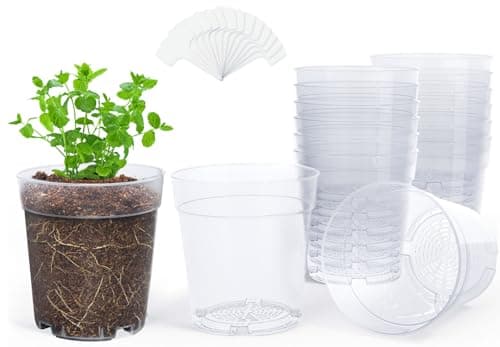
2. Watching roots instead of guessing
homenote 6.7 in Clear Plastic Nursery Pots with Drainage, 15 pack
Clear walls, which turn the one variable you cannot otherwise check, what the roots are doing, into something you can just look at.
#ad · Price as of October 18, 2026. How we are funded
- What the listing publishes
- 6.7 in clear plastic with drainage holes, 15 per pack
- Against a 10-inch pot
- No weight rating is published for this product, so there is nothing to check. That counts against it here rather than being treated as neutral.
The reason to use a clear nursery pot inside an opaque cachepot is diagnostic: you can see root growth, you can see when water has actually reached the bottom, and you can see rot before the leaves tell you.
Fifteen pots is a whole shelf and a propagation run's worth of potting-up, at a per-pot price no ceramic reaches.
They are not attractive. They are meant to sit inside something else, which is also the arrangement that keeps a decorative pot with no drainage hole from killing a plant.
What is good
- Root visibility that no other pot format gives you
- Fifteen pots at nursery pricing
- The correct inner pot for a decorative cachepot with no hole
What is not
- Ugly on their own
- Algae grows on the inside of a clear pot in a bright window
- Thin plastic flexes when you lift a wet one
Skip it if you want the pot to be the visible object. These are working pots and they look it.
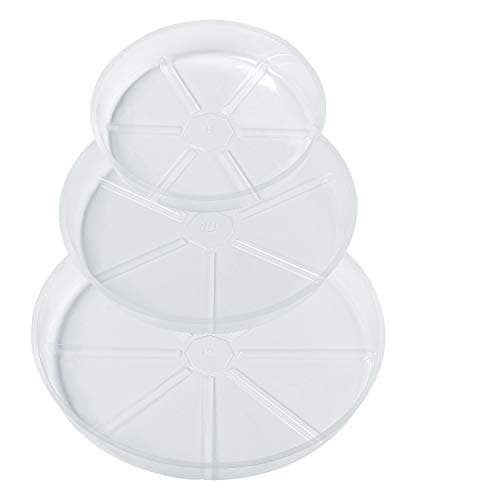
3. Fixing the pots you already own
Idyllize Clear Plant Saucers, 6, 8 and 10 in, 15 pack
Fifteen saucers in the three sizes that cover almost every pot in a normal apartment, which is a cheaper fix for a floor than a new pot is.
#ad · Price as of October 18, 2026. How we are funded
- What the listing publishes
- Published five each of 6, 8 and 10 in; clear plastic, stated lightweight and durable
- Against a 10-inch pot
- No weight rating is published for this product, so there is nothing to check. That counts against it here rather than being treated as neutral.
The commonest reason a plant lives in a pot with no drainage is that the owner has no saucer for it. Fifteen saucers removes that reason for a whole collection at once.
Clear saucers show standing water, which is the thing you actually need to see. An opaque saucer with two inches of water in it looks exactly like an empty one.
A saucer is only half the answer. A pot sitting flat in its own drainage wicks it back up, so pair these with pot feet.
What is good
- Covers three common pot sizes in one order
- Clear, so standing water is visible
- Cheaper than replacing a single pot
What is not
- Thin plastic cracks if a heavy pot is dragged across it
- Clear plastic clouds over a couple of years
- Does not solve wicking on its own
Skip it if all your pots are already in cachepots. A cachepot is a saucer with sides, and stacking a saucer inside it just hides the water.
Questions people actually ask
Can plants survive in pots without drainage holes?
Does gravel at the bottom of a pot help drainage?
How many drainage holes should a pot have?
Can I drill a drainage hole in a ceramic pot?
Sources
- Clemson HGIC: Indoor Plants — cleaning, fertilizing, containers and light requirements
- Clemson HGIC: Indoor Plants — watering
- University of Georgia Extension B1318: Growing Indoor Plants with Success
Product specifications are quoted from each seller's own listing and are the seller's claim, not a measurement of ours.