Planters
The Best Hygrometers for Plant Rooms
A device whose only job is producing a number, and which will not tell you how wrong that number might be, is not really specified.
By Scooter M., enthusiast · Published
The short answer
Buy one that publishes an accuracy figure, because on a measuring instrument that is the specification and plenty of listings substitute an adjective for it. The meters here that publish accuracy state plus or minus 2 to 3 percent relative humidity, which is fine for answering "is this room dry?" and not fine for chasing a set point — a reading of 42% could be 39% or 45%. And buy more than one if you have plants in more than one room, because humidity is a property of a spot rather than of a house.
Disclosure Pot & Prop earns a commission when you buy through the Amazon links on this page, at no extra cost to you. It does not change which products get recommended or what we say about them, and we have not been given any of them. How this site is funded.
Two days ago this site published a humidifier roundup that told readers, in a callout, to measure the room before buying an appliance — and then had nowhere to send them. This is the page that fixes that, and it is a short shopping decision because there is really only one thing to compare.
Accuracy is the specification
A hygrometer has no other job. It does not hold a plant, support a weight or move water. It produces a number, and the only interesting question about it is how close that number is to the truth.
| Meter | Published humidity accuracy | Published temperature accuracy |
|---|---|---|
| Three-pack | +/- 2 to 3% RH | +/- 1 degree F/C |
| Single unit | +/- 2 to 3% RH | +/- 1 degree F/C |
| Mini unit | Not published — "high-precision sensors" | Not published |
That last row is the familiar move, and it is sharper here than in most categories. Elsewhere on this site, a light says "High PPFD" without a figure and a plant stand says "heavy duty" without a rating. On an instrument, declining to publish precision is declining to specify the product at all.
What plus or minus three percent actually means
University of Minnesota Extension describes 40 to 60 percent as the range houseplants want, which this site has cited on the mister and humidifier pages. Put the published accuracy next to that band and the implication is immediate.
reading +/- stated accuracy, compared with the 40-60% target band
A 42% reading at +/-3% RH is somewhere between 39% and 45%. The band itself is 20 points wide, so the instrument's error spans about a sixth of it.
Accuracy quoted from the listings; the band is from extension guidance already cited on this site. Nothing here is measured by us.
So here is the honest read on what these are good for. Deciding whether a room is dry — 28% against 52% — is comfortably inside what a plus-or-minus-three instrument can tell you. Deciding whether you have hit exactly 50% is not. If you were hoping to dial a humidifier to a set point and verify it, the verification is softer than the target.
Humidity is a property of a spot, not a house
This is the argument for buying more than one, and it is why the three-pack leads this page. A windowsill above a radiator, an interior shelf across the room and a corner near a bathroom can read very differently on the same afternoon.
A single meter tells you about wherever you put it, which means a single meter can send you to buy an appliance for the wrong room. Three meters, left in three places for a day, turn that into a map — and they cost barely twice one.
- Put one where the plants actually are, at their height, not on a desk across the room.
- Keep it away from the humidifier's plume. A meter in the mist reads the mist, not the room, and will happily tell you a dry room is at 70%.
- Away from radiators, vents and direct sun, all of which are local conditions rather than room conditions.
- Give it time after moving it. These take minutes to equilibrate; the first reading in a new spot is not the spot's reading.
- Check it at night as well as during the day. Humidity often swings when the heating cycles, and a daytime-only reading misses the dry part.
This is not the same as a soil moisture meter
Worth stating plainly, because the two get confused constantly and this site sells both. A soil moisture meter has a probe and reads the medium in a pot — it answers "should I water this plant?". A hygrometer reads the air and answers "is this room dry?".
They diagnose different failures, and the symptoms overlap enough that people buy one and solve nothing. Brown crispy leaf edges can be low humidity; they can also be underwatering, a salt build-up, or a plant sitting in a draught from a vent. The probe and the meter between them rule two of those in or out.
Quick picks
Ranked, with the published figure each pick turns on. Tap a row for the full reasoning further down this page.
| # | Product | Best for | Price |
|---|---|---|---|
| 1 | 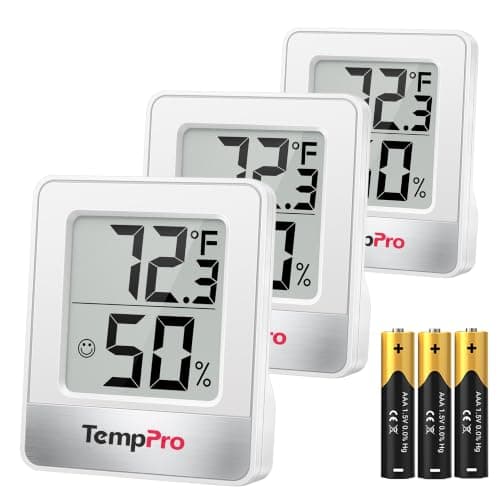 TempPro Digital Hygrometer and Thermometer, 3 packPublishes its accuracy and gives you three of them, which together answer the question one meter cannot: where in the home is the problem. | Finding out which room is actually dry, rather than which room you guessed | $20.89 at Amazon $28.99 · 28% off |
| 2 | 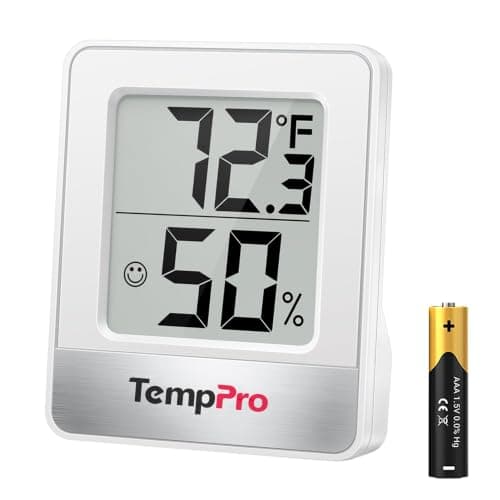 TempPro Digital Hygrometer and Thermometer, singleThe same published accuracy as the three-pack in a single unit, which is the right purchase when you already know which shelf you care about. | One plant shelf, from a listing that publishes what its sensor is worth | $9.99 at Amazon $12.99 · 23% off |
| 3 | 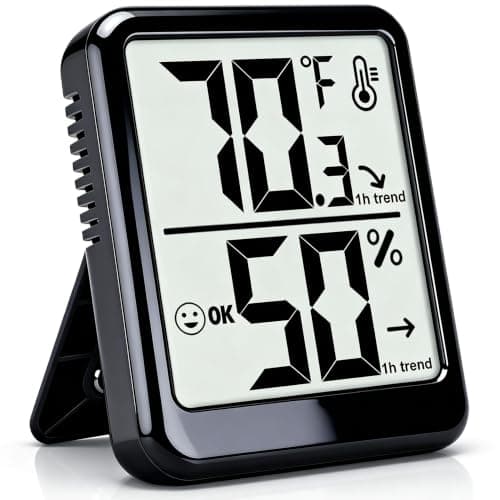 Ayawiss Mini Room Thermometer and Hygrometer, 2.1 by 2.6 inCheapest here and the fastest refresh, from a listing that describes its sensor as high-precision and declines to say how precise. | The cheapest way to find out whether the room is dry at all | $5.00 at Amazon $5.97 · 16% off |
Links to Amazon are affiliate links. Prices and availability are Amazon's and change without notice.
How we ranked these
On published accuracy first, then on how many spots you can cover, then on how readable the thing is from across a room. The three-pack leads because it publishes an accuracy figure and because humidity varies by location — three meters answer a question one cannot, and that question is the expensive one, since it decides which room you spend money on. The single unit is second with the same published accuracy for a third of the price, and is the right purchase when you already know which shelf you care about. The mini unit is third and is genuinely worth owning at its price, with the fastest refresh here and a trend arrow the others lack, held there by a listing that calls its sensor high-precision and never says how precise.
| Your question | Buy | Why |
|---|---|---|
| Which room is dry? | Three-pack | Humidity is local; one reading is one spot |
| Is this shelf dry? | Single unit | Same published accuracy, a third of the price |
| Is it dry at all? | Mini unit | Cheapest, and coarse is all the question needs |
| Is my humidifier working? | Any, plus a trend arrow | Watch the number move, from outside the plume |
| Should I water this plant? | A soil moisture meter | Different instrument, different question |
| Hold exactly 50% | A humidistat, not a meter | +/-3% is softer than the target you are chasing |
What we deliberately do not recommend
Buying a meter whose listing will not state an accuracy when one that does costs the same. Reading a single meter as though it described the whole home. Leaving a meter inside a humidifier's plume and believing the result. Chasing a set point with an instrument whose error is a sixth of the band. Taking the first reading after moving a meter as the new spot's value. And buying a hygrometer when the actual question was whether to water — that is a probe in the pot, not a number on the wall.
Every pick, in full
We have not handled any of these. What follows is what each listing publishes, what that means once you put a watered pot on it, and who should buy something else.
1. Finding out which room is actually dry, rather than which room you guessed
TempPro Digital Hygrometer and Thermometer, 3 pack
Publishes its accuracy and gives you three of them, which together answer the question one meter cannot: where in the home is the problem.
- What the listing publishes
- Published accuracy of +/-1 degree F/C and +/-2 to 3% RH; stated 10 second refresh; face icons indicating DRY, COMFORT or WET; three placement options — tabletop stand, magnetic back and hanging mount; 3 units per pack
- Against a 10-inch pot
- No weight rating is published for this product, so there is nothing to check. That counts against it here rather than being treated as neutral.
Humidity is not a property of a house, it is a property of a spot. A windowsill above a radiator, an interior shelf and a bathroom-adjacent corner can differ by twenty points, and a single meter tells you about wherever you happened to put it. Three meters turn a guess into a map.
That matters before you spend money. The humidifier page makes the case for measuring before buying an appliance, and the commonest outcome of measuring is discovering the room was fine and the crisping leaves were something else.
The published accuracy — plus or minus 2 to 3 percent RH — is the specification, and it is worth reading against what you are judging. A reading of 42% could be 39% or 45%. That is usable for deciding whether a room is dry; it is not usable for chasing a target to the point.
What is good
- Publishes an accuracy figure for both humidity and temperature
- Three units, so you can compare rooms instead of guessing
- Magnetic back, stand and hanging mount, so placement is never the blocker
What is not
- Three small screens is three more batteries to remember
- +/-3% RH is a meaningful share of the band you are judging
- No logging or history — each unit shows the current reading only
Skip it if you only care about one shelf. One meter with the same published accuracy costs a third as much.
2. One plant shelf, from a listing that publishes what its sensor is worth
TempPro Digital Hygrometer and Thermometer, single
The same published accuracy as the three-pack in a single unit, which is the right purchase when you already know which shelf you care about.
- What the listing publishes
- Published accuracy of +/-1 degree F/C and +/-2 to 3% RH; stated 10 second refresh rate; compact LCD with large digits; face icon comfort indicator for DRY, COMFORT and WET; three-way mounting — tabletop stand, magnetic back or hanging
- Against a 10-inch pot
- No weight rating is published for this product, so there is nothing to check. That counts against it here rather than being treated as neutral.
Publishing an accuracy figure at all puts this ahead of most of the category. It is the only specification that matters on an instrument: a device whose job is to produce a number, and which will not tell you how wrong that number might be, is not really specified.
A ten-second refresh is fast enough to watch a change happen, which is more useful than it sounds — standing a meter beside a running humidifier and seeing whether the reading actually moves is how you find out if the appliance is doing anything.
The face icons are a small thing done well. A dial that says DRY is read at a glance from across a room, where a two-digit percentage is not, and glanceability is most of what decides whether a meter gets looked at after the first week.
What is good
- Publishes +/-2 to 3% RH accuracy, unlike much of this category
- Ten second refresh, fast enough to watch a change
- Magnetic, standing or hanging, so it goes where the plants are
What is not
- One meter tells you about one spot, and humidity varies by room
- No logging, so you never see the overnight low
- +/-3% RH is about a sixth of the 40-60% band it is judging
Skip it if you have plants in more than one room. Humidity is local, and three meters cost barely twice this one.
3. The cheapest way to find out whether the room is dry at all
Ayawiss Mini Room Thermometer and Hygrometer, 2.1 by 2.6 in
Cheapest here and the fastest refresh, from a listing that describes its sensor as high-precision and declines to say how precise.
- What the listing publishes
- Published 2.1 by 2.6 in body with a sturdy stand; stated 5 second data refresh and an automatic 3-minute calibration on power-up; humidity trend indicator; AAA battery pre-installed; stated "high-precision sensors" with no accuracy figure published
- Against a 10-inch pot
- No weight rating is published for this product, so there is nothing to check. That counts against it here rather than being treated as neutral.
"High-precision sensors" with no figure is the exact behavior this site keeps finding across categories: naming the property that would settle the question and then not quantifying it. On a measuring instrument it is a sharper problem than elsewhere, because precision is the entire product.
The trend indicator is a genuinely useful feature the pricier units here lack. An arrow showing whether humidity is rising or falling tells you whether whatever you just did is working, which a bare number does not.
At this price it is still worth owning. A meter with unstated accuracy will reliably tell you the difference between a 25% room and a 50% room, and that is the decision most readers are actually trying to make.
What is good
- Cheapest instrument here by a clear margin
- Humidity trend arrow, which the pricier units do not have
- Five second refresh and a battery already in the box
What is not
- No accuracy figure published anywhere on the listing
- "High-precision" is an adjective on a device that should carry a number
- Small screen is harder to read at a glance than the larger-digit units
Skip it if you are trying to hold a specific humidity rather than diagnose a dry room. Chasing a target with an instrument of unstated accuracy is chasing a number you cannot trust.
Questions people actually ask
Do I need a hygrometer for my houseplants?
What humidity do houseplants need?
How accurate are cheap hygrometers?
Where should I put a hygrometer?
Is a hygrometer the same as a soil moisture meter?
Why do two hygrometers in my house show different numbers?
Sources
- University of Minnesota Extension: African violets — containers, wick watering and care
- Michigan State University Extension: Smart Gardening — growing houseplants indoors
- Clemson HGIC: Indoor Plants — cleaning, fertilizing, containers and light requirements
Product specifications are quoted from each seller's own listing and are the seller's claim, not a measurement of ours.