Planters
The Best Self-Watering Planter Inserts
Every one of these is sold as a way to leave your plants for two weeks. Only some of them hold enough water to do it, and the capacity is checkable.
By Scooter M., enthusiast · Published
The short answer
Work out how much water your pots actually need before buying anything: a 6-inch pot holds about 870 ml between dry and saturated, and a 10-inch pot about 4 liters. Then check the device's published capacity against that. A 100 ml globe is roughly a tenth of one watering for a 6-inch pot, which makes it a long-weekend top-up rather than a holiday system. For a real trip, use a wick or a pump into a reservoir you choose the size of.
Disclosure Pot & Prop earns a commission when you buy through the Amazon links on this page, at no extra cost to you. It does not change which products get recommended or what we say about them, and we have not been given any of them. How this site is funded.
This site already covers self-watering pots, and the honest conclusion there was narrow: a reservoir pot solves one problem, being away, and creates a different one for any plant that needs to dry out. This page is about the other half of that decision — the devices you add to pots you already own, so you do not have to repot a collection to survive a fortnight in another country.
It is also a category that runs almost entirely on vibes. Nearly every product is photographed in a sunlit windowsill above a claim about going on holiday, and almost none of them tell you the one thing that decides whether that claim is true: how much water the device actually holds. Where a figure is published, it can be checked — and this page checks it.
First, how much water does a pot actually need?
This is the number the category avoids, and it falls straight out of figures already published on this site's methodology page. Potting mix at the planning densities used here weighs about 22 lb per cubic foot dry and about 55 lb per cubic foot saturated. The difference between those two — 33 lb per cubic foot — is the water the mix takes up going from bone dry to fully wet. Divide by the density of water and you have the volume of one full watering.
water = pot mix volume x (55 - 22) lb/ft^3, then / 62.4 lb/ft^3 for volume
6-inch pot: 0.058 ft^3 x 33 = 1.91 lb of water = about 870 ml. 10-inch pot: 0.268 ft^3 x 33 = 8.84 lb = about 4,010 ml, or a little over a US gallon.
Derived from the dry and saturated densities and the density of water, all of which are sourced on the methodology page. This is an upper bound — a full soak from completely dry — but it is the right scale to judge a device against.
| Pot size | Water per watering | What one 100 ml globe covers |
|---|---|---|
| 4 in | About 260 ml | About 39 percent |
| 5 in | About 500 ml | About 20 percent |
| 6 in | About 870 ml | About 12 percent |
| 8 in | About 2,050 ml | About 5 percent |
| 10 in | About 4,010 ml | About 2.5 percent |
| 12 in | About 6,940 ml | About 1.4 percent |
Read that table before reading any product description. It explains, without needing to test a single device, why globes disappoint people with large plants and why a wine bottle on a terracotta spike does noticeably better — a standard bottle is about 750 ml, which is most of one watering for a 6-inch pot rather than a tenth of one.
The five mechanisms, and which ones hold up
- Wick or capillary cord. An absorbent rope from a reservoir into the medium. The most dependable passive mechanism, because nothing has to bubble, valve or unblock — water simply travels along the fibers. You choose the reservoir, so you choose the duration.
- Insert spikes with a wick. The same physics, packaged, with a spike that holds position in the medium and published guidance on how many to use per pot. Easier to set up than bare cord and priced per plant rather than per collection.
- Porous terracotta spikes. Unglazed clay passes water through its wall at a rate that depends on how dry the surrounding medium is, so it self-regulates. Genuinely clever, and the rate is not published — it varies with your clay, your medium and your room.
- Globes and bulbs. Water leaves only as air bubbles back in past the stem, which is the least controllable mechanism here. Capacity is usually small and often unpublished. Fine for a small pot over a long weekend.
- Pump on a timer. The only option that meters water rather than waiting for the soil to ask. Published duration and interval, adjustable per pot, and the only one whose behavior you can predict before you leave.
Quick picks
Ranked, with the published figure each pick turns on. Tap a row for the full reasoning further down this page.
| # | Product | Best for | Price |
|---|---|---|---|
| 1 | 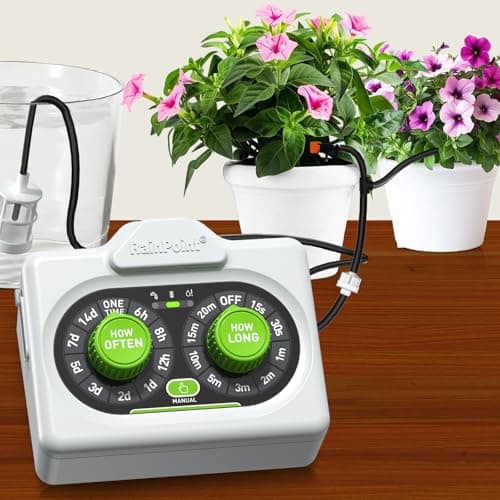 RAINPOINT Automatic Plant Waterer, battery pump, adjustable emittersThe only product in this category that meters water rather than releasing it on the soil's terms, which is the difference between a system and a hopeful gadget. | The only device here that waters on a schedule you set | |
| 2 | 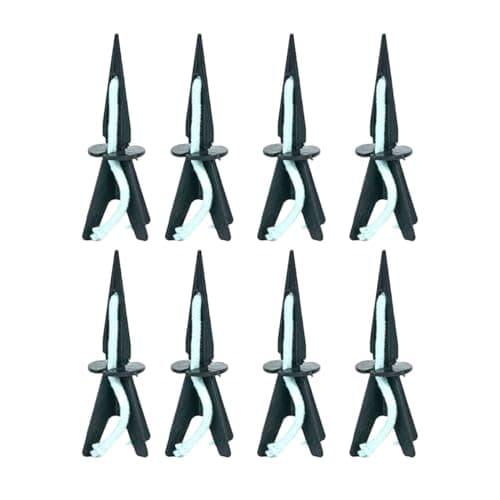 GreenShip Self Watering Planter Insert Spikes with wicking rope, 8 packThe rare device in this category that publishes which pots it fits and how many you need, which turns guesswork into a purchase decision. | Converting pots you already own, with published sizing | $9.99 at Amazon $14.99 · 33% off |
| 3 | 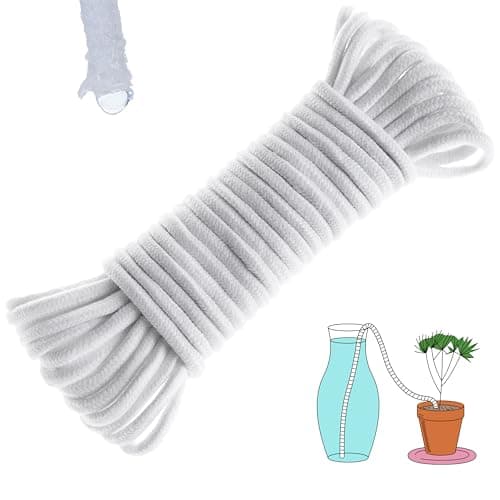 ORIMERC Self Watering Wick Cord, 1/4 in, 50 ftFifty feet of rope that will keep more plants alive over a trip than any gadget on this page, for less money than any of them. | The cheapest mechanism that actually works | |
| 4 | 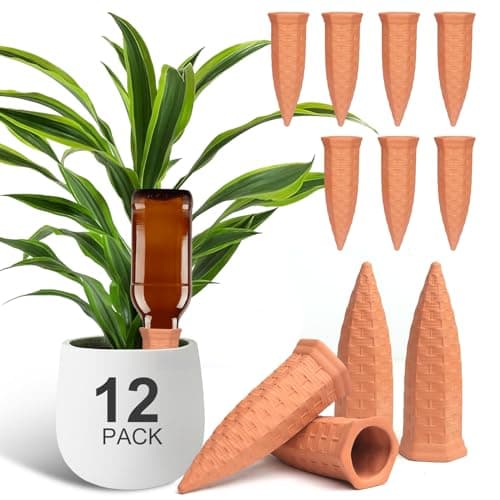 Baxrou Terracotta Watering Spikes for wine bottles, 12 packPorous clay releasing water as the surrounding medium dries — a genuinely self-regulating mechanism, and the one whose rate you have least control over. | Reusing the bottles you already have | $17.98 at Amazon $19.98 · 10% off |
| 5 | 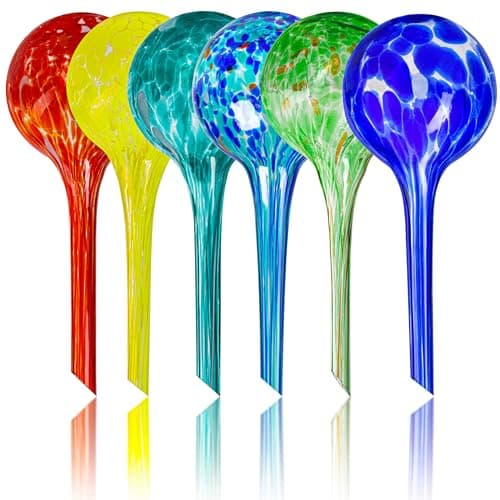 Glass Watering Globes, 100 ml each, set of 6Publishes its capacity, which almost no globe does — and that published number is exactly what shows the limits of the format. | Small pots, short absences, and honest expectations | $27.99 at Amazon $32.99 · 15% off |
| 6 | 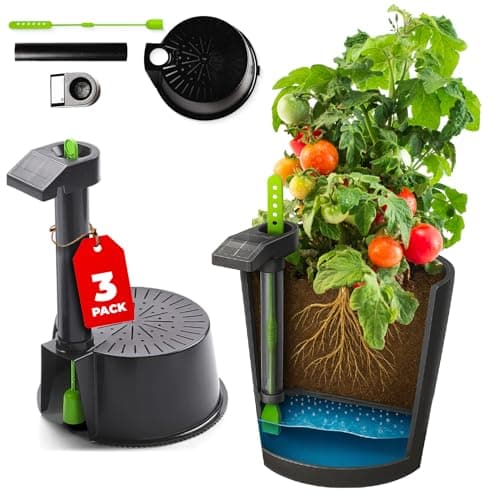 GroBucket Self Watering Planter Insert with 1 gallon reservoir and level indicatorThe only true insert here — it builds a real reservoir under the root zone — and it is built for a five gallon bucket rather than anything you would display. | Edibles in a bucket, not a decorative apartment pot |
Links to Amazon are affiliate links. Prices and availability are Amazon's and change without notice.
Match the device to the trip, not to the photograph
| Away for | What works | What will not |
|---|---|---|
| A long weekend, small pots | Globes, or nothing at all | Nothing needed for most plants |
| A week, mixed collection | Terracotta spikes on bottles, or wicks | Globes on anything 8 in or larger |
| Two weeks, mixed collection | Wicks into large reservoirs, or a pump timer | Any sealed device with a fixed small capacity |
| Two weeks, large floor plants | Pump timer with adjustable emitters | Every passive device except a large reservoir |
| A month | A neighbor with a key | All of it, honestly |
That last row is not a joke and it belongs on the page. Passive devices are reservoirs, and a reservoir sized to survive a month in an apartment is a bucket. At some point the right answer stops being a purchase.
Run a trial before you leave
This is the step that decides whether any of this works, and it is the one nobody does. Every passive device on this page releases water at a rate set by your medium, your pot, your room temperature and your humidity — none of which are on the packaging. The only way to know what a device does in your apartment is to set it up while you are still there.
- Set it up a week before the trip, on the plants you actually intend to leave.
- Mark the reservoir level with a piece of tape on day one.
- Check on day three and day seven. You are looking for a steady fall, not an empty vessel or an untouched one.
- Extrapolate honestly. If a bottle empties in four days, it will not cover fourteen, and adding a second bottle is a better answer than hoping.
- Water everything thoroughly the morning you leave, so the device is topping up rather than starting from dry.
Which plants need any of this
Fewer than you would think, and this is where the site's usual argument reappears. Snake plants, ZZ plants, cacti and most succulents are storing water in their tissue precisely so that they can ignore a dry fortnight — leaving a device in one is not neutral, it is the same permanently-damp problem that self-watering pots create for those plants.
The plants that genuinely need help are the thirsty ones: peace lilies, ferns, calatheas, most herbs, and anything in a small pot in a bright spot. Set devices up for those and leave the drought-tolerant ones alone. The material argument for the pots themselves is here.
What we deliberately do not recommend
Standing pots in a tray of water while you are away, which is the improvised version of this and reliably drowns anything left in it for a fortnight — it is a no-drainage pot by other means. We also do not recommend globes for anything in an 8-inch pot or larger, because the published capacity says they cannot do it and no arrangement of them changes the arithmetic. And we do not recommend any device fitted for the first time the night before a trip: untested, a wick either does nothing or siphons a pot into a swamp, and you find out which on your return.
Every pick, in full
We have not handled any of these. What follows is what each listing publishes, what that means once you put a watered pot on it, and who should buy something else.
1. The only device here that waters on a schedule you set
RAINPOINT Automatic Plant Waterer, battery pump, adjustable emitters
The only product in this category that meters water rather than releasing it on the soil's terms, which is the difference between a system and a hopeful gadget.
#ad · Price as of October 25, 2026. How we are funded
- What the listing publishes
- Published watering duration 15 seconds to 20 minutes and frequency every 6 hours to 14 days; adjustable drippers per pot; manual watering button; low-water LED with automatic shut-off
- Against a 10-inch pot
- No weight rating is published for this product, so there is nothing to check. That counts against it here rather than being treated as neutral.
Every passive device on this page releases water when the surrounding soil dries enough to let it — a rate you do not set and cannot check. A pump on a timer is the opposite: you dial a duration and an interval, and it delivers that whether the soil asks for it or not. For a two-week trip that predictability is the whole product.
The published range is unusually specific for this category: 15 seconds to 20 minutes per watering, every 6 hours to 14 days. Being able to read those two numbers before buying is what lets you work out whether it covers your longest trip on one reservoir.
The low-water shut-off matters more than it sounds. A pump that keeps running after the reservoir empties is a pump that burns out while you are away, and then nothing gets watered at all.
What is good
- Published duration and frequency ranges, both adjustable
- Per-pot adjustable emitters, so a fern and a succulent can share one system
- Low-water auto shut-off protects the pump
What is not
- Batteries, tubing and a reservoir bucket to find room for
- The most conspicuous option — this is visible equipment in a small apartment
- You supply the reservoir, and its size sets the real trip length
Skip it if you are away for a weekend. This is a system to set up for a real trip, not something to rig for two days.
2. Converting pots you already own, with published sizing
GreenShip Self Watering Planter Insert Spikes with wicking rope, 8 pack
The rare device in this category that publishes which pots it fits and how many you need, which turns guesswork into a purchase decision.
- What the listing publishes
- Published pot height fit — small 4.7 to 12 in, medium 12 to 17 in, large 17 in and over; listing suggests 4 spikes per standard pot; spike plus wicking rope into your own reservoir
- Against a 10-inch pot
- No weight rating is published for this product, so there is nothing to check. That counts against it here rather than being treated as neutral.
Almost every passive waterer is sold without telling you what size pot it suits, which is exactly the information you need. Publishing three height bands and a suggested count per pot is a small act of honesty that puts this ahead of most of the category before the mechanism is even discussed.
The mechanism is wick plus spike: the spike sits in the medium, the rope runs to a reservoir you provide, and capillary action moves water across. That is a genuinely reliable process — it is the same principle that makes a self-watering pot work — and unlike a globe it does not depend on air bubbling back into a sealed vessel.
Because you supply the reservoir, the trip length is yours to set. A larger jug means longer coverage without buying anything else, which is the practical advantage of a wick system over any sealed device.
What is good
- Published pot height ranges and a suggested count per pot
- You choose the reservoir, so you choose the duration
- Works with pots you already own, no repotting
What is not
- A visible reservoir sitting next to the plant
- The reservoir must sit at or below the pot for the wick to behave predictably
- Eight spikes covers roughly two standard pots at the suggested four each
Skip it if you want something invisible. A wick system is a jug with a rope going into a plant pot and it looks exactly like that.
3. The cheapest mechanism that actually works
ORIMERC Self Watering Wick Cord, 1/4 in, 50 ft
Fifty feet of rope that will keep more plants alive over a trip than any gadget on this page, for less money than any of them.
#ad · Price as of October 25, 2026. How we are funded
- What the listing publishes
- Published 50 ft of 1/4 in wicking cord; listing states water begins transporting within about 15 minutes of setup; washable and reusable
- Against a 10-inch pot
- No weight rating is published for this product, so there is nothing to check. That counts against it here rather than being treated as neutral.
Capillary action is the most dependable passive watering mechanism there is: put one end of an absorbent cord in water and the other in the medium, and water moves steadily along it without pumps, valves, air locks or anything to clog. It is also the mechanism a self-watering pot uses internally, so this is the same physics unbundled from the pot.
Fifty feet cuts into a lot of individual runs. That makes this the only option here that scales to a whole collection for one modest purchase, where globes and spikes are priced per plant.
The catch is that it is genuinely do-it-yourself. There is no packaging to tell you how long a run should be or how much water a given plant will draw; you have to set it up a few days before you leave and watch what happens. Doing that trial run is not optional.
What is good
- The most reliable passive mechanism, with nothing to clog or air-lock
- One purchase covers an entire collection
- Washable and reusable indefinitely
What is not
- No instructions tuned to your plants — you have to test it
- Needs a reservoir positioned at or below pot level
- Cord and jugs across a windowsill is not a tidy look
Skip it if you will not run a trial before leaving. Untested wicks either do nothing or siphon a pot into a swamp, and you find out which on your return.
4. Reusing the bottles you already have
Baxrou Terracotta Watering Spikes for wine bottles, 12 pack
Porous clay releasing water as the surrounding medium dries — a genuinely self-regulating mechanism, and the one whose rate you have least control over.
- What the listing publishes
- Published clay construction working by osmosis through the porous wall; takes a standard wine or drinks bottle as the reservoir; listing advises testing the release rate before relying on it
- Against a 10-inch pot
- No weight rating is published for this product, so there is nothing to check. That counts against it here rather than being treated as neutral.
The appeal is real: unglazed clay passes water through its wall at a rate that depends on how dry the medium around it is, so a spike in damp soil releases slowly and one in dry soil releases faster. That is closer to responsive watering than anything else on this page achieves without a pump.
The listing itself advises testing the release rate before depending on it, which is unusually candid and worth taking literally. Release depends on your clay, your medium, your bottle and your room, and none of those are published figures.
A wine bottle holds around 750 ml, which is a meaningful reservoir — several times what a small globe carries — and it costs nothing because you already have the bottle.
What is good
- Self-regulating: releases faster as the medium dries
- A wine bottle is a far larger reservoir than any globe
- Twelve spikes covers a whole collection cheaply
What is not
- Release rate is not published and varies with clay, medium and room
- The listing tells you to test it first, which means it can go wrong
- An upended bottle in a plant pot is a distinctive look
Skip it if you cannot run a trial week first. This is the device whose behavior varies most between one apartment and another.
5. Small pots, short absences, and honest expectations
Glass Watering Globes, 100 ml each, set of 6
Publishes its capacity, which almost no globe does — and that published number is exactly what shows the limits of the format.
- What the listing publishes
- Published 100 ml per globe and a stated duration of up to about 5 days depending on plant, medium and climate; handcrafted glass; listing specifies mounting at a 75 to 85 degree angle
- Against a 10-inch pot
- No weight rating is published for this product, so there is nothing to check. That counts against it here rather than being treated as neutral.
A hundred milliliters is a real figure and it deserves credit for being printed at all. It is also small. Working from this site's own density constants, a 6-inch pot holds roughly 870 ml of water between bone dry and fully saturated, so one 100 ml globe is a little over a tenth of a single watering. In a 10-inch pot it is closer to a fortieth.
That does not make globes useless — it makes them a top-up for small pots rather than a holiday solution for a collection. For a 4 or 5 inch plant on a desk over a long weekend, one globe is a sensible amount of water.
The mechanism is also the least controllable here. Water leaves only as air bubbles back in, which depends on how the medium settles around the stem, so a globe can empty in a day or sit full for a week. The published 75 to 85 degree mounting angle is an attempt to make that more consistent and is worth following.
What is good
- Publishes capacity in milliliters and a stated duration
- Attractive enough to leave in place permanently
- Six globes for a collection of small pots
What is not
- 100 ml is roughly a tenth of one watering for a 6-inch pot
- Release rate depends on air bubbling back in, which is unpredictable
- Glass in a pot is fragile, and the stem clogs with fine medium
Skip it if you are leaving for two weeks with 10-inch pots. The published capacity says this cannot do that job, and no amount of them arranged in one pot changes the mechanism.
6. Edibles in a bucket, not a decorative apartment pot
GroBucket Self Watering Planter Insert with 1 gallon reservoir and level indicator
The only true insert here — it builds a real reservoir under the root zone — and it is built for a five gallon bucket rather than anything you would display.
#ad · Price as of October 25, 2026. How we are funded
- What the listing publishes
- Published 1 gallon reservoir created below the medium; refill level indicator; designed to convert a standard 5 gallon bucket, which is not included
- Against a 10-inch pot
- No weight rating is published for this product, so there is nothing to check. That counts against it here rather than being treated as neutral.
This is what a self-watering conversion looks like when it is done properly: a false floor, a one gallon reservoir beneath it and a visible refill cue, which together behave like a purpose-built self-watering pot rather than a device stuck into one.
A gallon is a serious reservoir. For comparison, a 10-inch pot holds roughly a gallon of water between dry and saturated, so this genuinely covers a full watering and then some — which is why it is the only passive option here that can plausibly carry a large plant through two weeks.
The honest limitation is what it fits. It is designed around a 5 gallon bucket and marketed for tomatoes, peppers and herbs. In an apartment that is a balcony product for edibles, not something to put a monstera in, and the bucket is not included.
What is good
- A published 1 gallon reservoir with a refill indicator
- A genuine self-watering conversion, not a spike
- The largest passive capacity on this page by a wide margin
What is not
- Fits a 5 gallon bucket, which you supply and which is not a display pot
- Aimed at edibles and container gardening rather than houseplants
- No use at all for the 5 to 10 inch decorative pots most apartments run on
Skip it if your plants are in ordinary houseplant pots. This solves a container-gardening problem, and the spikes or the wick solve yours.
Questions people actually ask
Do watering globes actually work?
How long can indoor plants go without water?
What is the best way to water plants while on vacation?
Can I convert a normal pot into a self-watering one?
Do self-watering spikes work for all plants?
How much water does a plant pot hold?
Sources
- Cornell University, Greenhouse Management: bulk density of greenhouse media components
- Biology Insights: how much a cubic foot of potting soil weighs, dry and saturated
- Clemson HGIC: Indoor Plants — watering
- Clemson HGIC: Indoor Plants — cleaning, fertilizing, containers and light requirements
- Michigan State University Extension: Smart Gardening — growing houseplants indoors
Product specifications are quoted from each seller's own listing and are the seller's claim, not a measurement of ours.