Planters
The Best Pots for a Peace Lily
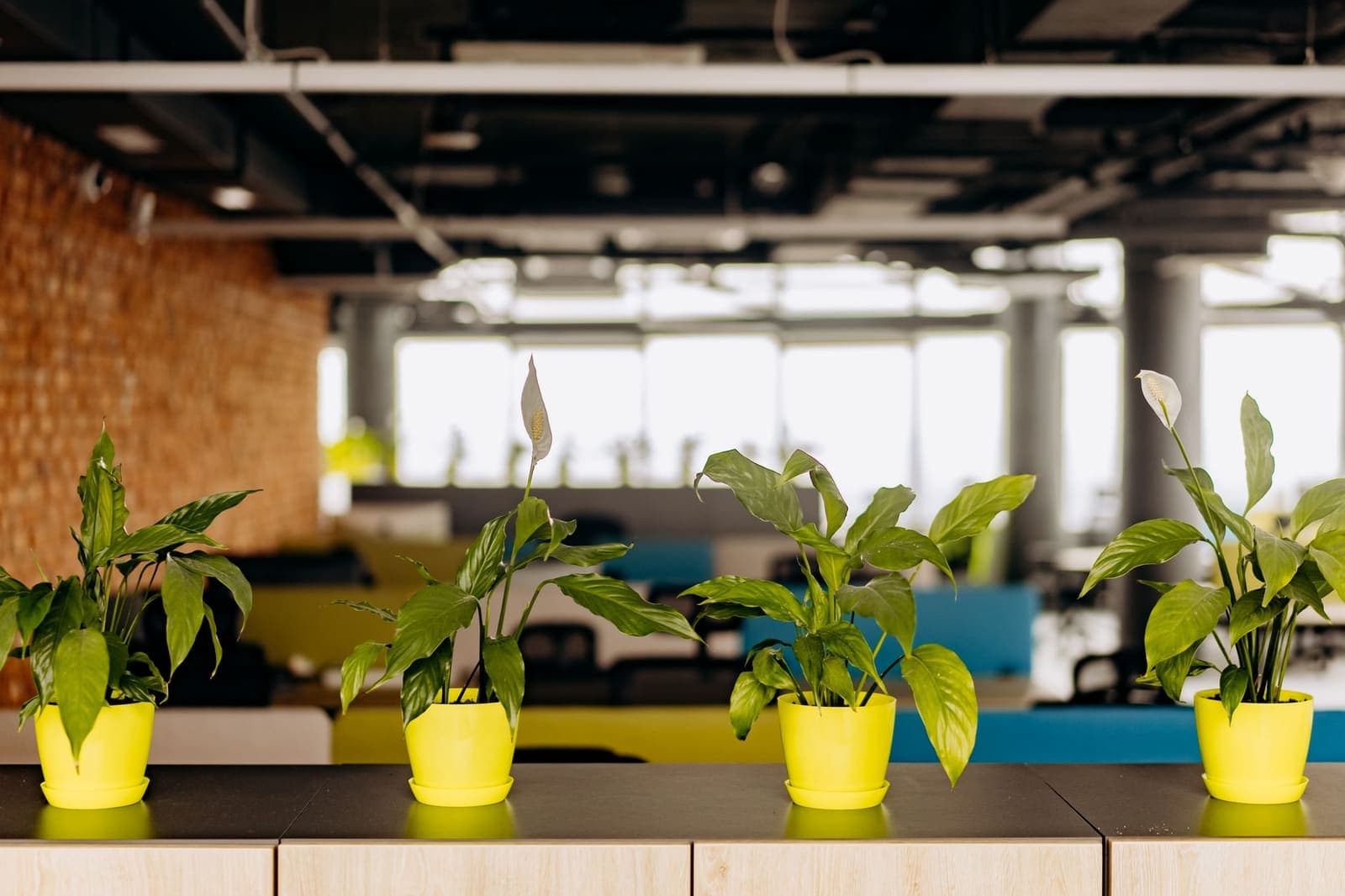
This is the plant self-watering pots were made for. It wants to stay evenly moist, tells you loudly when it is dry, and still needs a hole at the bottom.
By Scooter M., enthusiast · Published
The short answer
A peace lily wants evenly moist mix and wilts dramatically when it dries, which makes it the one common houseplant this site recommends a self-watering pot for. A 12-inch pot with a published 60 oz reservoir suits a full plant; a 6-inch ceramic pot with a saucer suits a small one that you can water on a rhythm. Whatever you choose, it needs a drainage hole or an overflow — the plant likes moist, not submerged.
Disclosure Pot & Prop earns a commission when you buy through the Amazon links on this page, at no extra cost to you. It does not change which products get recommended or what we say about them, and we have not been given any of them. How this site is funded.
Most of this site's planters pages argue against self-watering pots, and the argument is about the plant rather than the pot: most common houseplants want to dry out between waterings, and a reservoir denies them that. A peace lily is the exception the argument was waiting for. It wants the mix evenly moist, it collapses when it dries — every leaf flat over the rim within a day — and it recovers within hours of a drink. That is a plant asking for a reservoir, and this page is where the site finally recommends one without a caveat.
Almost without a caveat. The plant likes moist, not waterlogged, and a pot with no drainage and no overflow will still rot it. So the criteria here are a reservoir that actually holds a useful amount — a figure the listing has to publish for the pot to rank — an overflow or drainage path, and a size the plant will fill within a year rather than one it will sit wet in for two.
How much a peace lily's pot drinks
The self-watering question is a capacity question, and it can be worked out. This site's methodology page carries a dry and a saturated density for potting mix; the difference between them is the water the mix takes up going from dry to wet, and that gives the water in one full watering for any pot size. Set that against a published reservoir and you know how many waterings the reservoir is worth, which is the number the packaging never prints.
water = mix volume x (55 - 22) lb/ft^3, / 62.4 lb/ft^3
12-inch pot: 0.463 ft^3 x 33 = 15.3 lb of water = about 6.9 liters, or about 235 fl oz. A published 60 oz reservoir is therefore about a quarter of one full soak — several days of top-up for a peace lily, not two weeks away.
Derived from the densities on the methodology page. A peace lily is never watered from bone dry, so the reservoir stretches further in practice — but the scale is right, and it is why the reservoir pot is a convenience for this plant rather than a vacation system.
| Pot size | Water per full watering | What a 60 oz reservoir covers |
|---|---|---|
| 6 in | About 870 ml (29 fl oz) | About two soaks |
| 8 in | About 2,050 ml (69 fl oz) | Most of one soak |
| 10 in | About 4,010 ml (136 fl oz) | Under half a soak |
| 12 in | About 6,940 ml (235 fl oz) | About a quarter of a soak |
| Pot size | Mix volume | Dry | Watered | Rating needed |
|---|---|---|---|---|
| 6 in | 0.058 cu ft | 1.3 lb | 3.2 lb | 5 lb |
| 8 in | 0.137 cu ft | 3 lb | 7.5 lb | 12 lb |
| 10 in | 0.268 cu ft | 5.9 lb | 14.7 lb | 23 lb |
| 12 in | 0.463 cu ft | 10.2 lb | 25.5 lb | 39 lb |
Self-watering, but only with a way out
The pots that work for this plant separate the mix from the reservoir — a wick or a mesh platform lifts the roots above the water and lets them draw it up as the mix dries. The pots that fail are the sealed ones where the plant sits in its own reservoir, which is a pot with no drainage under another name. Every self-watering pick below publishes either an overflow, drainage under the platform, or a removable reservoir you can check. The full self-watering comparison is where the site sets out the mechanism.
The plain ceramic pots are on the page for the other kind of owner. A peace lily on a windowsill you pass every day does not need a reservoir; it needs a hole, a saucer and a person who waters it when the surface is dry. The 6-inch pot suits the small plants sold in supermarkets, and the 12-inch ceramic pot suits a full plant for someone who would rather not have a reservoir to clean.
Size: this plant fills a pot
Peace lilies grow in clumps and fill a pot within a season or two, which is the one thing that makes them safer in a slightly generous pot than a pothos would be. One size up is still the rule — a 6-inch plant to 8 inches, an 8-inch plant to 10 — because the cube rule punishes bigger jumps. Water use rises with the plant, and a full plant in a 10 or 12-inch pot in a warm room can want water twice a week, which is the case for the reservoir.
Quick picks
Ranked, with the published figure each pick turns on. Tap a row for the full reasoning further down this page.
| # | Product | Best for | Price |
|---|---|---|---|
| 1 | 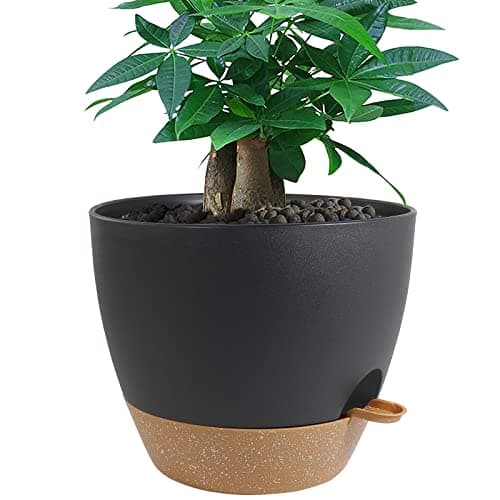 UOUZ 12 in Self Watering Pot, 60 oz reservoirThe only pot here that publishes its reservoir volume, which is the number that decides how long the plant survives without you. | Two weeks away from home | |
| 2 | 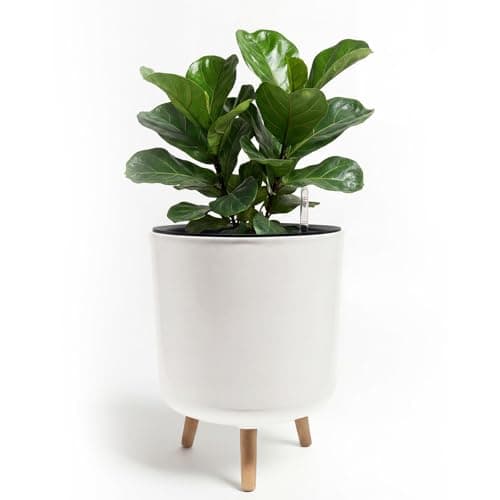 Bamworld 12 in Self Watering Pot with Water Level Indicator and StandA float gauge, which converts a self-watering pot from a thing you hope is working into a thing you can check in one glance. | Knowing when the reservoir is empty | $69.99 at Amazon $79.99 · 13% off |
| 3 | 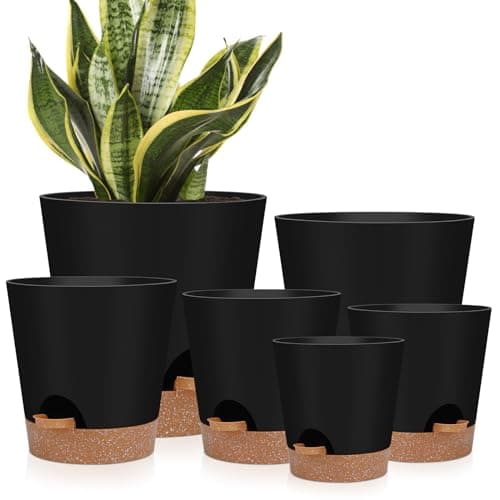 YNNICO Self Watering Planters with Drainage and Saucers, 6 potsSelf-watering pots that also have drainage holes, which sounds contradictory and is the detail that makes them survivable for a normal waterer. | A whole shelf on the same watering system | $19.79 at Amazon $21.99 · 10% off |
| 4 | 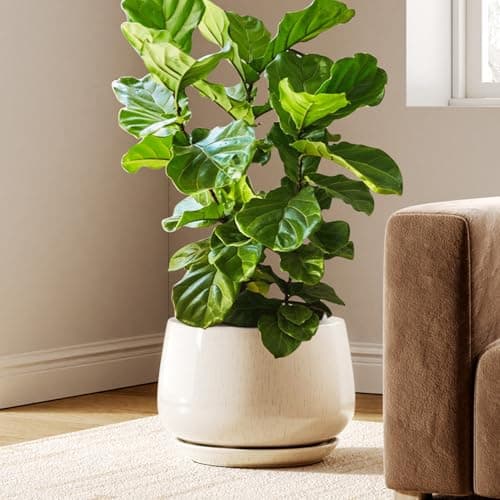 LE TAUCI 12 in Ceramic Planter with Drainage and SaucerA 12-inch glazed pot with a hole and a saucer, which is the size where the weight conversation starts and most people have not had it. | A floor plant in something that is not plastic | $84.99 at Amazon $89.99 · 6% off |
| 5 | 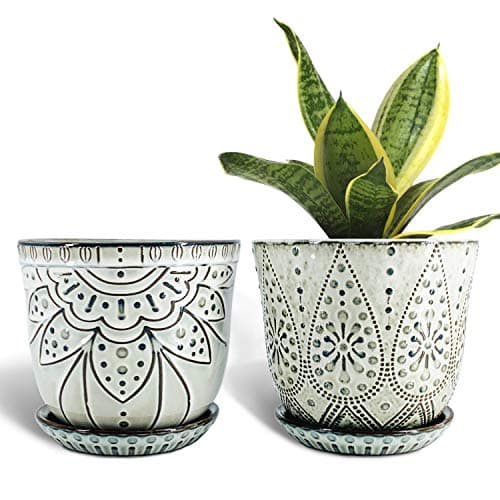 Gepege 6 in Ceramic Plant Pots with Drainage and SaucersThe size most houseplants are sold in and the size most shelves are built for, with the hole that the decorative version of the same pot leaves out. | The default shelf pot | $19.49 at Amazon $24.99 · 22% off |
Links to Amazon are affiliate links. Prices and availability are Amazon's and change without notice.
How we ranked these for a peace lily
A published reservoir capacity first, because that is the figure the whole self-watering decision turns on and most listings omit it. The UOUZ pot leads on exactly that: 60 oz, stated, with drainage under the mesh. The Bamworld pot follows for its water level indicator, which is the feature that stops a reservoir being forgotten. The six-pot set is the pick for someone with several small peace lilies or a mixed shelf on one system. The two plain ceramic pots are for owners who water by hand and want the plant to look like it lives somewhere.
| Your plant | Pot | Why |
|---|---|---|
| Full plant, in a warm room, you travel for work | 12 in self-watering, 60 oz reservoir | Days of buffer; the drainage stops it drowning |
| Full plant, you forget rather than travel | 12 in self-watering with level indicator | The gauge is the reminder |
| Several small plants on one shelf | Six-pot self-watering set | One system, six pots, saucers included |
| Full plant, on show, watered by hand | 12 in ceramic with saucer | Drains, looks right, no reservoir to clean |
| Supermarket plant in a 4 in nursery pot | 6 in ceramic with saucer | One size up |
The wilt, and why it is not an emergency
A dry peace lily collapses completely, and the first time it happens it looks fatal. It is not: watered thoroughly, the plant stands back up within a few hours, and it will do this many times over its life. What it does not recover from is the opposite — a pot with no way for water to leave, in which the roots rot slowly and the leaves yellow from the base. The wilt is the plant's alarm; use it to set your rhythm rather than to justify a sealed pot.
What we deliberately do not recommend
Sealed self-watering pots with no overflow, in which the plant sits in water and rots regardless of how much it likes moisture. Terracotta on a sunny sill — unglazed clay dries a pot fastest of any material, which is the opposite of this plant's brief; the material comparison explains why. And any reservoir pot bought as a vacation system for two weeks: the arithmetic above says a 60 oz reservoir is days, not weeks, and the travel-watering page covers what to do instead.
Every pick, in full
We have not handled any of these. What follows is what each listing publishes, what that means once you put a watered pot on it, and who should buy something else.
1. Two weeks away from home
UOUZ 12 in Self Watering Pot, 60 oz reservoir
The only pot here that publishes its reservoir volume, which is the number that decides how long the plant survives without you.
#ad · Price as of October 26, 2026. How we are funded
- What the listing publishes
- 12 in; published 60 oz removable reservoir; multi-mesh drainage
- Against a 10-inch pot
- No weight rating is published for this product, so there is nothing to check. That counts against it here rather than being treated as neutral.
60 fluid ounces is about 3.9 lb of water, and it sits under the mix rather than in it. That is added weight the moment you fill it: a full 12-inch self-watering pot computes to roughly 29 lb against 25.5 lb for the same pot without a reservoir.
Reservoir volume is the specification that matters and almost nobody prints. Without it, self-watering is a shape rather than a duration.
A removable reservoir is what makes it cleanable. Fixed-reservoir pots grow things in the bottom that you cannot reach.
What is good
- Publishes the reservoir volume, which most competitors do not
- Removable reservoir can actually be cleaned
- Wicking beats a schedule for anyone who travels
What is not
- Adds about 4 lb of water weight to an already 25 lb pot
- Self-watering suits thirsty plants and drowns succulents
- Plastic at 12 inches flexes when carried full
Skip it if you are growing cacti, succulents or a snake plant. A permanently damp root zone is the specific way those plants die.
2. Knowing when the reservoir is empty
Bamworld 12 in Self Watering Pot with Water Level Indicator and Stand
A float gauge, which converts a self-watering pot from a thing you hope is working into a thing you can check in one glance.
- What the listing publishes
- 12 in with a water level indicator; supplied on a wooden stand
- Against a 10-inch pot
- No weight rating is published for this product, so there is nothing to check. That counts against it here rather than being treated as neutral.
The failure mode of a self-watering pot is silent: the reservoir empties, the wick dries out, and the plant is a week into drought before it shows. An indicator removes exactly that failure.
It ships on a stand, which puts the pot's roughly 25 lb of saturated mix plus its water on four small feet. That is a floor arrangement.
The reservoir volume is not published here, so how long a fill lasts is not something this listing lets you calculate.
What is good
- A level indicator removes the silent-failure mode
- Stand included
- 12 in fits most floor plants
What is not
- Reservoir volume is not published, so autonomy cannot be calculated
- Stand feet concentrate a heavy pot on four points
- Indicators stick if the reservoir gets grubby
Skip it if you want to know how many days a fill lasts. That needs a published reservoir volume, and this listing does not give one.
3. A whole shelf on the same watering system
YNNICO Self Watering Planters with Drainage and Saucers, 6 pots
Self-watering pots that also have drainage holes, which sounds contradictory and is the detail that makes them survivable for a normal waterer.
- What the listing publishes
- Six pots from 5 to 8 in, each with drainage holes and a saucer
- Against a 10-inch pot
- No weight rating is published for this product, so there is nothing to check. That counts against it here rather than being treated as neutral.
Most self-watering pots have no drainage hole, so an overfill has nowhere to go and the roots sit in it. Holes plus a reservoir means the system tolerates being watered from the top by mistake.
Six pots from 5 to 8 inches computes to between 1.8 and 7.5 lb of saturated mix each. Even fully loaded that is a shelf-safe set.
Matching a whole shelf to one watering method is worth more than it sounds. Mixed systems are how half a shelf gets overwatered.
What is good
- Drainage holes and reservoirs together
- Six graduated sizes
- Light enough for any stand here
What is not
- Small reservoirs mean days, not weeks
- Plastic
- Six near-identical pots is a commitment to one look
Skip it if you wanted a fortnight of autonomy. Small reservoirs in 5 to 8 inch pots buy days, and the 12-inch with a published 60 oz reservoir is the pot for a vacation.
4. A floor plant in something that is not plastic
LE TAUCI 12 in Ceramic Planter with Drainage and Saucer
A 12-inch glazed pot with a hole and a saucer, which is the size where the weight conversation starts and most people have not had it.
- What the listing publishes
- 12 in ceramic, drainage hole and saucer included
- Against a 10-inch pot
- No weight rating is published for this product, so there is nothing to check. That counts against it here rather than being treated as neutral.
12 inches of saturated mix computes to about 25.5 lb before the pot itself, and a glazed ceramic pot this size is not light empty. This is a floor pot, not a shelf pot, and putting it on an unrated tiered stand is the mistake this site is built around.
It is also the size at which you stop moving the plant. A rated caddy underneath is the difference between cleaning behind it twice a year and never.
The saucer is included, which at 12 inches is worth real money. Large saucers are priced oddly high when bought alone.
What is good
- Drainage hole and saucer at a size where both are usually extra
- Glazed, so it does not sweat onto the floor
- Heavy enough not to be knocked over
What is not
- About 25.5 lb of saturated mix before the pot's own weight, so floor only
- Ceramic at this size is genuinely fragile in a move
- Slow-drying for plants that want to dry out
Skip it if you were planning to put it on a tiered stand. None of the tiered stands here publish a weight rating, and this is the pot that finds out.
5. The default shelf pot
Gepege 6 in Ceramic Plant Pots with Drainage and Saucers
The size most houseplants are sold in and the size most shelves are built for, with the hole that the decorative version of the same pot leaves out.
- What the listing publishes
- 6 in ceramic with drainage hole and saucer
- Against a 10-inch pot
- No weight rating is published for this product, so there is nothing to check. That counts against it here rather than being treated as neutral.
A 6-inch pot of saturated mix computes to about 3.2 lb. Any stand on this site holds it, which is why 6 inches is where you can buy on looks rather than on arithmetic.
It is also the size where the no-drainage-hole trap is most common, because 6-inch pots are sold as decor as often as they are sold as pots.
Nursery plants usually arrive in a plastic 6-inch. Dropping that pot straight into a ceramic cachepot is a legitimate alternative to repotting, as long as you lift it to water.
What is good
- The correct default size for most houseplants
- Hole and saucer included
- Light enough for any shelf here
What is not
- Outgrown within a year by anything vigorous
- Glazed ceramic holds moisture longer than plastic
- One pot per order at this price point
Skip it if your plant came in a 6-inch nursery pot and is root-bound. You need the next size up, not the same size in ceramic.
Questions people actually ask
Are self-watering pots good for peace lilies?
What size pot does a peace lily need?
Does a peace lily need a drainage hole?
How long will a self-watering pot keep a peace lily going?
Should a peace lily be in terracotta?
Why does my peace lily wilt so dramatically?
Sources
- Cornell University, Greenhouse Management: bulk density of greenhouse media components
- Biology Insights: how much a cubic foot of potting soil weighs, dry and saturated
- Clemson HGIC: Indoor Plants — cleaning, fertilizing, containers and light requirements
- Clemson HGIC: Indoor Plants — watering
- University of Georgia Extension B1318: Growing Indoor Plants with Success
Product specifications are quoted from each seller's own listing and are the seller's claim, not a measurement of ours.