Hanging
Plant Shelf Ideas for a Rented Apartment
Nine arrangements, sorted by what each one asks of the building — because most shelf inspiration assumes you are allowed to drill.
By Scooter M., enthusiast · Published
The short answer
Start with the arrangements that need no fixings — a window tension rod, a floor-to-ceiling pole, a leaning shelf — because they cost nothing to undo and they usually sit in better light than an interior wall. Add wall-mounted shelves only where you can drill, keep them near a window, and size the pots to 4 to 6 inches.
Disclosure Pot & Prop earns a commission when you buy through the Amazon links on this page, at no extra cost to you. It does not change which products get recommended or what we say about them, and we have not been given any of them. How this site is funded.
Search for plant shelf ideas and you get photographs of walls full of shelves, in apartments whose owners were clearly allowed to put fifty holes in the plasterboard. That is a real constraint for most people renting, and it is the axis this page is organized around: what each arrangement asks of the building, and what you get for it.
The other thing those photographs leave out is light. A shelf on an interior wall is a dim position, and a plant on it declines slowly for a year before anyone connects the two. Every idea below is rated on the light it realistically gets, because that decides which plants can live there — or whether the arrangement needs a light of its own.
The nine, sorted by what they cost the building
| Idea | Fixings | Plants | Light |
|---|---|---|---|
| Window tension rod across a reveal | None | 3 to 5 hanging | The best in the apartment |
| Floor-to-ceiling tension pole | None | 6 to 8 | Wherever you put it |
| Leaning ladder shelf against a wall | None | 6 to 8 | Depends on the wall |
| Suction shelf on the glass | None | 2 to 3 small | Excellent, but small pots only |
| Tiered riser on an existing windowsill | None | 4 to 6 small | Excellent |
| Over-door rack | None | 2 to 3 hanging | Usually poor — check first |
| Floating shelves beside a window | Screws | 1 to 2 per shelf | Good if within a few feet of glass |
| A gallery wall of small L-shelves | Screws, many | 1 small each | Poor on an interior wall |
| Lit shelf on a bookcase you own | None, if clip-mounted | 4 to 12 | Whatever you provide |
The three that renters should try first
A window tension rod is the highest-value shelf idea in a rented apartment and almost nobody does it. It presses between the two sides of a window reveal, holds three to five hanging pots in the brightest position in the building, carries far more than a suction cup on the same glass, and comes out in seconds leaving nothing. The only requirement is a recess — a flush window gives it nothing to push against.
A floor-to-ceiling pole spends almost no floor: six to eight positions on a little over a square foot, no fixings, and it works in the middle of a room where nothing else does. It needs a solid ceiling rather than a suspended tile grid, and it needs re-tensioning after the first week as the carpet compresses. The poles are here.
A tiered riser on the windowsill you already have costs the least of anything on this page and converts one row of pots into two or three, in light you are already paying rent for. It works on sills too shallow for anything else, and it needs nothing from the building at all.
Quick picks
Ranked, with the published figure each pick turns on. Tap a row for the full reasoning further down this page.
| # | Product | Best for | Price |
|---|---|---|---|
| 1 | 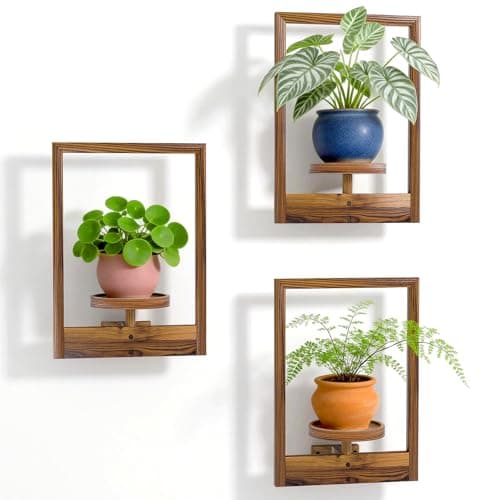 Wood Wall Plant Shelf, 16.5 by 11.8 in, 22 lb, set of 3Publishes a weight rating and a maximum pot base in the same listing, which almost nothing in this category does, and both numbers check out against a 6-inch pot. | The only wall shelf here that publishes both a rating and a pot size | $29.99 at Amazon $36.99 · 19% off |
| 2 | 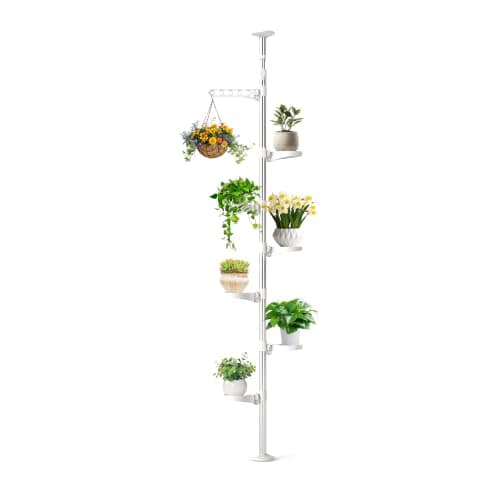 BAOYOUNI Plant Stand, 7-tier tension pole with 6 trays and a hook, 7.5 to 9.5 ftSix tray positions plus a hook in a little over a square foot of floor, held up by pressure between your floor and your ceiling rather than by a base. | A vertical plant column with no fixings at all | |
| 3 | 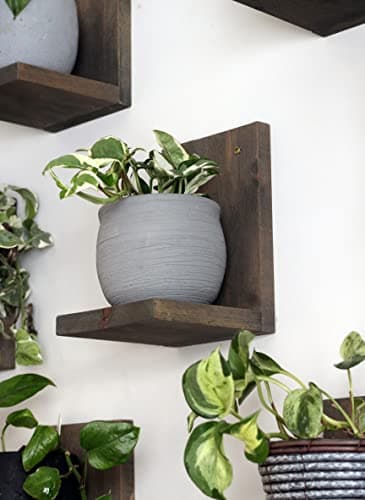 Daniel's Plants L Shaped Floating Plant Shelf, solid wood, 3 packSized honestly for the pots people actually put on wall shelves, and sold in threes because one of these on a wall looks like a mistake. | A gallery wall of small pots |
Links to Amazon are affiliate links. Prices and availability are Amazon's and change without notice.
If you can drill, do it near the window
Wall-mounted shelves are the arrangement everyone pictures, and they are worth doing — with two constraints that the inspiration photographs ignore. Put them within a few feet of a window, because an interior wall is a dim position no shelf design can fix. And size the pots to what the shelf publishes, which is usually 4 to 6 inches.
Buy shelves in threes at staggered heights rather than one at a time. It spreads the load across three sets of fixings, it suits how plants grow — trailing at the top, upright at the bottom — and a single small shelf on a large wall reads as an afterthought. The wall shelf roundup covers what to look for.
| Pot size | Mix volume | Dry | Watered | Rating needed |
|---|---|---|---|---|
| 4 in | 0.017 cu ft | 0.4 lb | 0.9 lb | 2 lb |
| 5 in | 0.034 cu ft | 0.7 lb | 1.8 lb | 3 lb |
| 6 in | 0.058 cu ft | 1.3 lb | 3.2 lb | 5 lb |
| 8 in | 0.137 cu ft | 3 lb | 7.5 lb | 12 lb |
The mistakes that make a plant shelf fail
- Putting it on an interior wall. The most common and the slowest to reveal itself. If there is no sightline to a window, the shelf needs a light or it needs genuinely low-light plants.
- Pots at the front edge. On a cantilever shelf the load pulls the top fixing outward, and the further forward the pot sits the harder it pulls. Heavy pots go toward the wall.
- Skipping the anchors. A screw straight into plasterboard holds a shelf for about as long as it takes to walk away.
- Forgetting the saucer. A shelf above eye level with an unsaucered pot on it waters whatever is below it. Saucers and pot feet are the companion purchase — they are covered here.
- Over a bed, a sofa or a desk. The same rule this site applies to hanging plants, and for the same reason.
- Buying one shelf. It looks unfinished and it gets overloaded because everything has to go on it.
Where each idea leads
If the answer is no fixings at all, start with renter-friendly plant shelves for the freestanding options and window plant shelves for the glass. If you can drill, wall plant shelves has the two specifications that matter. And if the position you want has no daylight, the shelf is not the problem and a lit shelf is the answer.
Every pick, in full
We have not handled any of these. What follows is what each listing publishes, what that means once you put a watered pot on it, and who should buy something else.
1. The only wall shelf here that publishes both a rating and a pot size
Wood Wall Plant Shelf, 16.5 by 11.8 in, 22 lb, set of 3
Publishes a weight rating and a maximum pot base in the same listing, which almost nothing in this category does, and both numbers check out against a 6-inch pot.
- What the listing publishes
- Published 22 lb per shelf; 16.5 by 11.8 in; fits planters with bases up to 6.1 in; set of 3
- Against a 10-inch pot
- Rated 22 lb against 14.7 lb of saturated mix in a 10-inch pot. That is only 1.5x, inside the rating but short of the 1.5x margin once you add the pot and the plant.
A 6-inch pot computes to 3.2 lb of saturated mix, so a published 22 lb shelf is carrying its stated pot size at nearly seven times the load — a margin nothing else on this page comes close to. The 6.1-inch base limit is the real constraint, not the weight.
Publishing the pot base width rather than just the shelf width is the detail that matters. A shelf can be 11.8 inches deep and still not take your pot if the frame's lip is in the way, and this listing tells you where the limit is.
It mounts with screws. There is no adhesive version of a loaded cantilever shelf, and no adhesive product publishes a rating for one.
What is good
- Published 22 lb per shelf, and a published pot base limit
- Three shelves in the set, so a wall becomes a group rather than one shelf
- Wood with a stated waterproof coat, which matters under a watered pot
What is not
- Screws and anchors only — not an option in a no-fixings tenancy
- 6.1 in pot base is a real ceiling; a 8-inch pot will not sit in it
- A front lip means taller pots have to clear it
Skip it if you cannot drill. A freestanding shelf with a clip-on light does the same job and leaves the wall alone.
2. A vertical plant column with no fixings at all
BAOYOUNI Plant Stand, 7-tier tension pole with 6 trays and a hook, 7.5 to 9.5 ft
Six tray positions plus a hook in a little over a square foot of floor, held up by pressure between your floor and your ceiling rather than by a base.
#ad · Price as of October 21, 2026. How we are funded
- What the listing publishes
- Published six trays plus a hook; 7 ft 6 in to 9 ft 6 in adjustable height; 13.2 in hanger span; trays and hook both rotate 360 degrees and adjust for height; stainless steel composite pipe; no published weight rating
- Against a 10-inch pot
- No weight rating is published for this product, so there is nothing to check. That counts against it here rather than being treated as neutral.
Six positions across the published 13.2-inch span is about 5.1 plants per square foot, well clear of the 3 that the best tiered corner frame here manages — and it gets there without a base, which is the floor a freestanding stand spends just to stay upright.
A tension pole loads your ceiling in compression rather than tension, so it does not care whether there is a joist above it. It does care whether your ceiling is solid, and a suspended or lath ceiling is not the surface for this. The published range starts at 7 ft 6 in, so check it against a standard 8-foot ceiling before buying.
No published weight rating, and again that is honest for a tension product. Keep the pots small and symmetrical, because an asymmetric load is what makes a pole walk out of position.
What is good
- Six tray positions plus a hook, so potted and trailing plants share one pole
- No fixings, so no deposit risk
- Trays and hook both rotate 360 degrees and set their own height
What is not
- No published weight rating
- Needs a solid ceiling, not suspended and not lath
- Asymmetric loading makes the pole drift
Skip it if your ceiling is a suspended grid or an artexed lath ceiling. A tension pole needs something firm to push against and neither of those is.
3. A gallery wall of small pots
Daniel's Plants L Shaped Floating Plant Shelf, solid wood, 3 pack
Sized honestly for the pots people actually put on wall shelves, and sold in threes because one of these on a wall looks like a mistake.
#ad · Price as of October 21, 2026. How we are funded
- What the listing publishes
- Published 8.25 in tall by 5.5 in wide with 5.5 in of usable shelf; designed for 4 to 6 in pots; solid pine; 3 pack; a 30 lb maximum weight capacity in the listing's attributes, with no stated basis
- Against a 10-inch pot
- No weight rating is published for this product, so there is nothing to check. That counts against it here rather than being treated as neutral.
The listing publishes the usable shelf depth rather than only the outer dimension, which is the number that tells you whether your pot fits. 5.5 inches of usable space and a stated 4 to 6 inch pot range is a specific, checkable claim.
Three shelves is the right unit for this product. A single small L-bracket shelf reads as an afterthought; three at staggered heights reads as intentional, which is the whole reason to put plants on a wall.
A 30 lb maximum weight capacity appears in the listing's attributes, but nowhere does it say whether that is per shelf or for the set of three — and on a cantilever that is the difference that matters. Treat it as a figure without a basis rather than as a rating. At the 4 to 6 inch pot sizes the shelf is sold for, the load is 0.9 to 3.2 lb of saturated mix each, which is modest either way.
What is good
- Publishes usable shelf depth, not just outer size
- Honest 4 to 6 inch pot range
- Solid pine, pre-drilled, anchors included
What is not
- Its 30 lb capacity is an attribute with no stated basis, per shelf or per set
- Small — genuinely will not take an 8-inch pot
- Screws required
Skip it if your plants are in anything larger than a 6-inch pot. This is a small-pot product and it says so.
Questions people actually ask
How can I put up plant shelves without drilling?
Where should plant shelves go in a small apartment?
What size pots fit on a plant shelf?
How many plant shelves should I put on a wall?
Do plant shelves need saucers?
Sources
- Cornell University, Greenhouse Management: bulk density of greenhouse media components
- Biology Insights: how much a cubic foot of potting soil weighs, dry and saturated
- University of Illinois Extension: Houseplants — lighting
- Clemson HGIC: Indoor Plants — cleaning, fertilizing, containers and light requirements
Product specifications are quoted from each seller's own listing and are the seller's claim, not a measurement of ours.