Planters
Bottom Watering or Top Watering?
Bottom watering as the routine, top watering to flush. Doing only one of them is how a well-cared-for collection quietly accumulates a problem.
By Scooter M., enthusiast · Published
The short answer
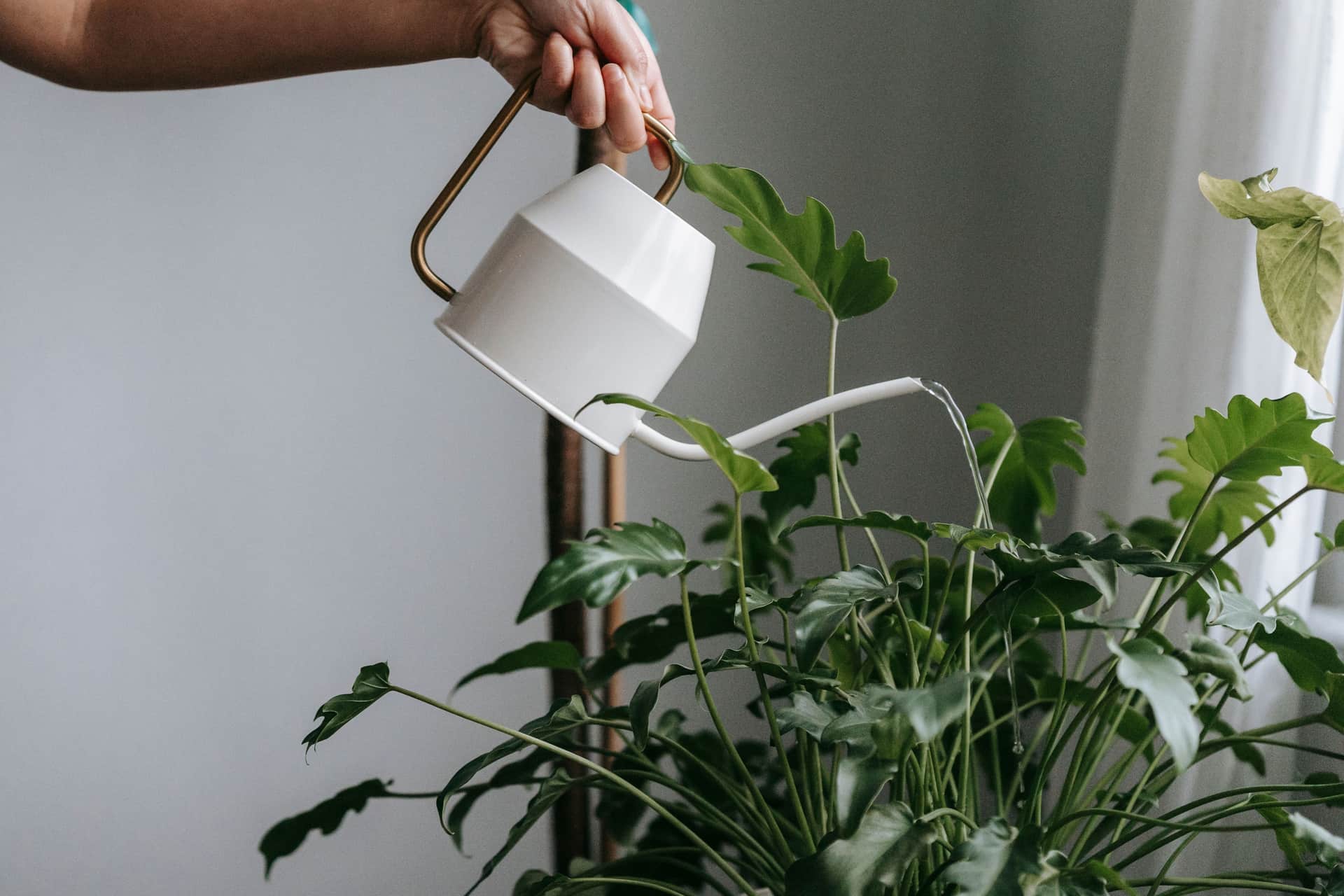
Bottom water as your routine and top water every fourth or fifth time to flush. Bottom watering — standing the pot in a few inches of water until the surface goes damp, then taking it out — is the better default for most apartment pots: it cannot wet the crown, it stops when the mix is saturated, and it is much harder to overwater with, which matters because Clemson calls overwatering the main cause of death of potted plants. The catch is that it never produces runoff, and runoff is what washes accumulated fertiliser salts out of the mix. So neither method wins. What makes bottom watering actually work is the vessel: a standard saucer holds about a quarter inch of water, and a dry 10-inch pot will drink roughly four liters, so a deep tray rather than a saucer is the real purchase here.
Disclosure Pot & Prop earns a commission when you buy through the Amazon links on this page, at no extra cost to you. It does not change which products get recommended or what we say about them, and we have not been given any of them. How this site is funded.
Bottom watering has become the thing confident plant people do, and top watering the thing beginners do. That framing is wrong in a specific and fixable way: both methods appear in extension guidance, both are endorsed, and each one does something the other cannot. The useful question is not which to adopt but which to use as the routine and which to use as the correction.
What the two methods actually are
Worth stating precisely, because "bottom watering" gets used for three different things and only one of them is the method extension services describe.
| What people call it | What actually happens | Is it this page? |
|---|---|---|
| Bottom watering | You stand the pot in water, the mix wicks it up, you take the pot out | Yes |
| Self-watering pot | A reservoir built into the pot feeds it continuously | No — that comparison is here |
| Leaving it in a full saucer | The pot sits in water indefinitely | No — this is the failure mode, not the method |
The difference between the first and the third is one instruction, and Illinois Extension states it plainly: place the pot in a few inches of water in a sink or a saucer, then remove the pot when the moisture has wicked upward through the soil and is evident at the top. The same page says, separately and unambiguously, not to allow the pot to sit in a saucer of water. Bottom watering is a thing you finish.
What each method is genuinely better at
| Bottom watering | Top watering | |
|---|---|---|
| Wets the whole root ball | Yes, by capillary action from below | Yes, if you water to runoff |
| Flushes accumulated salts | No — there is no runoff | Yes, Clemson: runoff "washes out the excess salts" |
| Keeps water off the crown and leaves | Yes | Only with care and a long spout |
| Can you overwater with it | Much harder — it stops at saturation | Easily, and it is the commonest cause of death |
| Disturbs the surface of the mix | No | Yes, which matters for fine seed and top-dressing |
| Discourages fungus gnats | Keeps the top layer drier for longer | Wets the top layer every time |
| Works on a pot with no drainage hole | No | No — nothing does |
| Time per pot | Minutes of waiting, no attention | Seconds of attention |
Two rows there decide the verdict. Clemson describes watering to runoff as what ensures the bottom two-thirds of the pot gets water and as what washes out excess salts, and warns that if the salt level in the container is high, root damage may occur. Bottom watering produces no runoff by definition, so it cannot do that job however carefully you do it.
And the other row: Clemson states that the main cause of death of potted plants is over-watering. Bottom watering is structurally resistant to that failure, because mix stops wicking once it is saturated — you cannot push a fifth liter into a pot that has taken four. That is a real advantage and it is why the method deserves its reputation.
The vessel is the part nobody checks
Here is why bottom watering has a reputation for being slow and fiddly, and it has nothing to do with the method. Illinois Extension says to stand the pot in a few inches of water. A plant saucer, filled to the brim, is about a quarter of an inch deep. People try the method in a saucer, refill it four times, and conclude the method is tedious.
The water a pot will take is calculable, and this site has already published the derivation on the travel-watering page. Potting mix at the planning densities used here weighs about 22 lb per cubic foot dry and about 55 lb saturated; the 33 lb per cubic foot difference is the water the mix absorbs, and dividing by the density of water turns it into a volume.
volume of water = pot mix volume x (55 - 22) lb/ft^3 / 62.4 lb/ft^3
a 6-inch pot: 0.058 ft^3 x 33 / 62.4 = 0.031 ft^3, about 0.87 liters. A 10-inch pot: 0.268 ft^3 x 33 / 62.4 = 0.142 ft^3, about 4.0 liters.
Mix volume comes from the frustum model on /how-we-pick, which is reproducible from the diameter on any listing. The densities are the published planning figures this whole site uses. Nothing here is measured by us.
| Vessel | Water it holds | Fraction of one 10-inch watering |
|---|---|---|
| Standard saucer, filled to the brim | about 0.3 liters | under a tenth |
| Extra-deep 10-inch saucer, 1 inch of water | about 1.3 liters | about a third |
| Rectangular tray 17.5 by 10.6 in, 1.5 inches | about 4.6 liters | more than one — or five 6-inch pots at once |
| Kitchen sink, 3 inches of water | far more than needed | the free option, for one pot at a time |
| Bath, 3 inches of water | far more than needed | the only realistic option for floor pots |
Which reframes the shopping list completely. The thing to buy for bottom watering is not a special pot — it is a basin with some depth, and ideally one wide enough to take several pots so the method becomes one operation rather than six. Everything below follows from that.
The pot still has to have holes, and more of them helps
Capillary action needs an entry point. A pot with one small central hole will bottom water, slowly; a pot with a ring of holes around the base will do it in a fraction of the time, because water enters across the whole footprint rather than wicking sideways from a single point.
This is the one place where bottom watering genuinely argues for different pots, and it is also an argument for keeping plants in their plastic nursery pots inside a decorative outer — which this site already recommends for other reasons on the cachepot page. A nursery pot is a mesh of holes. A heavy glazed pot with one hole is the slowest possible vessel for this method.
- Clear nursery pots are the best of both, because you can see the waterline rise and the roots at the same time, which removes the guesswork about when to lift the pot out.
- No hole, no method. A pot with no drainage hole cannot be bottom watered, and it cannot really be top watered either — the drainage argument is here.
- Let it drain before it goes back. Clemson's instruction for the method is to remove the pot and let it drain completely. A pot returned to a dry saucer while still dripping has just created the standing water the guidance warns about.
- Room temperature water only. Illinois Extension says not to use cold water, and Clemson gives a range of 62 to 72 degrees F. A basin filled from the cold tap and left twenty minutes is in range.
- Do not water softened water through either method. Clemson is explicit: softened water adds sodium and chloride, which is the opposite of flushing salts out.
How to tell when to water at all
Neither method helps if the timing is wrong, and both extension sources make the same point about schedules. Illinois Extension: water your plants when they need it and not according to the calendar. Clemson: the rule of thumb is to water when necessary, and the symptoms of over-watering and underwatering are similar, so wilting is not a reliable signal — a plant with rotted roots wilts in wet mix, and watering it then makes things worse.
The tests both sources describe are free: a finger into the mix to about two inches, the weight of the pot in your hand, and the sound of the pot when you tap it — dull is moist, hollow wants water. If you would rather read a number, the soil moisture meters are here, with Illinois Extension's own caveat that a probe can be useful but is not always reliable.
Quick picks
Ranked, with the published figure each pick turns on. Tap a row for the full reasoning further down this page.
| # | Product | Best for | Price |
|---|---|---|---|
| 1 | 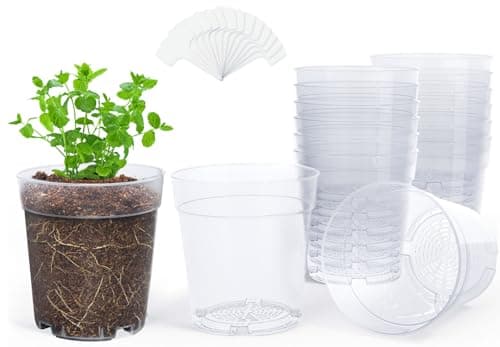 homenote 6.7 in Clear Plastic Nursery Pots with Drainage, 15 packClear walls, which turn the one variable you cannot otherwise check, what the roots are doing, into something you can just look at. | Watching roots instead of guessing | |
| 2 | 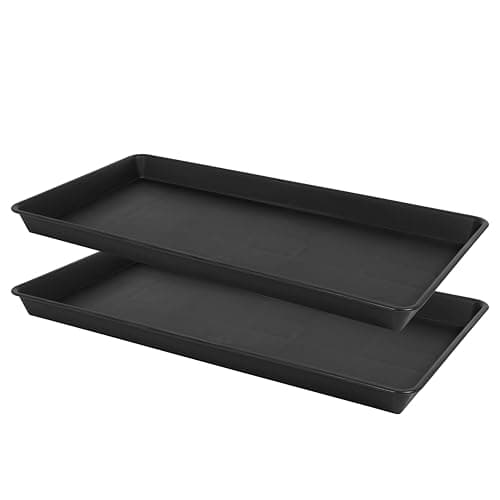 VUWEZ Rectangular Plant Tray, 17.5 by 10.6 in, no holes, 2 packOne basin, several pots, one filling — the version of bottom watering that actually survives contact with a plant collection. | Bottom watering a whole shelf in one pass | |
| 3 | 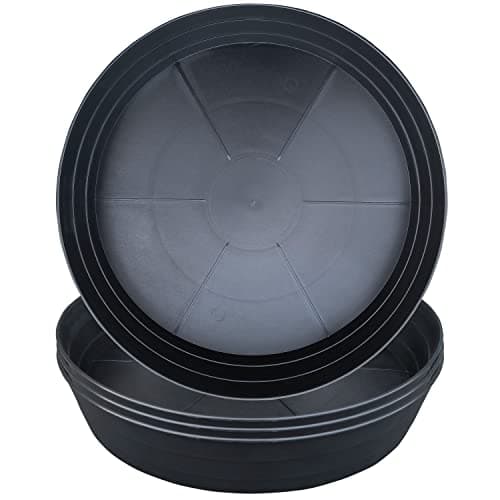 Extra-Deep Plant Saucers, 10 in, 4 packDeep enough to hold a meaningful fraction of one watering, which an ordinary saucer is not. | Bottom watering one pot at a time | |
| 4 | 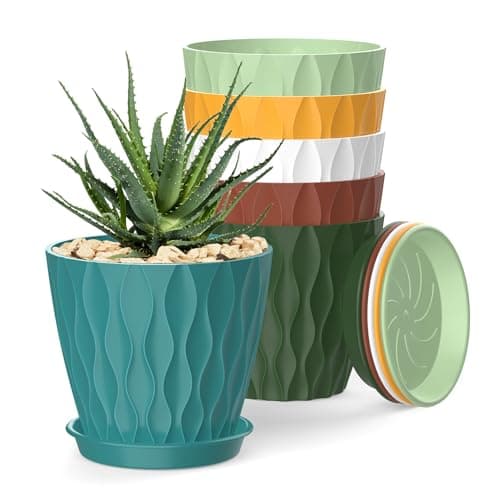 SQKH 4 in Plant Pots with Drainage Holes and attached trays, 6 packSmall, cheap and full of holes, which is all bottom watering asks of a pot — and bottom watering is one of the three methods extension guidance lists for violets. | Bottom-watering a collection for very little | |
| 5 | 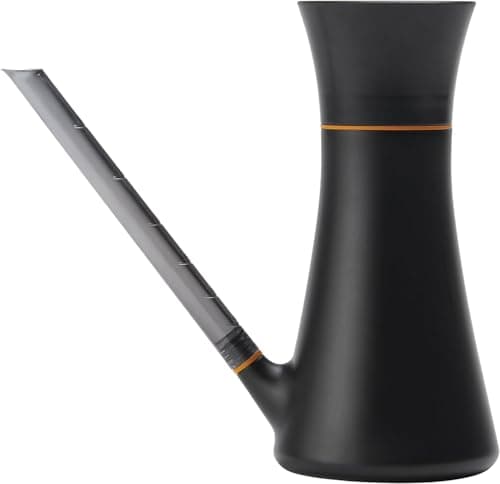 Fiskars Indoor Watering Can, 40 oz, long reach spoutMeasurement markings turn a watering can into an instrument, which on a site that computes how much water a pot actually takes is the difference between pouring and dosing. | The only can here with volume markings on it | |
| 6 | 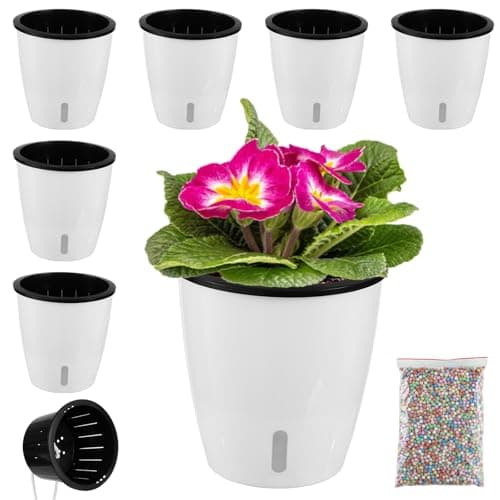 Planterhoma 5 in Self Watering Wick Pots with Drainage Holes and water-level indicator, 6 packDrainage holes and a wick in the same pot, which is exactly the combination extension guidance describes, sold in a six-pack at a price that makes one per violet realistic. | The design that matches both halves of the extension advice |
Links to Amazon are affiliate links. Prices and availability are Amazon's and change without notice.
How we ranked these
By how much of the method each product actually solves. The clear nursery pots lead because they fix the pot side — a mesh of holes to admit water and a transparent wall to show you when to stop — and because they are the cheapest change on this page. The rectangular tray is second because the vessel is the real bottleneck and it is the only one here that takes several pots in one filling. The extra-deep saucers are third for the same reason at one pot per saucer, which suits a shelf of larger pots. The 4-inch pots with attached trays are fourth as the small-pot version of the whole system in one purchase, which is why they already lead this site's African violet page. The long-spout can is fifth and is not an afterthought: top watering to runoff is half the verdict, and a 40 oz can with reach is what does that without wetting the crown. The wick pots are last as a third way for anyone whose actual problem is being away rather than being inconsistent.
What we deliberately do not recommend
Bottom watering exclusively and indefinitely, which is the specific advice this page exists to correct — no runoff means no leaching, and the salts accumulate. Leaving a pot standing in water because it was still drinking, which both sources warn against. Trying either method on a pot with no drainage hole. Bottom watering a plant whose published guidance is to keep water off the crown and then standing it in a basin for an hour unattended. Using a saucer as a bottom-watering basin and concluding the method is slow. And switching methods to solve a problem that was a light problem — a light meter settles that in one reading.
Every pick, in full
We have not handled any of these. What follows is what each listing publishes, what that means once you put a watered pot on it, and who should buy something else.
1. Watching roots instead of guessing
homenote 6.7 in Clear Plastic Nursery Pots with Drainage, 15 pack
Clear walls, which turn the one variable you cannot otherwise check, what the roots are doing, into something you can just look at.
#ad · Price as of October 18, 2026. How we are funded
- What the listing publishes
- 6.7 in clear plastic with drainage holes, 15 per pack
- Against a 10-inch pot
- No weight rating is published for this product, so there is nothing to check. That counts against it here rather than being treated as neutral.
The reason to use a clear nursery pot inside an opaque cachepot is diagnostic: you can see root growth, you can see when water has actually reached the bottom, and you can see rot before the leaves tell you.
Fifteen pots is a whole shelf and a propagation run's worth of potting-up, at a per-pot price no ceramic reaches.
They are not attractive. They are meant to sit inside something else, which is also the arrangement that keeps a decorative pot with no drainage hole from killing a plant.
What is good
- Root visibility that no other pot format gives you
- Fifteen pots at nursery pricing
- The correct inner pot for a decorative cachepot with no hole
What is not
- Ugly on their own
- Algae grows on the inside of a clear pot in a bright window
- Thin plastic flexes when you lift a wet one
Skip it if you want the pot to be the visible object. These are working pots and they look it.
2. Bottom watering a whole shelf in one pass
VUWEZ Rectangular Plant Tray, 17.5 by 10.6 in, no holes, 2 pack
One basin, several pots, one filling — the version of bottom watering that actually survives contact with a plant collection.
#ad · Price as of October 18, 2026. How we are funded
- What the listing publishes
- Published 17.5 by 10.6 in; solid, no drainage holes; 2 pack
- Against a 10-inch pot
- No weight rating is published for this product, so there is nothing to check. That counts against it here rather than being treated as neutral.
The practical objection to bottom watering is that it is a per-pot ritual. A tray this size takes four 4-inch pots or two 6-inch pots at once, which turns the ritual into a single operation you do while the kettle boils.
Filled to an inch and a half, the published footprint holds roughly four and a half liters — which is more than one full watering for anything that fits in it, and the reason this is the vessel that makes the method stick.
Solid-bottomed, which is the specification to check: the same listings are frequently sold as seed trays with drainage, and a basin with holes in it is not a basin.
What is good
- Holds several pots, so bottom watering becomes one task rather than six
- Published footprint and solid construction, both stated on the listing
- Doubles as a drip tray under a shelf the rest of the time
What is not
- Too shallow for a large floor pot, which still needs a sink or a bucket
- Rectangular, so it wastes space under round pots
- Nothing in the listing publishes the depth, which is the figure that decides the refill count
Skip it if your plants are mostly large floor pots. Those go in the bath or a bucket, and a tray will not hold a tenth of what a 14-inch pot drinks.
3. Bottom watering one pot at a time
Extra-Deep Plant Saucers, 10 in, 4 pack
Deep enough to hold a meaningful fraction of one watering, which an ordinary saucer is not.
#ad · Price as of October 18, 2026. How we are funded
- What the listing publishes
- Published 10 in diameter, extra-deep profile, no holes; sold in a 4 pack, other sizes listed to 25 in
- Against a 10-inch pot
- No weight rating is published for this product, so there is nothing to check. That counts against it here rather than being treated as neutral.
The reason bottom watering has a reputation for being slow is almost always the vessel. Illinois Extension's instruction is to stand the pot in a few inches of water — and a standard saucer, filled to the brim, is about a quarter of an inch deep.
Depth converts directly into refills avoided. The arithmetic is on the bottom-watering page: a dry 10-inch pot will take about four liters to reach saturation, and an inch of water in a 10-inch saucer is roughly a third of that.
No holes, which on a saucer is the correct specification and worth checking anyway — several listings in this category are nursery trays with drainage, which are the wrong product for this job.
What is good
- Deep profile holds a useful fraction of one watering, so fewer refills
- Published no-hole construction, which is what a bottom-watering basin needs
- Four of them, so a whole shelf can be watered in one pass
What is not
- Only fits one pot each, so a collection means a stack of saucers
- Deep saucers are easy to leave full, and a pot left standing in water is the failure mode
- Plastic, and the listing publishes no thickness
Skip it if you want to water several pots at once. A single rectangular tray takes four small pots and one filling.
4. Bottom-watering a collection for very little
SQKH 4 in Plant Pots with Drainage Holes and attached trays, 6 pack
Small, cheap and full of holes, which is all bottom watering asks of a pot — and bottom watering is one of the three methods extension guidance lists for violets.
#ad · Price as of October 18, 2026. How we are funded
- What the listing publishes
- Published 4 in pots, 3.7 in tall, 6 per pack; 48 drainage holes in each base; attached drip tray; extra-thick polypropylene
- Against a 10-inch pot
- No weight rating is published for this product, so there is nothing to check. That counts against it here rather than being treated as neutral.
University of Minnesota Extension describes setting a violet's pot in a bowl of room-temperature water about an inch deep until the surface of the mix feels moist, then lifting it out to drain. That method needs a pot that draws water in quickly and lets it out again, and 48 holes in a 4-inch base does both.
Four inches is small on purpose. Violets have fine roots, and the extension page stresses well-drained mix and never letting the plant sit wet. A small pot dries through; a large one around a small root ball holds wet mix the roots cannot reach.
The attached tray catches drips on the windowsill, but it is shallow and it is not a reservoir. Empty it after watering — a violet left standing in its own runoff is the condition every source on this plant warns against.
What is good
- 48 drainage holes per pot, which suits bottom watering
- Six pots for about the price of one ceramic violet pot
- Attached tray, so nothing to lose or mismatch
What is not
- Plastic in bright colors, which will not suit every room
- The tray is shallow and must be emptied, not left full
- At 4 in, a large standard violet will outgrow it
Skip it if you want a pot you only fill every week or two. These need watering by hand, and the wick pots on this page are the low-attention option.
5. The only can here with volume markings on it
Fiskars Indoor Watering Can, 40 oz, long reach spout
Measurement markings turn a watering can into an instrument, which on a site that computes how much water a pot actually takes is the difference between pouring and dosing.
#ad · Price as of October 18, 2026. How we are funded
- What the listing publishes
- Published 40 oz (1.2 L) capacity; long slender spout; translucent nozzle with volume measurement markings and an anti-drip tip; body stated to be 30 percent post-consumer recycled plastic; 12.1 in tall, 0.35 lb empty; lifetime warranty stated
- Against a 10-inch pot
- No weight rating is published for this product, so there is nothing to check. That counts against it here rather than being treated as neutral.
Every other can here tells you its total capacity and nothing else. This one has volume markings up the translucent nozzle, so you can pour a known amount rather than a confident glug. That matters because the water a pot takes between dry and saturated is a computable figure — roughly 870 ml for a 6-inch pot — and a marked can is how you act on it.
1.2 liters is a sensible size for a shelf collection and a poor one for a floor plant. A 10-inch pot takes around 4 liters for a full soak, so a big plant is three or four trips to the tap. Know which of those you are before buying on looks.
The anti-drip tip is the feature you notice on the way back to the sink rather than at the plant. A can that dribbles across the floor between pots is the usual reason people stop using one.
What is good
- Publishes capacity and puts measurement markings on the nozzle
- Long slender spout reaches under foliage without wetting leaves
- Lifetime warranty stated, and 30 percent recycled body
What is not
- 1.2 L means several refills for any pot 10 inches or larger
- Plastic, on a shelf where a metal can would look better
- The spout must be clicked into place, which is one more part to lose
Skip it if your collection is floor plants in large pots. You will spend the watering doing laps to the tap; a bigger can is the right tool.
6. The design that matches both halves of the extension advice
Planterhoma 5 in Self Watering Wick Pots with Drainage Holes and water-level indicator, 6 pack
Drainage holes and a wick in the same pot, which is exactly the combination extension guidance describes, sold in a six-pack at a price that makes one per violet realistic.
#ad · Price as of October 18, 2026. How we are funded
- What the listing publishes
- Published 4.9 in pots, 6 per pack; inner pot with drainage holes and a cotton-rope wick into an outer reservoir; water-level indicator; stated to keep plants watered for up to 2 weeks; reservoir volume not published
- Against a 10-inch pot
- No weight rating is published for this product, so there is nothing to check. That counts against it here rather than being treated as neutral.
University of Minnesota Extension says two things about African violet containers that most violet pots only satisfy one of: the pot should have holes so excess water drains, and a wick running from a reservoir can give the roots steady moisture. A wick pot with drainage holes in the inner basket does both, which is why it leads this page rather than the prettier ceramic designs.
The water-level indicator is the feature that stops a wick system failing quietly. A dry wick stops drawing, and the same extension page warns against letting it dry out — a visible level is how you know before the plant does.
What the listing does not publish is how much the reservoir holds, so the stated two weeks cannot be checked against anything. Treat it as a claim, fill it, and watch how fast the level falls in your own room before relying on it.
What is good
- Drainage holes in the inner pot plus a wick into a reservoir
- Water-level indicator, so a dry wick is visible
- Six pots, which suits a collection rather than a single plant
What is not
- Reservoir volume is not published, so the two-week claim cannot be checked
- Plastic reads as utilitarian on a windowsill that is on show
- The listing warns watering must not exceed the inner basket, so top-ups need care
Skip it if you have one violet and want it to look like a gift. This is a six-pack of practical plastic, and one of the ceramic pots on this page is the better single purchase.
Questions people actually ask
Is bottom watering better than top watering?
How long should you bottom water a plant?
Does bottom watering cause salt build-up?
Can you bottom water a pot with no drainage hole?
How much water do you put in the tray to bottom water?
Is bottom watering good for fungus gnats?
Which plants should always be bottom watered?
Sources
- University of Illinois Extension: Houseplants — watering
- Clemson HGIC: Indoor Plants — watering
- University of Minnesota Extension: African violets — containers, wick watering and care
- Cornell University, Greenhouse Management: bulk density of greenhouse media components
- Biology Insights: how much a cubic foot of potting soil weighs, dry and saturated
Product specifications are quoted from each seller's own listing and are the seller's claim, not a measurement of ours.