Planters
The Best Watering Cans for Indoor Plants
Capacity is the only spec that matters, and it is the one nobody converts into something useful. Here is what each can is worth in pots per fill.
By Scooter M., enthusiast · Published
The short answer
Buy the capacity that matches your biggest pot, not the one that looks best. A 10-inch floor pot takes about 4 liters for a full soak, so a 1.2 L can is three or four trips to the tap and a 1.8 L can is still two. For a shelf of 6-inch pots, 1.2 L covers one pot with room to spare. Get a long, narrow spout so you can water at soil level rather than over the leaves, and prefer a can with volume markings — it is the only way to pour a known amount.
Disclosure Pot & Prop earns a commission when you buy through the Amazon links on this page, at no extra cost to you. It does not change which products get recommended or what we say about them, and we have not been given any of them. How this site is funded.
A watering can is a jug with a long nose, and there is genuinely not much to it. Which is exactly why the category is sold on color, on metal versus plastic, on how it photographs next to a monstera. The one specification that decides whether you will still be using it in a year — capacity — is printed on the box and then never converted into anything a buyer can use.
This site can convert it, because it already publishes the other half of the sum. The water a pot takes up going from dry to fully saturated is computable from the mix densities on how we pick, and once you have that, a can's capacity stops being a number and becomes a count of trips to the tap.
What a pot actually drinks
water = pot mix volume x (55 - 22) lb/ft^3, then / 62.4 lb/ft^3
6-inch pot: about 870 ml. 8-inch: about 2 liters. 10-inch: about 4 liters. 12-inch: about 6.9 liters.
Derived from the dry and saturated planning densities published on this site. This is a full soak from bone dry — an upper bound rather than a weekly dose — but it is the right scale to size a can against.
| Can capacity | 6 in pot | 8 in pot | 10 in pot | 12 in pot |
|---|---|---|---|---|
| 20 oz (0.6 L) | 1.5 fills | 3.5 fills | 6.8 fills | 11.7 fills |
| 40 oz (1.2 L) | covers it, 1.4x | 1.7 fills | 3.4 fills | 5.9 fills |
| 60 oz (1.8 L) | covers it, 2.1x | 1.1 fills | 2.2 fills | 3.9 fills |
Read that table before reading any product description. It explains why the small metal cans that photograph so well are desk objects — a 20 oz can does not hold one full soak for a 6-inch pot — and why nobody with a large floor plant enjoys owning a 1.2 L can. It also shows the ceiling: no indoor can on the market carries a full soak for a 12-inch pot, so for floor plants the honest answer is several trips or a different method entirely.
The spout is the second decision
A long, narrow spout exists so you can put water on the medium and not on the plant. That is not fussiness. Water sitting in the crown of a fuzzy-leaved plant causes real damage — University of Minnesota Extension warns that water on African violet leaves can cause leaf spots, and Clemson notes that cold water spots them too. A spout that reaches under the foliage to the soil solves both problems at once.
The other spout question is the rose — the perforated sprinkler head some cans include. A bare spout delivers a column of water, which soaks a pot efficiently and flattens a tray of seedlings. If you start seed, a detachable rose is the feature that makes one can do both jobs; if you never do, it is a part you will remove and lose.
Markings, and why almost no can has them
Only two picks here let you see how much you have poured. One puts measurement markings up a translucent nozzle; the other laser-engraves capacity lines inside a metal can. Every other can in this category gives you a capacity on the listing and a featureless interior.
That matters if you water to a number rather than by feel — which is the whole argument of the moisture meter page and of weighing a pot. If you have worked out that your 8-inch peace lily takes roughly a liter to run through, a marked can turns that into a repeatable action instead of a guess.
Quick picks
Ranked, with the published figure each pick turns on. Tap a row for the full reasoning further down this page.
| # | Product | Best for | Price |
|---|---|---|---|
| 1 | 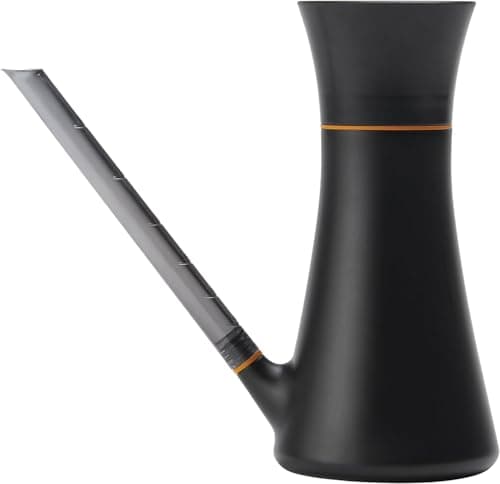 Fiskars Indoor Watering Can, 40 oz, long reach spoutMeasurement markings turn a watering can into an instrument, which on a site that computes how much water a pot actually takes is the difference between pouring and dosing. | The only can here with volume markings on it | $11.04 at Amazon $12.97 · 15% off |
| 2 | 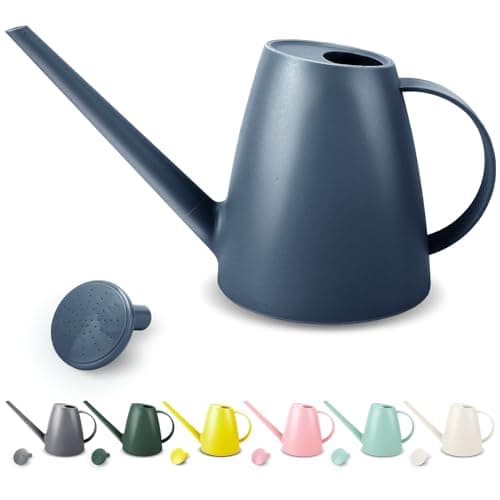 Qilebi Watering Can, 1.8 L, long spout with detachable roseThe detachable rose is the genuine functional difference in this category — a stream for the pot and a sprinkle for a seed tray, from one object. | One can that both soaks a pot and sprinkles a tray | $12.99 at Amazon $13.99 · 7% off |
| 3 | 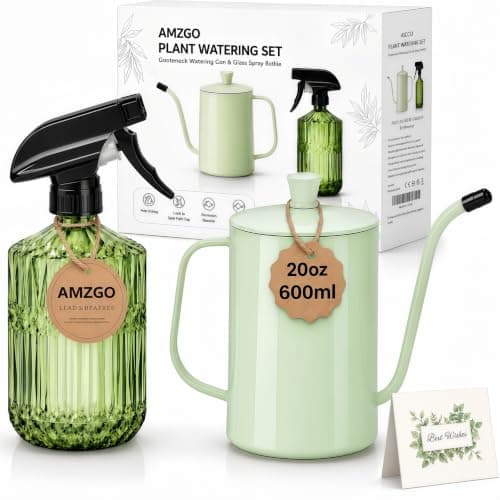 AMZGO Stainless Watering Can 20 oz and Glass Mister 13.5 oz, 2 piece setThe only metal can here and the only one with engraved capacity lines, sold with a glass mister — which makes it the tidiest way to buy both jobs at once. | A small metal can that looks like it belongs on the shelf | |
| 4 | 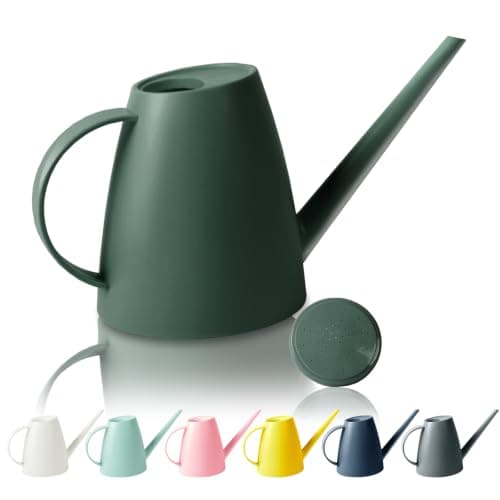 Etarewilt Watering Can, 60 oz, long spout with detachable roseFunctionally the twin of the other 1.8 L can on this page, and worth knowing about mainly because the two trade places on price and color. | The same 1.8 L format, in a different finish |
Links to Amazon are affiliate links. Prices and availability are Amazon's and change without notice.
How we ranked these
Published capacity first, converted into fills per pot; then the spout; then whether you can see what you have poured. The Fiskars leads on markings and a genuinely long spout, and is marked down honestly for a capacity that suits shelves rather than floors. The two 1.8 L cans rank next because that capacity is the practical sweet spot for a mixed collection — one fill is nearly a full soak for an 8-inch pot — and they are functionally the same can in different colors, so buy whichever is cheaper. The stainless set is the smallest capacity here and is ranked third rather than last because it is the only metal can, the only other one with capacity lines, and it arrives with a real glass mister.
| Your plants | Capacity to buy | Why |
|---|---|---|
| A few small pots on a desk | 20 oz metal | Looks right left out; enough for 4 in pots |
| A shelf of 6 in pots | 40 oz (1.2 L) | One pot per fill with room, and it has markings |
| Mixed shelf plus a couple of 8 in pots | 60 oz (1.8 L) | One fill is nearly a full soak at 8 in |
| A 10 in floor plant | 1.8 L, and expect 2 trips | Nothing indoor-sized carries 4 liters |
| Seedling trays as well as pots | Any can with a detachable rose | A bare spout flattens seedlings |
What we deliberately do not recommend
Buying on looks alone and discovering the capacity at the third refill. Short-spouted decorative cans that force you to pour over the foliage. Watering a pot with no drainage hole, whatever you pour it with — the drainage argument is here. Using a can to water plants that would rather be bottom-watered, which for African violets is the published guidance on their own page. And buying a 20 oz can for a floor plant because it was pretty; the table above is the whole reason not to.
Every pick, in full
We have not handled any of these. What follows is what each listing publishes, what that means once you put a watered pot on it, and who should buy something else.
1. The only can here with volume markings on it
Fiskars Indoor Watering Can, 40 oz, long reach spout
Measurement markings turn a watering can into an instrument, which on a site that computes how much water a pot actually takes is the difference between pouring and dosing.
- What the listing publishes
- Published 40 oz (1.2 L) capacity; long slender spout; translucent nozzle with volume measurement markings and an anti-drip tip; body stated to be 30 percent post-consumer recycled plastic; 12.1 in tall, 0.35 lb empty; lifetime warranty stated
- Against a 10-inch pot
- No weight rating is published for this product, so there is nothing to check. That counts against it here rather than being treated as neutral.
Every other can here tells you its total capacity and nothing else. This one has volume markings up the translucent nozzle, so you can pour a known amount rather than a confident glug. That matters because the water a pot takes between dry and saturated is a computable figure — roughly 870 ml for a 6-inch pot — and a marked can is how you act on it.
1.2 liters is a sensible size for a shelf collection and a poor one for a floor plant. A 10-inch pot takes around 4 liters for a full soak, so a big plant is three or four trips to the tap. Know which of those you are before buying on looks.
The anti-drip tip is the feature you notice on the way back to the sink rather than at the plant. A can that dribbles across the floor between pots is the usual reason people stop using one.
What is good
- Publishes capacity and puts measurement markings on the nozzle
- Long slender spout reaches under foliage without wetting leaves
- Lifetime warranty stated, and 30 percent recycled body
What is not
- 1.2 L means several refills for any pot 10 inches or larger
- Plastic, on a shelf where a metal can would look better
- The spout must be clicked into place, which is one more part to lose
Skip it if your collection is floor plants in large pots. You will spend the watering doing laps to the tap; a bigger can is the right tool.
2. One can that both soaks a pot and sprinkles a tray
Qilebi Watering Can, 1.8 L, long spout with detachable rose
The detachable rose is the genuine functional difference in this category — a stream for the pot and a sprinkle for a seed tray, from one object.
- What the listing publishes
- Published 1.8 L capacity; long spout with a twist-tight joint; detachable shower head switching between a direct stream and a soft spray; thick-walled plastic; semi-open inlet for filling
- Against a 10-inch pot
- No weight rating is published for this product, so there is nothing to check. That counts against it here rather than being treated as neutral.
A bare spout delivers a column of water, which is right for soaking a pot and wrong for a tray of seedlings that the column would flatten. A removable rose gives you both, and it is the one feature here that changes what the can can do rather than how it looks.
At 1.8 liters it holds half again as much as the Fiskars, which is the difference between one refill and two for an 8-inch pot — that pot takes about 2 liters for a full soak. For a shelf of 6-inch pots it covers two of them in a fill.
What it does not have is a marked scale. You get a capacity on the listing and nothing on the can, so dosing is by eye.
What is good
- Detachable rose converts stream to spray for seedlings
- 1.8 L is close to a full soak for an 8-inch pot
- Twist-tight spout joint rather than a push fit
What is not
- No volume markings anywhere on the can
- The rose is a small part that gets put down and lost
- Thick plastic is durable and reads as cheap next to metal
Skip it if you only water established pots. The rose is the reason to buy this, and if you never start seed it is a part you will remove once.
3. A small metal can that looks like it belongs on the shelf
AMZGO Stainless Watering Can 20 oz and Glass Mister 13.5 oz, 2 piece set
The only metal can here and the only one with engraved capacity lines, sold with a glass mister — which makes it the tidiest way to buy both jobs at once.
#ad · Price as of September 21, 2026. How we are funded
- What the listing publishes
- Published 20 oz stainless steel can with a gooseneck long spout and laser-engraved capacity lines, plus a 13.5 oz glass mister with an adjustable 360 degree nozzle; can stated 9.2 by 5.43 by 3.35 in; powder-coated exterior; 1.29 lb for the set
- Against a 10-inch pot
- No weight rating is published for this product, so there is nothing to check. That counts against it here rather than being treated as neutral.
Twenty ounces is small — about 0.6 liters, which is two thirds of what a 6-inch pot takes for a full soak. This is a can for a desk, a windowsill and a few small pots, not for a collection. Bought as a can for floor plants it will disappoint immediately.
What it does well is sit out. Stainless with a powder-coated finish and a gooseneck spout is an object you leave on the shelf rather than hide under the sink, and the engraved capacity lines mean it measures as well as the marked plastic can does.
The mister in the box is a real glass bottle with an adjustable nozzle rather than a token extra, which is why this appears on both the watering and misting pages. Two decent tools at the price of one mid-range one.
What is good
- Stainless steel with engraved capacity lines
- Gooseneck spout waters at soil level without wetting leaves
- Includes a genuine glass mister, not a throwaway
What is not
- 20 oz is under one full soak for even a 6-inch pot
- Metal and glass together weigh more than either plastic alternative
- Two small items to store rather than one
Skip it if you have more than a few small pots. The capacity makes this a desk tool, and a 1.8 L can is the one that waters a collection.
4. The same 1.8 L format, in a different finish
Etarewilt Watering Can, 60 oz, long spout with detachable rose
Functionally the twin of the other 1.8 L can on this page, and worth knowing about mainly because the two trade places on price and color.
#ad · Price as of September 21, 2026. How we are funded
- What the listing publishes
- Published 60 oz (stated 1.8 L) capacity in thickened PP resin; long spout plus a detachable shower head for fine spray; semi-open inlet; 0.51 lb empty
- Against a 10-inch pot
- No weight rating is published for this product, so there is nothing to check. That counts against it here rather than being treated as neutral.
Same capacity, same detachable rose, same long spout, same thickened plastic. Where these two cans differ is finish and whatever either is selling for on the day, so treat them as one product with two labels and buy whichever is cheaper.
The listing quotes the size two ways — 60 oz in the title and 1.8 L in the bullets — which happen to agree, since 60 fluid ounces is about 1.77 liters. It is a rare case in this category of two published numbers that actually reconcile.
1.8 liters against an 8-inch pot's roughly 2 liters means one fill very nearly does a full soak. That is the practical sweet spot for a shelf of medium pots.
What is good
- 1.8 L is close to one full soak for an 8-inch pot
- Detachable rose for seedlings and trays
- Its two published capacity figures agree with each other
What is not
- No markings on the can itself
- Indistinguishable in function from the other 1.8 L can here
- PP resin body scuffs where it knocks the tap
Skip it if the other 1.8 L can is cheaper today. There is no functional reason to prefer one over the other.
Questions people actually ask
What size watering can do I need for indoor plants?
Why do indoor watering cans have long spouts?
Is a metal or plastic watering can better for houseplants?
What is the rose on a watering can for?
How much water should I give a houseplant?
Can I just use a cup or a jug?
Sources
- Cornell University, Greenhouse Management: bulk density of greenhouse media components
- Biology Insights: how much a cubic foot of potting soil weighs, dry and saturated
- Clemson HGIC: Indoor Plants — watering
- University of Minnesota Extension: African violets — containers, wick watering and care
- Michigan State University Extension: Smart Gardening — growing houseplants indoors
Product specifications are quoted from each seller's own listing and are the seller's claim, not a measurement of ours.