Propagation
How to Propagate a Monstera
The node is the whole game, and it is the reason a test tube is the wrong vessel for this particular plant.
By Scooter M., enthusiast · Published · Last updated
The short answer
Cut just below a node — the ring on the stem where a leaf and often an aerial root emerge — keeping at least one leaf on the cutting. Put the node in water in a wide-mouth vessel, because a monstera node with an aerial root will not fit a test tube. Roots in two to six weeks; pot at two to three inches of root.
Disclosure Pot & Prop earns a commission when you buy through the Amazon links on this page, at no extra cost to you. It does not change which products get recommended or what we say about them, and we have not been given any of them. How this site is funded.
Monstera is the plant most people try to propagate first, and the one where the wrong equipment gets bought most often. The reason is specific: a monstera cutting is thick. The node is a raised ring on a stem that can be finger-width, and it usually has a stubby brown aerial root growing out of it. That assembly does not fit a 15 mm test tube, and the tube stations that dominate the propagation category are all built around 15 mm tubes.
So the first decision is the vessel, not the cut. Wide-mouth jars, and there is more on that in glass against ceramic and in the desktop station roundup.
Finding the node
On a monstera the node is a slightly raised band circling the stem, usually where a leaf stalk joins and often accompanied by a brown, stubby aerial root pointing downward. It is unmistakable once you have seen one. What matters is that every viable cutting must contain one: a length of stem between nodes, however long and however many leaves it carries, will sit in water indefinitely and never produce a root.
The steps
- Choose a section with at least one node and one leaf. The leaf feeds the cutting while it roots; the node produces the roots. Both are required.
- Cut about half an inch below the node with a clean, sharp blade. Clean matters more on a thick stem than on a thin one because the wound is larger.
- Keep the aerial root if there is one. It is a head start — aerial roots adapt to water quickly and often produce the first proper water roots.
- Let the cut end dry for an hour or two. Optional, and worth it on a thick stem: a slightly callused cut is less prone to rot than a fresh wet one.
- Put the node in water in a wide-mouth vessel, leaf above the surface. An inch or two of water is plenty.
- Bright indirect light, water changed weekly. Same as any cutting.
- Wait two to six weeks. Monstera is slower than pothos. New white roots emerging from the node are the signal, not new leaf growth.
- Pot at two to three inches of root into a small pot with drainage, in a chunky mix. Keep it slightly damper than usual for the first fortnight.
Why a chunky mix and a small pot
Monstera roots want air as much as water, which is why mature plants are usually grown in bark-and-perlite mixes rather than straight potting compost. A fresh cutting in a large pot of dense mix is surrounded by wet material that nothing is drinking from — the same over-potting problem covered in the pot size chart, made worse by roots that have never had to cope with soil at all. Start small, in something open, and pot on when it has filled it.
| Pot size | Mix volume | Dry | Watered | Rating needed |
|---|---|---|---|---|
| 6 in | 0.058 cu ft | 1.3 lb | 3.2 lb | 5 lb |
| 8 in | 0.137 cu ft | 3 lb | 7.5 lb | 12 lb |
| 10 in | 0.268 cu ft | 5.9 lb | 14.7 lb | 23 lb |
| 12 in | 0.463 cu ft | 10.2 lb | 25.5 lb | 39 lb |
What goes wrong
- No node on the cutting. The most common failure, and it is terminal — nothing you do afterwards helps.
- Stem rot at the cut. Thick stems rot more readily than thin ones. Change the water weekly and recut above any brown, soft tissue.
- A vessel too narrow. Forcing a node into a tube snaps the aerial root you were trying to keep and bruises the node.
- Waiting too long to pot. A jar full of long water roots is a plant that will struggle in soil. Two to three inches is the window.
Every pick, in full
We have not handled any of these. What follows is what each listing publishes, what that means once you put a watered pot on it, and who should buy something else.
1. Cuttings you want to actually watch root
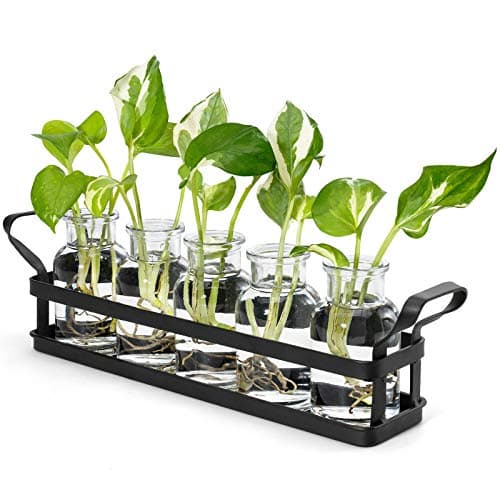
Mkono 5 Jar Desktop Propagation Station with Stand
Wide-mouth jars rather than narrow test tubes, which is the difference between changing the water in ten seconds and fishing a cutting out with tweezers.
#ad · Price as of October 18, 2026. How we are funded
- What the listing publishes
- Five wide-mouth glass jars in a stand; wide openings for water changes
- Against a 10-inch pot
- No weight rating is published for this product, so there is nothing to check. That counts against it here rather than being treated as neutral.
Neck diameter is the specification nobody compares and everybody feels. A narrow tube means you cannot get a finger in to clean the algae, and algae is what ends most propagation stations.
Five jars on roughly a 12 by 4 inch footprint is a third of a square foot for five cuttings, the densest thing on the site by a wide margin, because water weighs less than mix.
Wide jars also take a thicker cutting. A monstera node with an aerial root does not fit a 15 mm test tube.
What is good
- Wide mouths make water changes and cleaning trivial
- Fits thick cuttings and aerial roots
- Five positions in a third of a square foot
What is not
- Wider jars mean more water and more evaporation surface
- Jars lift out, which is convenient and also means they get knocked out
- Glass on a desk with a cat is a decision
Skip it if you are rooting thin herb cuttings in bulk. Narrow tubes hold more cuttings per inch and use a fraction of the water.
2. Watching roots instead of guessing
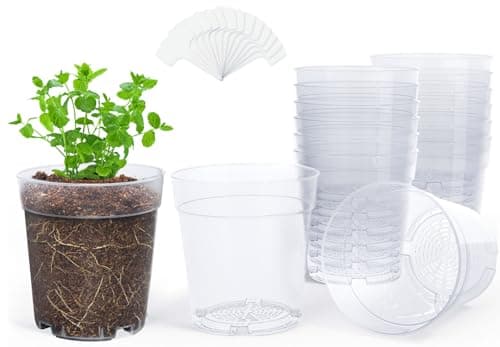
homenote 6.7 in Clear Plastic Nursery Pots with Drainage, 15 pack
Clear walls, which turn the one variable you cannot otherwise check, what the roots are doing, into something you can just look at.
#ad · Price as of October 18, 2026. How we are funded
- What the listing publishes
- 6.7 in clear plastic with drainage holes, 15 per pack
- Against a 10-inch pot
- No weight rating is published for this product, so there is nothing to check. That counts against it here rather than being treated as neutral.
The reason to use a clear nursery pot inside an opaque cachepot is diagnostic: you can see root growth, you can see when water has actually reached the bottom, and you can see rot before the leaves tell you.
Fifteen pots is a whole shelf and a propagation run's worth of potting-up, at a per-pot price no ceramic reaches.
They are not attractive. They are meant to sit inside something else, which is also the arrangement that keeps a decorative pot with no drainage hole from killing a plant.
What is good
- Root visibility that no other pot format gives you
- Fifteen pots at nursery pricing
- The correct inner pot for a decorative cachepot with no hole
What is not
- Ugly on their own
- Algae grows on the inside of a clear pot in a bright window
- Thin plastic flexes when you lift a wet one
Skip it if you want the pot to be the visible object. These are working pots and they look it.
3. A floor plant in something that is not plastic
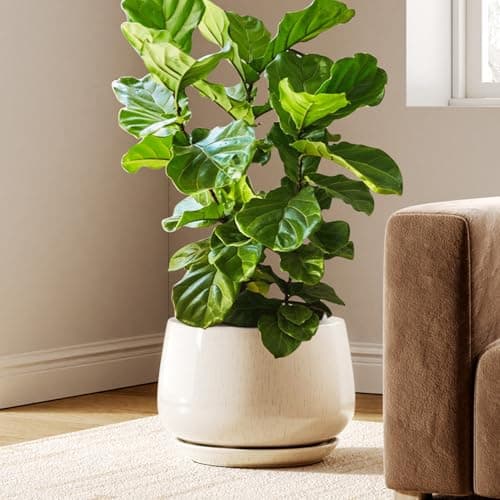
LE TAUCI 12 in Ceramic Planter with Drainage and Saucer
A 12-inch glazed pot with a hole and a saucer, which is the size where the weight conversation starts and most people have not had it.
- What the listing publishes
- 12 in ceramic, drainage hole and saucer included
- Against a 10-inch pot
- No weight rating is published for this product, so there is nothing to check. That counts against it here rather than being treated as neutral.
12 inches of saturated mix computes to about 25.5 lb before the pot itself, and a glazed ceramic pot this size is not light empty. This is a floor pot, not a shelf pot, and putting it on an unrated tiered stand is the mistake this site is built around.
It is also the size at which you stop moving the plant. A rated caddy underneath is the difference between cleaning behind it twice a year and never.
The saucer is included, which at 12 inches is worth real money. Large saucers are priced oddly high when bought alone.
What is good
- Drainage hole and saucer at a size where both are usually extra
- Glazed, so it does not sweat onto the floor
- Heavy enough not to be knocked over
What is not
- About 25.5 lb of saturated mix before the pot's own weight, so floor only
- Ceramic at this size is genuinely fragile in a move
- Slow-drying for plants that want to dry out
Skip it if you were planning to put it on a tiered stand. None of the tiered stands here publish a weight rating, and this is the pot that finds out.
Questions people actually ask
Can you propagate monstera from a leaf?
How long does a monstera take to root in water?
Should I cut the aerial root off before propagating?
What size pot should a rooted monstera cutting go into?
Sources
- University of Illinois Extension: Houseplants — propagation
- Clemson HGIC: Indoor Plants — cleaning, fertilizing, containers and light requirements
- Cornell University, Greenhouse Management: bulk density of greenhouse media components
- Biology Insights: how much a cubic foot of potting soil weighs, dry and saturated
Product specifications are quoted from each seller's own listing and are the seller's claim, not a measurement of ours.