Planters
The Best Moss Poles for Monstera and Climbing Plants
Two questions decide this purchase: how tall the pole needs to be, and whether it has to be kept damp. The category disagrees with itself about the second one.
By Scooter M., enthusiast · Published

The short answer
Buy a pole taller than you think and one you can extend, because being outgrown is how nearly every moss pole fails. A stackable set of 22-inch coir sections that states its assembled height is the safest first purchase; a single 50-inch pole suits a plant that is already large. Set the pole when you repot, push it to the base of the pot, and tie the stem loosely with soft rope rather than wire. Whether the pole needs to be kept damp is genuinely contested — the listings themselves disagree, and this page shows both claims rather than picking one.
Disclosure Pot & Prop earns a commission when you buy through the Amazon links on this page, at no extra cost to you. It does not change which products get recommended or what we say about them, and we have not been given any of them. How this site is funded.
A moss pole is the most-searched accessory in this whole section, and it is sold with less published information than almost anything else on this site. A pot states its diameter. A plant stand states its tiers. A moss pole states a length — sometimes two different lengths in the same listing — and then talks about aerial roots.
What a pole does is not in doubt: it holds a climbing plant upright and gives it a vertical surface to grow against. A monstera, a philodendron or a pothos left without one leans toward the window, sprawls across the furniture, and eventually snaps a stem when somebody walks past. What is in doubt is the second job — whether the pole also feeds the plant's aerial roots — and that turns out to depend on a variable the sellers openly contradict each other on.
The thing this category cannot agree on
Read four coir pole listings and you will find two incompatible sales pitches. The imezos pole ranked below states that no soaking is required, and sells that as a convenience. The Organo Republic pole, also ranked below, is built around a funnel whose entire purpose is keeping the coir moist without wasting water. One listing treats dryness as a feature; the other treats it as the problem it solved.
This site is not going to settle that with invented physics. What can be said plainly is the shape of the disagreement: a pole that only props the plant up works dry, and a pole meant to have roots grip it is being sold, by at least one maker, as something that should be kept damp. If your aim is a straighter plant, either will do. If your aim is aerial roots anchoring into the pole, buy the one with a way to wet it, or plan to mist it yourself.
Length is the failure mode
Poles do not usually break. They get outgrown. A monstera that is climbing well adds height steadily, and the moment the plant tops the pole it goes back to leaning — except now the pole is locked into a pot full of roots, and pushing a taller one in means driving a stake through them.
There are two honest ways out. Buy a single pole far taller than the plant currently needs and accept that it looks oversized for a season, or buy a sectional pole and add height at the top as the plant grows. Both are on this page. The sectional route is the one that avoids ever disturbing the root ball, which is why it leads.
assembled height = total section length - joint overlap
The CHIAFFI set publishes four 22-inch sections — 88 inches of pole — and states 70 inches assembled. That is 18 inches lost across three joints, about 6 inches per joint.
Both figures are the listing's own. It is the only stackable set here that publishes its assembled height, which is why the overlap can be checked at all; the cheaper set below gives two different section lengths and two different totals.
| Your plant | Pole | Why |
|---|---|---|
| A cutting or a young pothos | A short section, 16 to 22 in | Anything taller is unsupported weight in a small pot |
| A monstera just out of its nursery pot | 30 in, or two stacked sections | Tall enough to matter, short enough to stay stable |
| An established plant, knee height and climbing | 50 in single piece, or 3 stacked sections | One rigid run with no joints to flex |
| A large plant you intend to keep growing | Stackable, added to over time | Add height without ever disturbing the roots |
| A plant whose aerial roots you want to anchor | A pole you can keep damp | The makers who care about this sell a way to wet it |
Setting it in the pot, and the lever problem
Set the pole when you repot, not afterward. Push it down until it reaches the base of the pot, then backfill around it — a pole seated in the top two inches of mix is a pole that leans the first time the plant does. Doing this at repotting is also the only time you can position it without cutting roots.
Then there is the arithmetic nobody publishes. A 50-inch pole in a 10-inch pot is five times the pot's width in height, carrying a plant that reaches outward. No listing in this category states a tipping point, and this site will not invent one. What can be computed is the ballast — what the planted pot actually weighs — and that is the number to think with.
| Pot size | Mix volume | Dry | Watered | Rating needed |
|---|---|---|---|---|
| 8 in | 0.137 cu ft | 3 lb | 7.5 lb | 12 lb |
| 10 in | 0.268 cu ft | 5.9 lb | 14.7 lb | 23 lb |
| 12 in | 0.463 cu ft | 10.2 lb | 25.5 lb | 39 lb |
| 14 in | 0.735 cu ft | 16.2 lb | 40.5 lb | 61 lb |
Tying the stem without damaging it
- Soft ties only. Jute rope, plant tape or strips of cloth. Wire and cable ties cut into a petiole as the stem thickens, and the damage shows up months later.
- Loose figure-eight. A twist between stem and pole leaves room for growth instead of clamping the two together.
- Two or three points, not one. A single tie pivots; two hold the stem against the pole along its length.
- Retie as it grows. A tie that was loose in spring is a tourniquet by fall.
- Do not bury the aerial roots. Let them meet the pole surface; they find it on their own.
Quick picks
Ranked, with the published figure each pick turns on. Tap a row for the full reasoning further down this page.
| # | Product | Best for | Price |
|---|---|---|---|
| 1 | 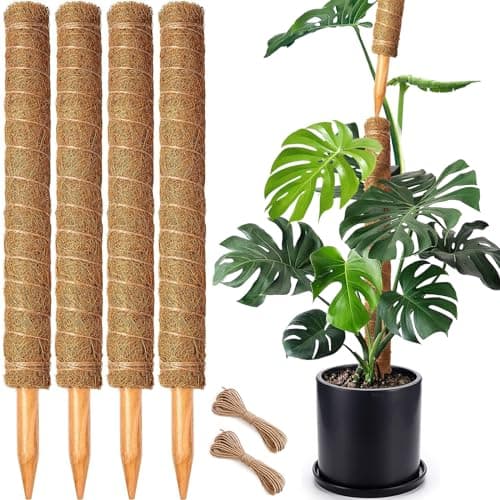 CHIAFFI Stackable Coir Moss Poles, 22 in each, 4 packStacking is the answer to the one failure every moss pole shares, which is being outgrown — and this set publishes both the section length and the assembled height, so you can see what the joints cost. | The pole you do not have to replace next year | |
| 2 | 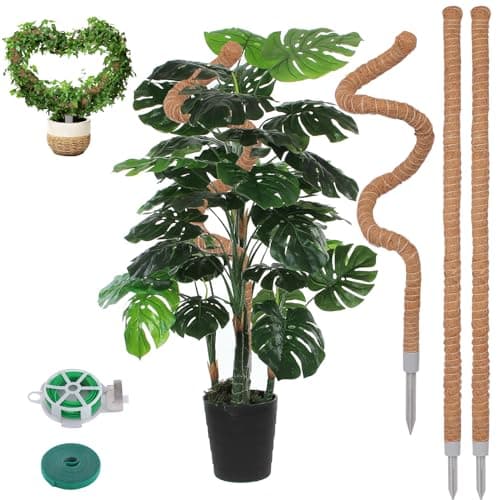 LifeNest 50 in Coco Coir Moss Pole with plant ties, 3 packFifty inches is the length a monstera actually reaches, and three of them in a pack is one for the plant and two for the plants it will become. | A monstera that has outgrown its first pole | |
| 3 | 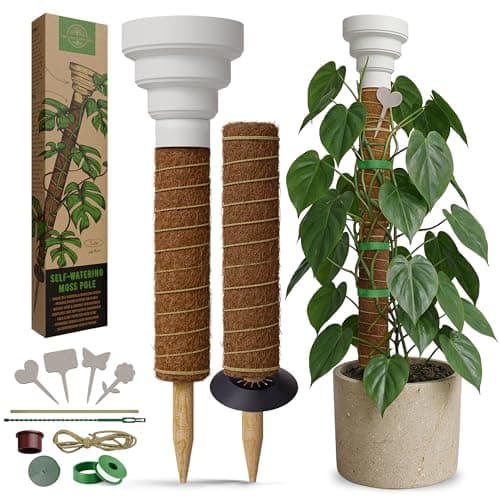 Organo Republic Self-Watering Coco Coir Moss Pole with funnel, 26.4 in, 2 packThe only pole here that takes the damp-pole problem seriously enough to build hardware for it, which is the difference between a support and a support that aerial roots actually grip. | Keeping the pole damp without standing over it | |
| 4 | 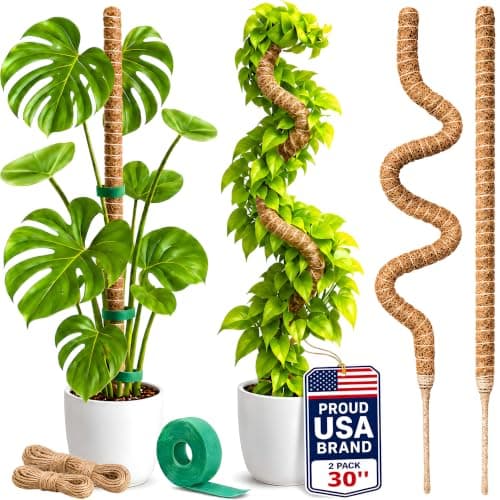 imezos 30 in Coco Coir Moss Pole, bendable aluminum core, 2 packThirty inches of coir on a bendable core, sold in a pair, which is exactly the size a monstera needs in the year it leaves a nursery pot. | The first pole for a monstera still in a 10 or 12 inch pot | |
| 5 | 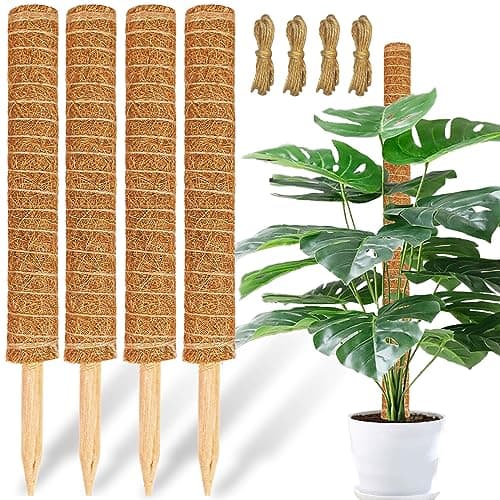 JJGoo Coco Coir Totem Poles, 4 pack, stackableThe cheapest stackable pole on this page, and the one whose listing cannot decide how long it is — which is a real mark against it on a site that ranks on published figures. | The cheapest way to get a stackable pole | |
| 6 | 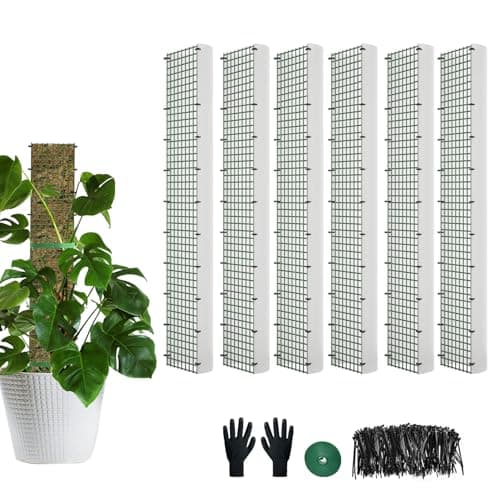 HOLANHING D-Shaped Metal Mesh Moss Poles, 24 in, 6 pack, moss not includedA mesh cage you fill yourself, which is the only design here that lets you use real sphagnum and see whether the roots are actually gripping it. | Packing your own sphagnum, and watching the roots take |
Links to Amazon are affiliate links. Prices and availability are Amazon's and change without notice.
How we ranked these
On what the listing publishes, then on whether the design survives the plant growing. The CHIAFFI set leads because it is the only stackable pole here that states both its section length and its assembled height, which makes the joint loss checkable — and because adding height later is the one feature that addresses this category's real failure. The 50-inch set follows for a plant that is already big and wants a single rigid run. The Organo Republic pole is third because it is the only one that builds hardware for the moisture question rather than making a claim about it. The imezos pair is the sensible first pole for a plant leaving a nursery pot. The JJGoo set is the cheapest way in and is marked down because its own title and bullets disagree about how long it is. The D-shaped mesh is last on price honesty — it needs moss you buy separately — and first for anyone who wants real sphagnum and a window onto whether the roots are taking.
| You want | Pick | The catch |
|---|---|---|
| To buy once and add height for years | Stackable 22 in sections | About 6 in per joint disappears into the overlap |
| One rigid pole for a big plant | 50 in, 3 pack | Top-heavy in anything smaller than a 12 in pot |
| The coir kept damp without effort | Funnel pole, 26.4 in | No published capacity for the funnel |
| A first pole for a nursery-pot monstera | 30 in bendable, 2 pack | Outgrown within a couple of seasons |
| The lowest price | 4 pack coir totems | The listing contradicts itself on length |
| Real sphagnum, and to see roots grip | D-shaped mesh, 6 pack | Moss is not included — budget for it |
What a moss pole will not do
It will not feed the plant. Coir and sphagnum are a surface and a moisture store, not fertilizer, and a pole is no substitute for repotting into fresh mix when the pot is exhausted. It will not fix a light problem either: a plant stretching toward a window is short of light, and tying it to a pole makes it a straighter stretched plant. That is a grow light question, not a support one.
And it will not hold a plant that is not tied to it. This sounds obvious and is the single most common way a pole disappoints — it goes into the pot, the plant is never attached, and three months later the monstera is leaning past it with the pole standing neatly upright behind.
What we deliberately do not recommend
Pushing a pole into a pot the plant has already filled, which drives a stake through the roots you are trying to help — wait for the repot. Wire or cable ties against a thickening stem. A tall single pole in a small light pot, where the pole becomes a lever on a pot with no ballast. Buying on the largest number in the title when the bullets say something smaller. And buying a mesh cage expecting it to arrive filled: one pole on this page states plainly that the moss is not included, and it is the honest one for saying so.
Every pick, in full
We have not handled any of these. What follows is what each listing publishes, what that means once you put a watered pot on it, and who should buy something else.
1. The pole you do not have to replace next year
CHIAFFI Stackable Coir Moss Poles, 22 in each, 4 pack
Stacking is the answer to the one failure every moss pole shares, which is being outgrown — and this set publishes both the section length and the assembled height, so you can see what the joints cost.
#ad · Price as of September 19, 2026. How we are funded
- What the listing publishes
- Published four 22 in coir poles stated to stack to 70 in; two 6.6 ft lengths of jute rope included; solid wood stakes that transfer from one section to the next; 1.48 lb for the set
- Against a 10-inch pot
- No weight rating is published for this product, so there is nothing to check. That counts against it here rather than being treated as neutral.
The commonest complaint about moss poles is not that they fail but that the plant passes them, and replacing a pole in a full pot means pushing a new stake through roots that have already gripped the old one. A sectional pole avoids that: you add height at the top rather than starting again at the bottom.
The published figures let you check the overlap, which most stackable listings hide. Four 22-inch sections is 88 inches of pole, and the listing states 70 inches assembled — so roughly 18 inches disappears into the three joints, about 6 inches each. That is the real number to plan around, not the 88.
Jute rope is included, which matters more than it sounds. Tying a thickening stem to a pole with wire or a cable tie is how petioles get cut, and soft rope in a loose figure-eight is the fix.
What is good
- Publishes both section length and assembled height, so the joint loss is checkable
- Add height without disturbing a rooted pole
- Jute rope included rather than sold separately
What is not
- About 18 in of the 88 in you buy is consumed by the joints
- A stacked pole has joints, and joints are where a tall pole flexes
- Coir sheds a little every time a section is handled
Skip it if your plant is already tall and you want one rigid piece. A single 50-inch pole has no joints to flex, and it is on this page for exactly that buyer.
2. A monstera that has outgrown its first pole
LifeNest 50 in Coco Coir Moss Pole with plant ties, 3 pack
Fifty inches is the length a monstera actually reaches, and three of them in a pack is one for the plant and two for the plants it will become.
#ad · Price as of September 19, 2026. How we are funded
- What the listing publishes
- Published 50 in; coconut fiber over a solid aluminum bar stated to be rust-free; two kinds of plant ties included; 3 pack
- Against a 10-inch pot
- No weight rating is published for this product, so there is nothing to check. That counts against it here rather than being treated as neutral.
Length is the whole argument. A monstera that is climbing well adds a leaf node every few weeks, and the most common complaint about moss poles is that they are outgrown within a year. Fifty inches buys that year back.
The aluminum bar inside matters for a different reason than on the 30 in pole: at this height a pole carries real leverage from a plant that is a yard wide, and a solid metal core is what stops it folding when the pot is moved.
Ties are included, and two kinds of them. That sounds trivial until you are holding a stem against a pole with one hand and looking for string with the other.
What is good
- 50 in covers a monstera from repotting to the ceiling
- Solid aluminum core resists bending under a wide plant
- Ties in the box
What is not
- 50 in in a 12 in pot is top-heavy until the plant is tied at several points
- Three poles is more than most apartments need
- No published pole diameter
Skip it if the plant is in a 6 or 8 inch pot. A 50 in pole in a small pot is a lever, and the 30 in pair is the stable choice until the next repot.
3. Keeping the pole damp without standing over it
Organo Republic Self-Watering Coco Coir Moss Pole with funnel, 26.4 in, 2 pack
The only pole here that takes the damp-pole problem seriously enough to build hardware for it, which is the difference between a support and a support that aerial roots actually grip.
#ad · Price as of September 19, 2026. How we are funded
- What the listing publishes
- Published 26.4 in, 2 pack, extendable coco coir; a funnel design the listing describes as self-watering and states is a pending design patent, intended to keep the coir moist without wasting water
- Against a 10-inch pot
- No weight rating is published for this product, so there is nothing to check. That counts against it here rather than being treated as neutral.
This category cannot agree with itself about moisture. Some coir poles are sold on the promise that no soaking is needed; this one is sold on a funnel whose whole purpose is keeping the coir wet. Both cannot be the most important thing, and the disagreement is worth knowing about before you buy either.
The practical case for damp is simple enough to state without overclaiming: a pole is only doing more than propping the plant up if the aerial roots attach to it, and roots do not grip a dry surface as readily as a moist one. A funnel that lets you top the pole up from above is a way to do that without unpotting anything.
What the listing does not publish is how much the funnel holds or how long it keeps the coir damp, so there is no figure to check the claim against. Treat it as a mechanism that makes watering the pole easy, not as a measured reservoir.
What is good
- Addresses the moisture question with hardware instead of a claim
- Extendable, so it is not a single fixed height
- Two poles per pack, which suits a plant plus a spare
What is not
- No published capacity or duration for the funnel, so the claim cannot be checked
- 26.4 in is short for a mature climber and will need extending
- The most design-dependent pole here; a clogged funnel is a funnel you cannot use
Skip it if you water the pole by hand anyway. A spray bottle and thirty seconds does the same job, and the plain poles here cost less.
4. The first pole for a monstera still in a 10 or 12 inch pot
imezos 30 in Coco Coir Moss Pole, bendable aluminum core, 2 pack
Thirty inches of coir on a bendable core, sold in a pair, which is exactly the size a monstera needs in the year it leaves a nursery pot.
#ad · Price as of September 19, 2026. How we are funded
- What the listing publishes
- Published 30 in; 100 percent coconut fiber over a flexible aluminum rod; stated to work dry without soaking; 2 pack
- Against a 10-inch pot
- No weight rating is published for this product, so there is nothing to check. That counts against it here rather than being treated as neutral.
The pole is the part of a monstera purchase that most pot roundups leave out, and it is the part that decides whether the plant climbs or sprawls across the sofa. Thirty inches is the useful first size: tall enough to matter, short enough not to tip a 10-inch pot.
The aluminum core is the detail worth paying for. A rigid pole can only ever go straight up; a bendable one can follow a stem that has already leaned toward the window, which is every monstera bought from a store.
The listing states the coir works without soaking. Read that as convenience rather than performance — aerial roots still attach better to a pole that is kept damp, and nothing in the listing says otherwise.
What is good
- Two poles, so the second is there when the first is outgrown or a second plant arrives
- Bendable core follows a stem that already leans
- 30 in is short enough to stay stable in a 10 in pot
What is not
- No published core diameter, so how far it bends before it kinks is unknown
- 30 in is outgrown by a healthy monstera within a couple of seasons
- Coir sheds a little on the way into the pot
Skip it if the plant is already at knee height. A 30 in pole disappears inside a mature monstera, and the 50 in set below is the right length.
5. The cheapest way to get a stackable pole
JJGoo Coco Coir Totem Poles, 4 pack, stackable
The cheapest stackable pole on this page, and the one whose listing cannot decide how long it is — which is a real mark against it on a site that ranks on published figures.
#ad · Price as of September 19, 2026. How we are funded
- What the listing publishes
- Published as four coir totem poles with jute string; the listing's own figures disagree — the title says 17 in each extending to 53 in, the bullets say 15.75 in each and 50 in connected; 1.26 lb for the set
- Against a 10-inch pot
- No weight rating is published for this product, so there is nothing to check. That counts against it here rather than being treated as neutral.
The pole itself is the standard article: coir wound onto a stake, sectional, with string to tie the stem. At this price it is the least painful way to find out whether your plant will use a pole at all before committing to a taller system.
The published numbers are the problem. A title claiming 17-inch sections extending to 53 inches and bullets claiming 15.75-inch sections totalling 50 inches cannot both be right, and neither figure explains the overlap. Plan for the smaller number and you will not be disappointed.
Sections this short mean more joints for a given height, and every joint is a flex point. For a pothos that is irrelevant; for a heavy monstera leaning outward it is the reason to buy longer sections.
What is good
- Cheapest route to a stackable pole here
- Jute string included for tying the stem
- Short sections suit a small plant that is only just starting to climb
What is not
- The listing's own length figures contradict each other
- More joints per foot of height than the 22 in sections
- No published figure for how much height the joints consume
Skip it if you want to buy once. The published figures here are too loose to plan a tall plant around, and the 22-inch stackable set states its assembled height.
6. Packing your own sphagnum, and watching the roots take
HOLANHING D-Shaped Metal Mesh Moss Poles, 24 in, 6 pack, moss not included
A mesh cage you fill yourself, which is the only design here that lets you use real sphagnum and see whether the roots are actually gripping it.
#ad · Price as of September 19, 2026. How we are funded
- What the listing publishes
- Published six 24 in D-shaped poles in metal mesh with a thickened PP backing, semi-transparent so root attachment is visible; 280 zip ties, a roll of garden ties and gloves included; moss is stated NOT included
- Against a 10-inch pot
- No weight rating is published for this product, so there is nothing to check. That counts against it here rather than being treated as neutral.
The D shape is the point: a flat mesh face for the stem to sit against and a curved plastic back that holds moisture in the moss behind it. That is a different proposition from a coir cylinder, and for a plant whose aerial roots you want to encourage it is the more controllable one.
It is also the only pole here you cannot use out of the box. The listing states plainly that moss is not included, so budget for a bag of sphagnum on top of the price — which makes the sticker price misleading if you compare it with the coir poles line by line.
The semi-transparent backing is a genuinely useful detail and the sort of thing this category rarely offers. Whether aerial roots have taken hold is normally invisible until you try to move the plant; here you can look.
What is good
- Lets you use real sphagnum rather than coir
- Semi-transparent back, so root attachment is visible
- Ties and gloves included; six poles covers a collection
What is not
- Moss is not included, so the real cost is higher than the listed price
- Assembly is a job — mesh, backing and zip ties, not a stake you push in
- 24 in sections mean joining or replacing for a tall plant
Skip it if you want to put a pole in a pot this afternoon. This is a kit that needs moss and half an hour; the coir poles here are ready to use.
Questions people actually ask
Does a monstera need a moss pole?
How tall should a moss pole be?
Do moss poles need to be kept wet?
How do you attach a plant to a moss pole?
Can you add height to a moss pole later?
When should you put a moss pole in the pot?
Sources
- Cornell University, Greenhouse Management: bulk density of greenhouse media components
- Biology Insights: how much a cubic foot of potting soil weighs, dry and saturated
- Clemson HGIC: Indoor Plants — cleaning, fertilizing, containers and light requirements
- Michigan State University Extension: Smart Gardening — growing houseplants indoors
Product specifications are quoted from each seller's own listing and are the seller's claim, not a measurement of ours.