Propagation
Glass or Ceramic Propagation Station?
Glass is transparent, which is the entire reason to propagate in water rather than in mix. Ceramic is opaque, which is a design decision with a real cost.
By Scooter M., enthusiast · Published · Last updated
The short answer
Glass, for almost everyone. Watching roots develop is how you know when to pot up, when a cutting has failed, and when the water needs changing — and all three are invisible in ceramic. Buy ceramic only when the station has removable glass tubes inside it, or when it is going somewhere the look matters more than the function.
Disclosure Pot & Prop earns a commission when you buy through the Amazon links on this page, at no extra cost to you. It does not change which products get recommended or what we say about them, and we have not been given any of them. How this site is funded.
Rooting a cutting in water instead of mix costs you something: water roots are more fragile than soil roots and the transition to a pot is a real setback. What you get in exchange is that you can see what is happening. That is the whole trade. An opaque vessel takes the payment and withholds the benefit, which is why this comparison is less balanced than most on this site.
That said, ceramic is not a mistake in every case, and the better ceramic stations solve the problem honestly by holding removable glass tubes. The desktop roundup has both kinds, and the hub covers the category.
What transparency actually tells you
- When to pot. Two to three inches of root is the window. Too early and the cutting has nothing to establish with; too late and it has built a water-adapted root system that struggles in mix. You cannot judge this by looking at leaves.
- When a cutting has failed. A rotting stem base goes brown and soft below the waterline, days before anything shows above it. In glass you pull it out and save the water; in ceramic you find out when the whole vessel smells.
- When the water needs changing. Cloudiness is visible immediately in glass. In ceramic you are working to a calendar rather than to what is in front of you.
- Whether it is doing anything at all. Most of the pleasure of propagating is watching roots appear. That is not a trivial point — it is why people keep topping the water up.
The two materials side by side
| Glass | Ceramic | |
|---|---|---|
| See the roots | Yes — the reason to propagate in water | No, unless it holds glass tubes |
| See the algae | Yes, immediately | No, which is why it gets worse |
| Cleaning | Easy, and you can see the result | Harder, and you are guessing |
| Algae growth | Faster — light reaches the water | Slower — that is its one real advantage |
| Durability | Chips and breaks | Chips; usually heavier and more stable |
| Looks | Laboratory or minimal | Reads as an object, not equipment |
The one thing ceramic genuinely does better
Algae needs light and glass lets light into the water, so a glass vessel greens up faster than an opaque one in the same spot. That is a real advantage and it is the honest case for ceramic. It is also a problem with a simpler solution: move the station out of direct sun and change the water weekly, and algae stops being the deciding factor. Buying an opaque vessel to avoid seeing algae is solving the symptom rather than the cause, and it costs you the roots.
Every pick, in full
We have not handled any of these. What follows is what each listing publishes, what that means once you put a watered pot on it, and who should buy something else.
1. Cuttings you want to actually watch root
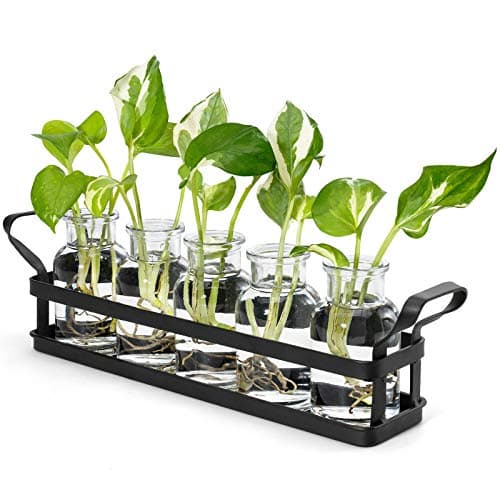
Mkono 5 Jar Desktop Propagation Station with Stand
Wide-mouth jars rather than narrow test tubes, which is the difference between changing the water in ten seconds and fishing a cutting out with tweezers.
#ad · Price as of October 18, 2026. How we are funded
- What the listing publishes
- Five wide-mouth glass jars in a stand; wide openings for water changes
- Against a 10-inch pot
- No weight rating is published for this product, so there is nothing to check. That counts against it here rather than being treated as neutral.
Neck diameter is the specification nobody compares and everybody feels. A narrow tube means you cannot get a finger in to clean the algae, and algae is what ends most propagation stations.
Five jars on roughly a 12 by 4 inch footprint is a third of a square foot for five cuttings, the densest thing on the site by a wide margin, because water weighs less than mix.
Wide jars also take a thicker cutting. A monstera node with an aerial root does not fit a 15 mm test tube.
What is good
- Wide mouths make water changes and cleaning trivial
- Fits thick cuttings and aerial roots
- Five positions in a third of a square foot
What is not
- Wider jars mean more water and more evaporation surface
- Jars lift out, which is convenient and also means they get knocked out
- Glass on a desk with a cat is a decision
Skip it if you are rooting thin herb cuttings in bulk. Narrow tubes hold more cuttings per inch and use a fraction of the water.
2. A station that reads as an object, not equipment
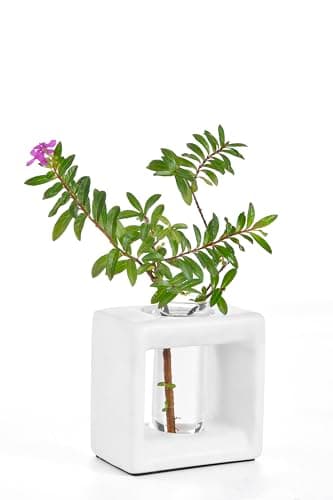
ORGJ Ceramic Propagation Station with Glass Tubes
Ceramic base, glass tubes. The opaque body hides the water line and shows the roots, which is exactly the wrong way round for propagation and exactly right for a living room.
#ad · Price as of October 18, 2026. How we are funded
- What the listing publishes
- Ceramic body holding removable glass propagation tubes
- Against a 10-inch pot
- No weight rating is published for this product, so there is nothing to check. That counts against it here rather than being treated as neutral.
An opaque base means you cannot see the water level in the part that holds it. That is a genuine functional cost, not a style quibble, because a dry tube kills a cutting in a day.
The glass tubes are removable, so the roots stay visible and cleaning is still possible. That is what separates this from a solid ceramic vase.
Ceramic is heavier and far harder to knock over than a glass rack, which is the real argument for it in a room with pets.
What is good
- Heavy enough that a cat does not move it
- Removable glass tubes keep roots visible and cleanable
- Looks like an object rather than laboratory equipment
What is not
- The opaque base hides the water level where it matters
- Fewer positions than a tube rack of the same footprint
- Costs more per cutting than any glass rack here
Skip it if you are propagating seriously. You want to see water levels at a glance, and a glass rack does that where ceramic does not.
3. Cuttings that live on a shelf, not a rack
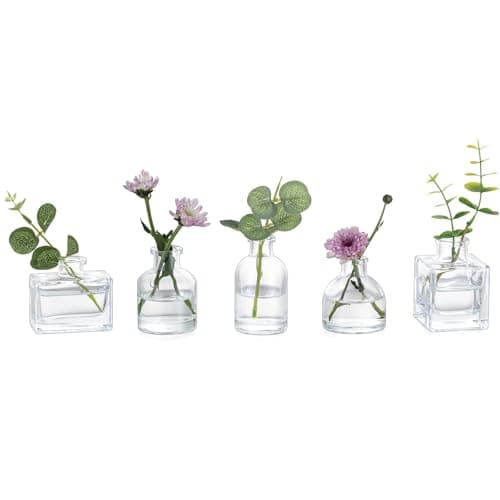
Glasseam Mini Glass Propagation Vases, set of 5
No rack at all: five loose vessels that go wherever there is light, which is the most flexible and least tidy way to propagate.
#ad · Price as of October 18, 2026. How we are funded
- What the listing publishes
- Five assorted small clear glass vases, no stand
- Against a 10-inch pot
- No weight rating is published for this product, so there is nothing to check. That counts against it here rather than being treated as neutral.
A rack forces every cutting into the same light. Loose vases let the pothos sit in a dim corner and the herb cutting take the sill, which is how they actually root fastest.
Assorted shapes means assorted neck widths, which by accident covers both thick and thin cuttings.
Loose glass on a shelf is the format most likely to get knocked off. A rack at least keeps them upright together.
What is good
- Each cutting goes where its light is
- Assorted necks fit assorted cuttings
- The cheapest way into propagation
What is not
- No stand, so they go over easily
- Looks like clutter rather than a display
- Small volumes need frequent water changes
Skip it if you want the station to be a feature. This is five jars on a shelf and it looks like it.
Questions people actually ask
Does glass cause algae in a propagation station?
Can cuttings root in an opaque vessel?
Is colored or tinted glass a problem?
How do I clean a cloudy propagation vessel?
Sources
Product specifications are quoted from each seller's own listing and are the seller's claim, not a measurement of ours.