Planters
The Best Planters for Snake Plants
A snake plant is the hardest houseplant to kill and the easiest one to drown. The pot decides which of those you get.
By Scooter M., enthusiast · Published
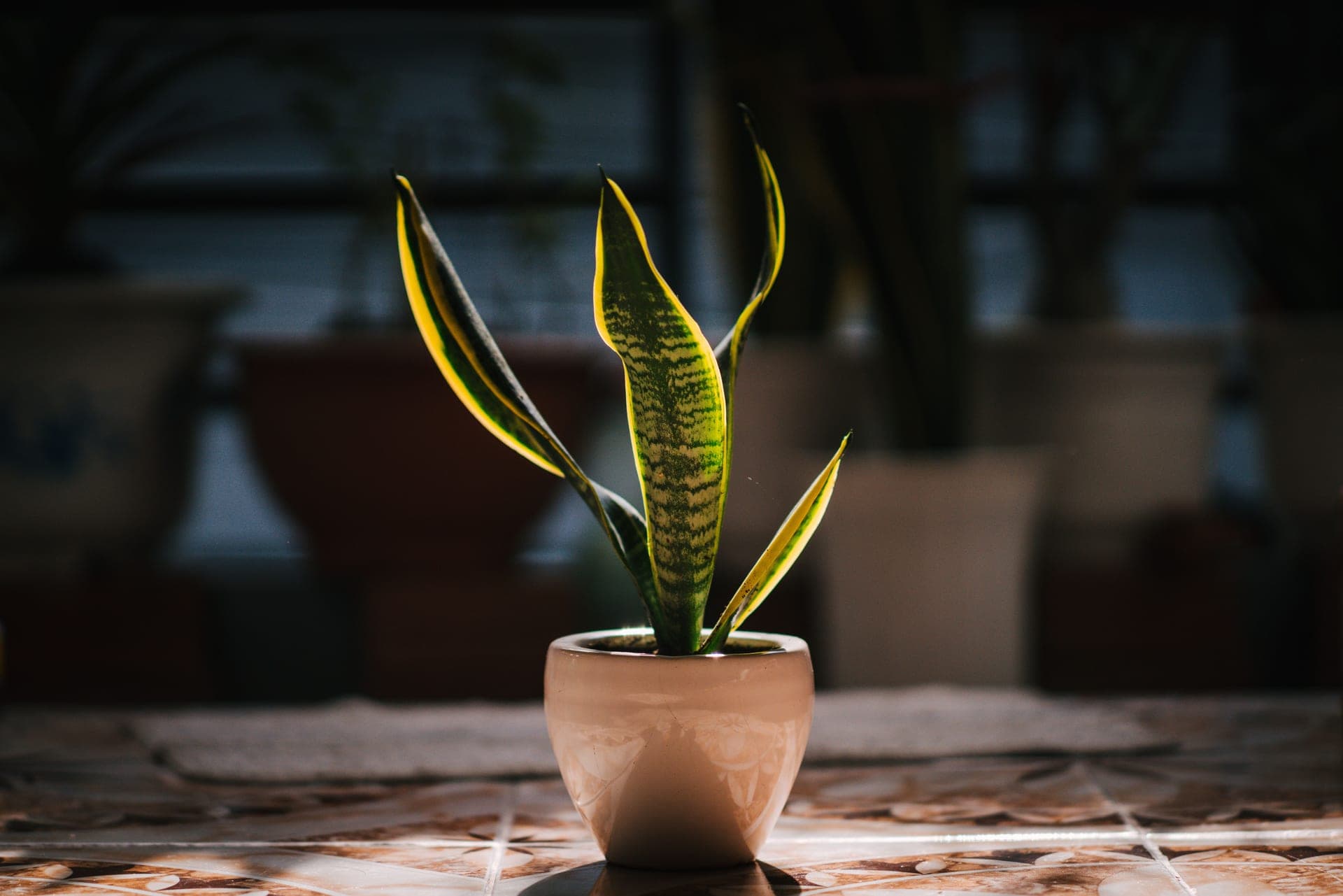
The short answer
Buy unglazed terracotta with a drainage hole, one size up from the pot the plant is in now. Snake plants store water in their leaves and rot in mix that stays damp, so the pot's job is to dry out faster than you can overwater it — which is exactly what porous clay does and what glazed ceramic, plastic and self-watering pots all do less well.
Disclosure Pot & Prop earns a commission when you buy through the Amazon links on this page, at no extra cost to you. It does not change which products get recommended or what we say about them, and we have not been given any of them. How this site is funded.
A snake plant is sold as the plant you cannot kill, and the reputation is deserved right up until somebody waters it on a schedule. It is a succulent in everything but name: it stores water in those thick upright leaves, it evolved in dry ground, and it has no defense at all against roots sitting in wet mix. Almost every dead snake plant died the same way, and it died slowly enough that nobody connected the watering can to the outcome.
That single failure mode is what makes the pot decision unusually consequential here. For a pothos, the pot is a container. For a snake plant, the pot is the thing standing between an occasional heavy-handed watering and root rot, because the difference between mix that dries in five days and mix that dries in twelve is entirely a property of what the pot is made of and how big it is.
So this page ranks pots by drying rate first, drainage second and stability third, and it does not rank them by looks at all. The material argument underneath it is set out in full in terracotta against ceramic against plastic, and how we pick explains the method every page here uses.
The four things that decide a snake plant pot
In order of how much difference each one makes. Get the first two right and the plant will forgive most of what else you do to it.
- A drainage hole. Not negotiable, not for this plant. Without one, water collects in the bottom of the pot where you cannot see it, that zone never gets air, and the roots in it die first. A snake plant gives you almost no warning before that becomes terminal — the leaves look fine until the day they go soft at the base. If the pot you love has no hole, use it as a sleeve and keep the plant in a nursery pot inside it. The full argument is here.
- Unglazed terracotta, because it dries the mix for you. Porous clay loses moisture through the pot wall as well as the surface, so the same mix in the same room dries measurably faster in clay than in glaze or plastic. For a plant whose only real enemy is staying wet, that is not a preference — it is the pot doing part of the watering job on your behalf.
- A snug size, one step up at most. Snake plants are happy slightly rootbound and miserable in a pot that dwarfs them. Move one from a 6-inch pot into a 10-inch and you have surrounded a small root ball with a wide ring of mix that no root reaches, which therefore dries only by evaporation and stays damp for weeks. That ring is where rot starts.
- A base wide enough for the leaves. This is the one nobody mentions. A mature snake plant is a column of stiff vertical leaves two feet or more tall, and it is genuinely top heavy. A tall narrow cylinder looks elegant and tips over when a cat brushes past it. Width at the base and some mass in the pot itself are stability, and terracotta and ceramic both supply the second one for free.
Why the size rule matters more here than elsewhere
Pot volume scales with the cube of the diameter, so a size jump that sounds modest is not. Going from an 8-inch pot to a 12-inch does not add half again as much mix — it adds roughly three and a half times as much, and almost all of that extra volume is beyond the reach of a root system that has just been moved. For a plant that wants its mix to dry out completely between waterings, that is the worst possible thing to do to it.
volume ratio = (D2 / D1)^3
8 in to 12 in: (12/8)^3 = 3.4 times the mix, not 1.5 times
One step at a time — about two inches of extra diameter. The pot size chart works through it.
The weight side is the other reason to be conservative, and it is the number the listings never give you. These are computed figures for the potting mix alone, saturated, at the planning density this site uses everywhere. Add the pot itself — a 12-inch ceramic pot is several pounds empty, and clay is not far behind.
| Pot size | Mix volume | Dry | Watered | Rating needed |
|---|---|---|---|---|
| 5 in | 0.034 cu ft | 0.7 lb | 1.8 lb | 3 lb |
| 6 in | 0.058 cu ft | 1.3 lb | 3.2 lb | 5 lb |
| 7 in | 0.092 cu ft | 2 lb | 5.1 lb | 8 lb |
| 8 in | 0.137 cu ft | 3 lb | 7.5 lb | 12 lb |
| 10 in | 0.268 cu ft | 5.9 lb | 14.7 lb | 23 lb |
| 12 in | 0.463 cu ft | 10.2 lb | 25.5 lb | 39 lb |
Quick picks
Ranked, with the published figure each pick turns on. Tap a row for the full reasoning further down this page.
| # | Product | Best for | Price |
|---|---|---|---|
| 1 | 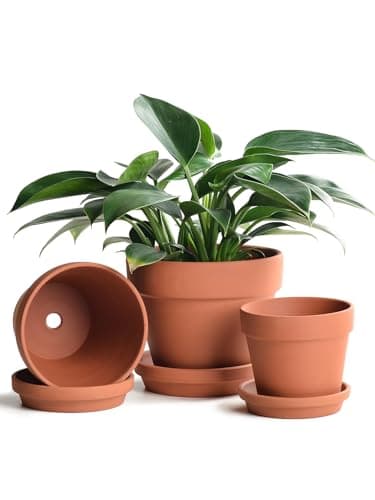 INGOFIN Terracotta Pots with Saucers, 5, 6 and 7 inPorous clay, the only pot material that actively removes water from the mix, and the reason succulents live longer in terracotta than in anything else. | Plants that must dry out between waterings | |
| 2 | 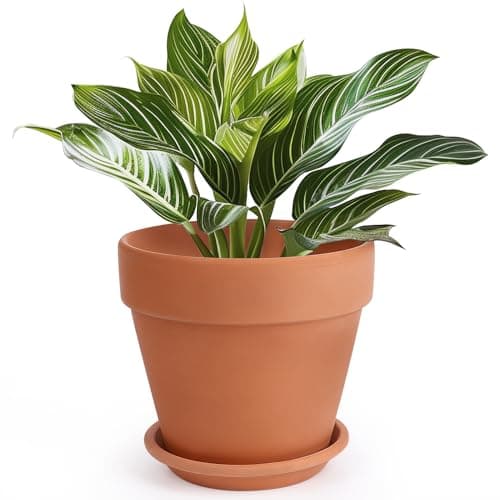 INGOFIN 10 in Terracotta Pot with SaucerTerracotta at the size where overwatering does the most damage, because a 10-inch pot of wet mix takes a long time to dry from the top alone. | A large plant that keeps rotting in plastic | |
| 3 | 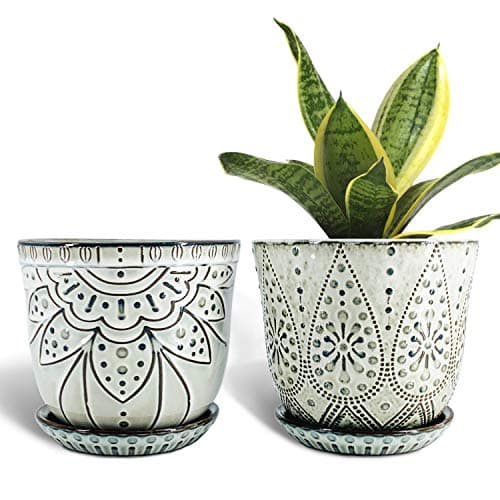 Gepege 6 in Ceramic Plant Pots with Drainage and SaucersThe size most houseplants are sold in and the size most shelves are built for, with the hole that the decorative version of the same pot leaves out. | The default shelf pot | |
| 4 | 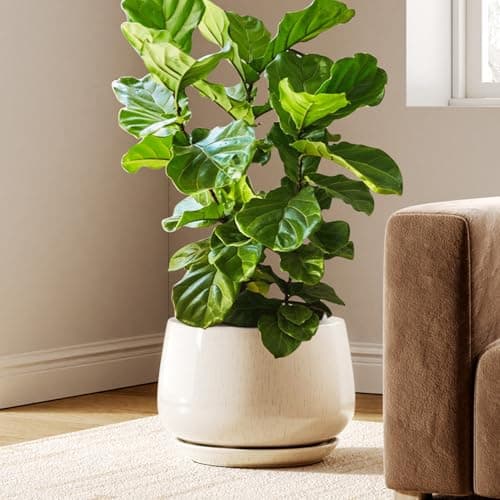 LE TAUCI 12 in Ceramic Planter with Drainage and SaucerA 12-inch glazed pot with a hole and a saucer, which is the size where the weight conversation starts and most people have not had it. | A floor plant in something that is not plastic | $84.99 at Amazon $89.99 · 6% off |
| 5 | 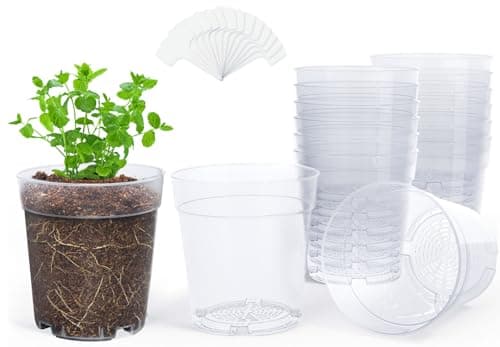 homenote 6.7 in Clear Plastic Nursery Pots with Drainage, 15 packClear walls, which turn the one variable you cannot otherwise check, what the roots are doing, into something you can just look at. | Watching roots instead of guessing | |
| 6 | 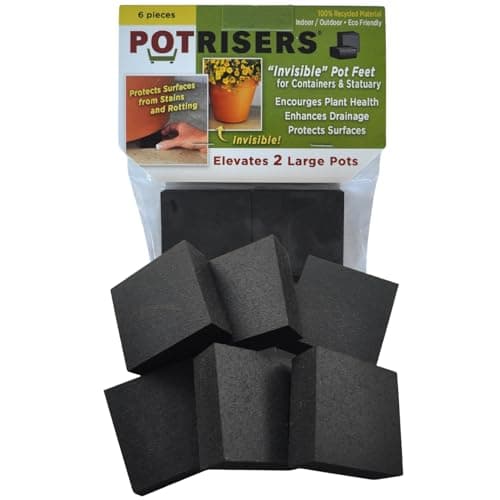 POTRISERS Invisible Pot Feet and Plant Risers, 2 in wide, 6 packThree quarters of an inch of lift, which is not a plant stand at all and solves a problem no plant stand solves: the pot base sitting in its own drainage. | Airflow under a pot with no height cost |
Links to Amazon are affiliate links. Prices and availability are Amazon's and change without notice.
What size pot for a snake plant
Match the pot to the root ball rather than to the height of the leaves, which is the mistake that produces over-potted plants. A snake plant that has doubled in height has usually not doubled its roots.
| Situation | Pot diameter | Why |
|---|---|---|
| A single division or a rooted leaf cutting | 4 in | Small enough that the mix dries between waterings |
| The plant a garden center sold you | 5 to 6 in | Usually already correct — leave it a season |
| Rootbound in a 6 in, roots at the drainage hole | 8 in | One step; about 7.5 lb of watered mix |
| Rootbound in an 8 in, a full clump | 10 in | About 14.7 lb watered; still liftable |
| A large floor specimen, several fans | 12 in | About 25.5 lb watered; put it somewhere it can stay |
| Any size, if in doubt | The one it is in | Snake plants are content slightly rootbound |
The signs it is genuinely time to repot
- Roots coming out of the drainage hole, or circling visibly when you slide the plant out.
- The pot dries much faster than it used to — more roots and less mix per watering, which is often the earliest honest signal.
- The pot is bulging or has cracked. Snake plant rhizomes are strong enough to split a plastic pot, and that is about as clear a message as a plant can send.
- It tips over. A stability problem is a legitimate reason to size up even when the roots are not asking for it.
- Not because it is spring. A snake plant with room in its pot gains nothing from a bigger one, and repotting is a disturbance with a real cost.
Mix matters as much as the pot
The best pot in this category still cannot save a snake plant sitting in dense, peat-heavy potting compost that holds water like a sponge. Cutting standard mix roughly half and half with perlite, pumice or coarse grit changes the drying curve more than any pot upgrade can, and it costs very little. Pot and mix work together: porous clay pulls moisture out through the wall, an open gritty mix lets air back in, and between them the plant gets the dry spell it needs.
This is the same reasoning that runs through the succulent pots roundup, and for the same reason — these are plants that fail wet.
What we deliberately do not recommend
Self-watering pots, categorically. The entire mechanism is designed to keep the lower mix permanently damp, which is precisely the one condition a snake plant cannot survive. This is not a matter of degree or careful use — it is a direct conflict between what the pot does and what the plant needs, and it is worked through in self-watering against a plain drainage hole.
Tall narrow cylinders, however good they look next to a sofa. They put a top-heavy plant on a small base, and they hold a deep column of mix that the shallow rhizome never reaches. Glass vessels and closed terrariums, which have no drainage and no airflow and are the most reliable way to kill a snake plant that arrived as a gift. And pots two or three sizes up, bought to save doing this again in two years, which buys a few months of convenience at the cost of the root system.
One more thing, if you have a cat
Snake plants are on the ASPCA's toxic list for cats. That does not necessarily mean giving the plant up, but it does change where it goes — and a heavy pot on a wide base is part of the answer, because a plant that cannot be knocked over is a plant that is not being chewed on the floor. The full picture, and how to put plants genuinely out of reach, is here.
Every pick, in full
We have not handled any of these. What follows is what each listing publishes, what that means once you put a watered pot on it, and who should buy something else.
1. Plants that must dry out between waterings
INGOFIN Terracotta Pots with Saucers, 5, 6 and 7 in
Porous clay, the only pot material that actively removes water from the mix, and the reason succulents live longer in terracotta than in anything else.
#ad · Price as of October 18, 2026. How we are funded
- What the listing publishes
- 5, 6 and 7 in unglazed clay, drainage hole and saucer per pot
- Against a 10-inch pot
- No weight rating is published for this product, so there is nothing to check. That counts against it here rather than being treated as neutral.
Unglazed terracotta breathes through the wall, so the mix dries from the sides as well as the top. For a plant that rots when wet that is a feature you cannot get from a plastic pot with a bigger hole.
It also means the pot itself is damp. Terracotta sitting directly on wood leaves a ring, which is what the pot feet elsewhere in this section exist for.
Clay adds real weight for its size. On a shelf with no published rating, a set of three terracotta pots is meaningfully heavier than the same set in plastic.
What is good
- Dries the mix from the sides, not just the top
- Three sizes for potting up
- A heavy base resists being knocked over
What is not
- Damp clay marks wood floors and shelves
- Heavier than plastic at the same size
- Dries so fast that thirsty plants need watering twice as often
Skip it if you travel or forget to water. Terracotta is the least forgiving material for an under-waterer, and glazed ceramic is the fix.
2. A large plant that keeps rotting in plastic
INGOFIN 10 in Terracotta Pot with Saucer
Terracotta at the size where overwatering does the most damage, because a 10-inch pot of wet mix takes a long time to dry from the top alone.
#ad · Price as of October 18, 2026. How we are funded
- What the listing publishes
- 10 in unglazed clay with drainage hole and saucer
- Against a 10-inch pot
- No weight rating is published for this product, so there is nothing to check. That counts against it here rather than being treated as neutral.
A 10-inch pot of saturated mix computes to about 14.7 lb, and unglazed clay adds several pounds of its own. This is a floor or a low sturdy shelf, not a tiered frame.
The larger the pot, the longer the middle of it stays wet, and the more the porous wall earns its keep. The material advantage that is marginal at 4 inches is substantial at 10.
Clay at this size is fragile in exactly one way that matters: the rim chips if it is set down hard on tile.
What is good
- The porous wall matters most at large pot sizes
- Saucer included at a size where they are expensive alone
- Heavy enough to anchor a top-heavy plant
What is not
- Heavy before the mix goes in
- Chips on tile
- Needs watering noticeably more often than a glazed pot the same size
Skip it if the pot is going on a shelf. At roughly 15 lb of saturated mix plus several pounds of clay, this belongs on the floor unless the shelf publishes a number.
3. The default shelf pot
Gepege 6 in Ceramic Plant Pots with Drainage and Saucers
The size most houseplants are sold in and the size most shelves are built for, with the hole that the decorative version of the same pot leaves out.
#ad · Price as of October 18, 2026. How we are funded
- What the listing publishes
- 6 in ceramic with drainage hole and saucer
- Against a 10-inch pot
- No weight rating is published for this product, so there is nothing to check. That counts against it here rather than being treated as neutral.
A 6-inch pot of saturated mix computes to about 3.2 lb. Any stand on this site holds it, which is why 6 inches is where you can buy on looks rather than on arithmetic.
It is also the size where the no-drainage-hole trap is most common, because 6-inch pots are sold as decor as often as they are sold as pots.
Nursery plants usually arrive in a plastic 6-inch. Dropping that pot straight into a ceramic cachepot is a legitimate alternative to repotting, as long as you lift it to water.
What is good
- The correct default size for most houseplants
- Hole and saucer included
- Light enough for any shelf here
What is not
- Outgrown within a year by anything vigorous
- Glazed ceramic holds moisture longer than plastic
- One pot per order at this price point
Skip it if your plant came in a 6-inch nursery pot and is root-bound. You need the next size up, not the same size in ceramic.
4. A floor plant in something that is not plastic
LE TAUCI 12 in Ceramic Planter with Drainage and Saucer
A 12-inch glazed pot with a hole and a saucer, which is the size where the weight conversation starts and most people have not had it.
- What the listing publishes
- 12 in ceramic, drainage hole and saucer included
- Against a 10-inch pot
- No weight rating is published for this product, so there is nothing to check. That counts against it here rather than being treated as neutral.
12 inches of saturated mix computes to about 25.5 lb before the pot itself, and a glazed ceramic pot this size is not light empty. This is a floor pot, not a shelf pot, and putting it on an unrated tiered stand is the mistake this site is built around.
It is also the size at which you stop moving the plant. A rated caddy underneath is the difference between cleaning behind it twice a year and never.
The saucer is included, which at 12 inches is worth real money. Large saucers are priced oddly high when bought alone.
What is good
- Drainage hole and saucer at a size where both are usually extra
- Glazed, so it does not sweat onto the floor
- Heavy enough not to be knocked over
What is not
- About 25.5 lb of saturated mix before the pot's own weight, so floor only
- Ceramic at this size is genuinely fragile in a move
- Slow-drying for plants that want to dry out
Skip it if you were planning to put it on a tiered stand. None of the tiered stands here publish a weight rating, and this is the pot that finds out.
5. Watching roots instead of guessing
homenote 6.7 in Clear Plastic Nursery Pots with Drainage, 15 pack
Clear walls, which turn the one variable you cannot otherwise check, what the roots are doing, into something you can just look at.
#ad · Price as of October 18, 2026. How we are funded
- What the listing publishes
- 6.7 in clear plastic with drainage holes, 15 per pack
- Against a 10-inch pot
- No weight rating is published for this product, so there is nothing to check. That counts against it here rather than being treated as neutral.
The reason to use a clear nursery pot inside an opaque cachepot is diagnostic: you can see root growth, you can see when water has actually reached the bottom, and you can see rot before the leaves tell you.
Fifteen pots is a whole shelf and a propagation run's worth of potting-up, at a per-pot price no ceramic reaches.
They are not attractive. They are meant to sit inside something else, which is also the arrangement that keeps a decorative pot with no drainage hole from killing a plant.
What is good
- Root visibility that no other pot format gives you
- Fifteen pots at nursery pricing
- The correct inner pot for a decorative cachepot with no hole
What is not
- Ugly on their own
- Algae grows on the inside of a clear pot in a bright window
- Thin plastic flexes when you lift a wet one
Skip it if you want the pot to be the visible object. These are working pots and they look it.
6. Airflow under a pot with no height cost
POTRISERS Invisible Pot Feet and Plant Risers, 2 in wide, 6 pack
Three quarters of an inch of lift, which is not a plant stand at all and solves a problem no plant stand solves: the pot base sitting in its own drainage.
#ad · Price as of October 18, 2026. How we are funded
- What the listing publishes
- 2 in wide by 3/4 in tall feet; lifts the pot base clear of its saucer
- Against a 10-inch pot
- No weight rating is published for this product, so there is nothing to check. That counts against it here rather than being treated as neutral.
A pot standing apartment in a saucer wicks the water it just drained straight back up. Feet break that contact, which is the difference between drainage that works and a saucer that is a reservoir.
It also protects the floor. Terracotta sitting wet on wood for a year leaves a ring that does not come out, and a few cents of plastic prevents it.
Six feet is two or three pots. Buy per pot, not per apartment.
What is good
- Fixes the wicking problem that drainage holes alone do not
- Keeps wet pot bases off wood floors
- Costs and weighs almost nothing
What is not
- Six feet only covers two or three pots
- Raises the pot enough to matter under a tight sill
- Not a substitute for a saucer
Skip it if your pots are already in cachepots with a gap at the bottom. You have the airflow, and feet just make the pot taller.
Questions people actually ask
What kind of pot is best for a snake plant?
Do snake plants like to be rootbound?
What size pot does a snake plant need?
Can a snake plant live in a pot without drainage holes?
Should I use a self-watering pot for a snake plant?
How heavy is a snake plant in a large pot?
What do I put my snake plant divisions in?
Sources
- Cornell University, Greenhouse Management: bulk density of greenhouse media components
- Biology Insights: how much a cubic foot of potting soil weighs, dry and saturated
- Clemson HGIC: Indoor Plants — cleaning, fertilizing, containers and light requirements
- Clemson HGIC: Indoor Plants — watering
- ASPCA: toxic and non-toxic plants list
Product specifications are quoted from each seller's own listing and are the seller's claim, not a measurement of ours.