Planters
The Best Houseplant Fertilizer
A fertilizer is three numbers and a dose. Three of the five bottles here do not print all of them, which makes the choice much simpler than it looks.
By Scooter M., enthusiast · Published
The short answer
Buy a bottle that publishes its N-P-K analysis and its dilution rate, because those two figures are the whole product and most listings print neither. A balanced concentrate that states 10-10-10 and an eighth of a teaspoon per quart tells you exactly what goes in the pot and makes roughly 400 waterings of a 6-inch pot from one 8 oz bottle. Follow the label of the bottle you actually bought rather than a schedule from a different one — the products here range from feed-every-watering to once two weeks, and those instructions are not interchangeable.
Disclosure Pot & Prop earns a commission when you buy through the Amazon links on this page, at no extra cost to you. It does not change which products get recommended or what we say about them, and we have not been given any of them. How this site is funded.
Fertilizer is the one houseplant purchase where the specification is standardized, legally defined and printed in the same format by every manufacturer on earth. Three numbers: nitrogen, phosphate, potash, as percentages. A dose. That is the product.
So it is genuinely striking how many bottles on a shelf will not tell you either one. Of the five here, two publish the analysis, one publishes a dose but no analysis, and two publish neither — and one of those two is the most recognizable bottle in the category.
The transparency ladder
| Bottle | N-P-K analysis | Dose | Yield |
|---|---|---|---|
| Balanced concentrate, 8 oz | 10-10-10, explained | 1/8 tsp per quart | Computable |
| Organic, 8 oz | 5-5-5, plus Ca/Mg/trace | One serving per gallon | 50 gallons, published |
| All-purpose concentrate, 32 oz | Not published | 1 tsp per gallon, containers | Computable |
| Indoor plant food, 8 oz x 2 | Not published | Unstated amount into 1 quart | Not computable |
| Complete liquid, 8 oz | Not published | Not published | Not computable |
Read the bottom two rows. "Mixed in 1 quart of water" names the water and not the fertilizer. "Balanced nutrition" and "complete" are adjectives standing where a three-number analysis would go. Neither listing is doing anything unusual for the category — that is the point.
How far a bottle actually goes
Where a listing publishes a dose, the yield is arithmetic. And because this site already computes what a pot drinks, the yield converts into something better than gallons: waterings.
bottle volume in tsp / dose per unit = solution volume, then / water per pot
8 oz = 48 tsp. At 1/8 tsp per quart: 384 quarts = 96 gallons. 32 oz = 192 tsp at 1 tsp per gallon = 192 gallons. A 6-inch pot takes about 870 ml, or 0.23 gallons, for a full soak — so 96 gallons is roughly 420 waterings and 192 gallons roughly 835.
Water-per-pot from the same model the load pages use. These are full soaks from dry, so they are an upper bound on water and therefore a lower bound on waterings covered.
| Bottle | Published dose | Solution per bottle | 6 in pot waterings |
|---|---|---|---|
| Balanced 10-10-10, 8 oz | 1/8 tsp per quart | About 96 gallons | About 420 |
| All-purpose, 32 oz | 1 tsp per gallon | About 192 gallons | About 835 |
| Organic 5-5-5, 8 oz | One serving per gallon | 50 gallons, published | About 217 |
| Indoor plant food, 8 oz | Amount unstated | Not computable | Not computable |
| Complete liquid, 8 oz | Not published | Not computable | Not computable |
Two feeding philosophies, both on this page
The bottles here split cleanly into two approaches, and mixing them up is the most common way people get this wrong.
- Weak and often. A very low dose in every watering — the balanced concentrate here instructs an eighth of a teaspoon per quart, used every time you water. The plant gets a steady trickle and there are no peaks.
- Stronger and periodic. A larger dose every couple of weeks, which is what the all-purpose and indoor products here instruct. Simpler to remember, and the plant sees a cycle rather than a plateau.
Neither is wrong. What is wrong is applying one bottle's schedule to another bottle's concentration — feeding two weeksly-strength dose at every watering, or a feed-every-watering product once a month and wondering why nothing happened. Read the label of the bottle in your hand.
When the medium changes the answer
One case on this site is not optional. A plant in an inert medium — fired clay pebbles, straight bark, anything with no organic matter in it — has no nutrient reserve at all. The LECA page puts it plainly: semi-hydroponics means feeding permanently or the plant slowly starves, because the medium gives it nothing.
That is the strongest argument on this page for a bottle that publishes its analysis. If the fertilizer is the plant's entire diet rather than a supplement to a potting mix, knowing what is in it stops being a preference.
Quick picks
Ranked, with the published figure each pick turns on. Tap a row for the full reasoning further down this page.
| # | Product | Best for | Price |
|---|---|---|---|
| 1 | 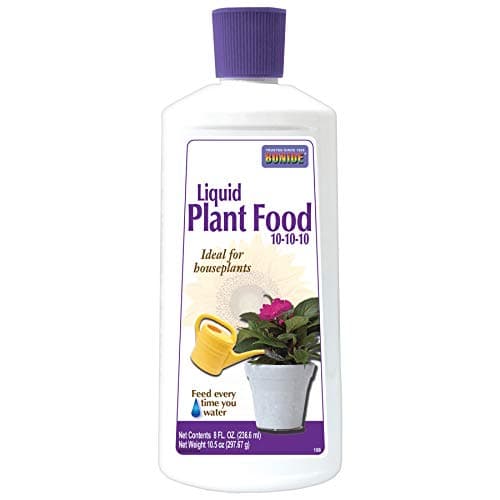 Bonide Houseplant Liquid Plant Food, 10-10-10, 8 oz concentrateThe only bottle here that publishes both halves of the equation — what is in it and how much to use — which on a fertilizer is the entire specification. | Knowing exactly what you are putting in the pot, and how much | $9.49 at Amazon $10.08 · 6% off |
| 2 | 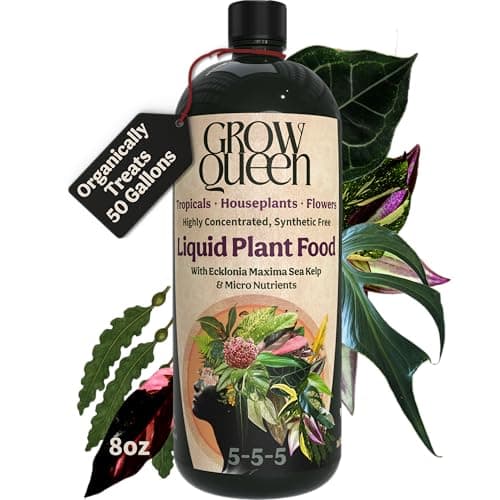 Grow Queen Organic Liquid Indoor Plant Food, 5-5-5, 8 ozPublishes its analysis and, unusually, how far the bottle goes — then hands you a flexible schedule instead of a fixed one. | A published analysis and a published yield, in an organic formulation | |
| 3 | 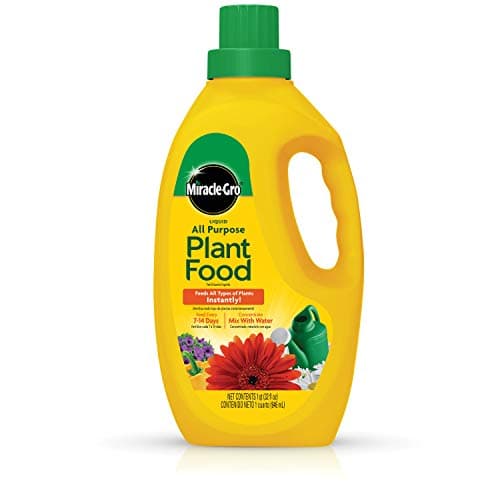 Miracle-Gro Liquid All Purpose Plant Food, 32 oz concentratePublishes a precise container dose and no analysis at all — so you know exactly how much of something unspecified you are adding. | The most feed solution per dollar, if you can live without the analysis | $7.97 at Amazon $10.49 · 24% off |
| 4 | 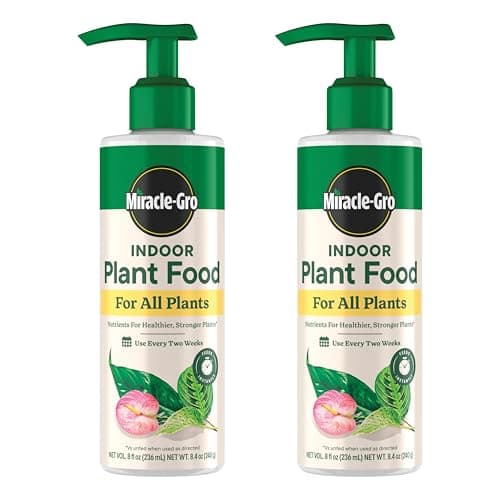 Miracle-Gro Indoor Plant Food for All Plants, 8 fl oz, 2 packThe most recognizable bottle in the category, and the one that publishes the least — no analysis, and no measured quantity for the quart it tells you to mix. | Feeding without thinking about it, at the cost of knowing anything about it | $11.68 at Amazon $13.49 · 13% off |
| 5 | 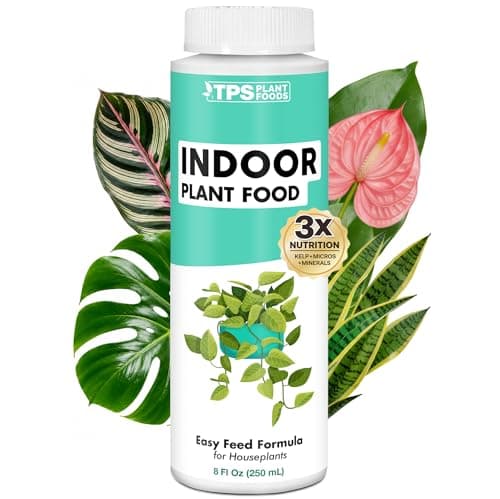 TPS NUTRIENTS Indoor Plant Food, complete liquid fertilizer, 8 ozNamed for every plant you own and specified for none of them. It is on this page as the floor of the category rather than as a recommendation. | Illustrating what a listing looks like with no checkable figure in it |
Links to Amazon are affiliate links. Prices and availability are Amazon's and change without notice.
How we ranked these
On whether the analysis is published, then on whether the dose is published, then on yield, then on price. The balanced concentrate leads on a clean sweep: it prints 10-10-10, explains what that means, gives an exact dilution, and is the cheapest bottle here — roughly 420 waterings of a 6-inch pot from eight ounces. The organic 5-5-5 is second for publishing both an analysis and a yield and for naming its kelp species rather than saying seaweed, held off the top by the lowest yield here at the highest price. The 32 oz all-purpose concentrate is third and is a genuinely awkward product to place: the best yield by a distance, a properly distinguished container dose, and no analysis at all. The two-pack indoor food is fourth — easy to use, impossible to compare, and it names the quart without naming the quantity. The complete liquid is last and is on the page as the floor of the category: five bullets, a dozen plant names and not one checkable figure.
| You | Buy | Why |
|---|---|---|
| Want to know what is in the pot | Balanced 10-10-10 | Analysis, dose, and the lowest price here |
| Feed a plant in LECA or bark | Balanced 10-10-10 | Inert medium means the bottle is the whole diet |
| Prefer an organic formulation | Organic 5-5-5 | Publishes analysis, yield and its kelp species |
| Have a lot of plants and a budget | All-purpose 32 oz | About 835 waterings, if you can accept no analysis |
| Want to feed and not think | Indoor plant food 2-pack | Simplest routine; nothing to compare it on |
| Feed monthly, not weekly | Any two-week-dose bottle | Match the schedule to the label you bought |
What we deliberately do not recommend
Buying a fertilizer whose listing does not publish an analysis when one that does costs less. Applying one bottle's schedule to another bottle's concentration. Doubling a dose because a plant looks unhappy — an unhappy plant is more often a light or water problem, and a salt build-up from overfeeding looks similar and is worse. Feeding a plant in an inert medium with plain water, which is a slow way to starve it. Treating "balanced nutrition" or "complete" as though they were specifications. And taking a feeding schedule from a website — including this one — over the one printed on the bottle you own.
Every pick, in full
We have not handled any of these. What follows is what each listing publishes, what that means once you put a watered pot on it, and who should buy something else.
1. Knowing exactly what you are putting in the pot, and how much
Bonide Houseplant Liquid Plant Food, 10-10-10, 8 oz concentrate
The only bottle here that publishes both halves of the equation — what is in it and how much to use — which on a fertilizer is the entire specification.
- What the listing publishes
- Published 10-10-10 analysis, stated on the listing as 10% nitrogen, 10% phosphate and 10% potash; published dilution of 1/8 tsp of concentrate into one quart of water; 8 oz concentrate; stated for use every time you water; listing notes liquid gives identical nutrient content in every drop where granular does not
- Against a 10-inch pot
- No weight rating is published for this product, so there is nothing to check. That counts against it here rather than being treated as neutral.
A fertilizer is three numbers and a dose. This listing prints all four and then explains what the three numbers mean, which is more than most of this category manages on a product whose whole job is delivering them. It is also the cheapest bottle on this page.
The dilution is the useful part and it is unusually precise: an eighth of a teaspoon into a quart. That is a small enough dose that an 8 oz bottle of concentrate goes a very long way, and specific enough that you can repeat it rather than eyeballing a glug.
"Use every time you water" is a different feeding philosophy from the two-week-dose products here, and the low dilution is what makes it coherent. Neither approach is wrong; what matters is following the label of the bottle you actually bought rather than the habits of a different one.
What is good
- Publishes the N-P-K analysis and explains it
- Publishes an exact dilution rather than a vague measure
- A small dose from a concentrate, so the bottle lasts
What is not
- A balanced 10-10-10 is a general answer, not a tuned one
- An eighth of a teaspoon needs a proper measuring spoon to repeat
- No micronutrient detail published alongside the three main numbers
Skip it if you want to feed monthly and forget about it. This is built around dosing every watering, and two weeksly product suits that habit better.
2. A published analysis and a published yield, in an organic formulation
Grow Queen Organic Liquid Indoor Plant Food, 5-5-5, 8 oz
Publishes its analysis and, unusually, how far the bottle goes — then hands you a flexible schedule instead of a fixed one.
#ad · Price as of September 27, 2026. How we are funded
- What the listing publishes
- Published 5-5-5 analysis with stated calcium, magnesium and trace elements; published yield of up to 50 gallons from the 8 oz bottle; stated Ecklonia maxima cold-processed sea kelp; published usage of one serving per gallon of water, stated for use every watering or as little as once a month
- Against a 10-inch pot
- No weight rating is published for this product, so there is nothing to check. That counts against it here rather than being treated as neutral.
Fifty gallons from eight ounces is a yield figure, and yield figures are rare in this category. It lets you compare bottles on something other than price per ounce: a bottle that makes 50 gallons of feed solution is a different purchase from one that makes 190, even at the same shelf price.
Five-five-five is half the concentration of the balanced product here, which is not a weakness — a gentler analysis used more often is a legitimate approach, and the listing offers exactly that flexibility, from every watering to once a month.
The named kelp is worth noting precisely because it is named. Ecklonia maxima is a specific species rather than "seaweed extract", and a listing willing to name its input is a listing whose other claims are worth slightly more.
What is good
- Publishes both the analysis and the bottle's yield in gallons
- Names the specific kelp species rather than saying seaweed
- States calcium, magnesium and trace elements, not just N-P-K
What is not
- "One serving" is not defined in volume on the listing
- Half the concentration of the balanced product here at nearly twice the price
- The listing's claim language is the most promotional in this set
Skip it if you want the most feed per dollar. The published 50 gallons is the lowest yield on this page and the bottle is not the cheapest.
3. The most feed solution per dollar, if you can live without the analysis
Miracle-Gro Liquid All Purpose Plant Food, 32 oz concentrate
Publishes a precise container dose and no analysis at all — so you know exactly how much of something unspecified you are adding.
- What the listing publishes
- Published 32 oz concentrate; published container dose of 1 teaspoon per gallon of water applied to the soil every 2 weeks, with a separate in-ground rate; stated for all plant types including houseplants; no N-P-K analysis stated on the listing
- Against a 10-inch pot
- No weight rating is published for this product, so there is nothing to check. That counts against it here rather than being treated as neutral.
Work the arithmetic and the value is real: 32 fluid ounces is 192 teaspoons, and at the published container rate of one teaspoon per gallon that is 192 gallons of feed solution. Nothing else here is close on volume.
What you cannot do is compare it on strength, because the listing does not print the analysis. A gallon of this and a gallon of the 10-10-10 mixed at its own rate are not the same thing, and there is no published way to find out how different they are.
The separate container and in-ground rates are a good sign in themselves — a listing that distinguishes a pot from a garden bed is one that has thought about the pot.
What is good
- By far the most feed solution per bottle, computed from its own numbers
- Publishes a distinct container dose, not just a garden rate
- Cheapest bottle on this page outright
What is not
- No N-P-K analysis published on the listing
- An all-purpose product rather than a houseplant one
- Yield advantage cannot be checked against strength, because strength is unstated
Skip it if you want to know what you are feeding. The analysis is the point of a fertilizer and this listing does not print it.
4. Feeding without thinking about it, at the cost of knowing anything about it
Miracle-Gro Indoor Plant Food for All Plants, 8 fl oz, 2 pack
The most recognizable bottle in the category, and the one that publishes the least — no analysis, and no measured quantity for the quart it tells you to mix.
- What the listing publishes
- Published two 8 fl oz bottles; stated application either directly to the soil then watered, or mixed into 1 quart of water, repeated every 2 weeks; stated for all indoor container plants; no N-P-K analysis and no measured dose stated on the listing
- Against a 10-inch pot
- No weight rating is published for this product, so there is nothing to check. That counts against it here rather than being treated as neutral.
"Mixed in 1 quart of water" without saying how much product is the gap that matters. Every other instruction on this page names an amount: an eighth of a teaspoon, a teaspoon, a serving. This one names the water and not the fertilizer.
It is genuinely easy to use, and for a reader who wants a plant fed rather than a nutrient program, that counts for something. Two bottles also means one for the shelf and one for the cabinet, which is how these actually get used.
But it cannot be compared with anything. Not to the 10-10-10 on strength, not to the 32 oz concentrate on yield. You are buying a brand's assurance rather than a specification, and this site's whole position is that those are different things.
What is good
- Simplest possible routine, applied straight to the soil or in water
- Two bottles, so it is around when you remember to use it
- Explicitly formulated for indoor container plants
What is not
- No N-P-K analysis published on the listing
- Tells you the water volume but not the product quantity
- Nothing here can be compared against the bottles that do publish numbers
Skip it if you have read this far. Every other published-analysis option on this page tells you more for the same money or less.
5. Illustrating what a listing looks like with no checkable figure in it
TPS NUTRIENTS Indoor Plant Food, complete liquid fertilizer, 8 oz
Named for every plant you own and specified for none of them. It is on this page as the floor of the category rather than as a recommendation.
#ad · Price as of September 27, 2026. How we are funded
- What the listing publishes
- Published 8 oz liquid, stated made in the USA; stated as balanced and complete nutrition for indoor houseplants and named for monstera, pothos, philodendron, snake plants, peace lilies and fiddle leaf figs; no N-P-K analysis, no dilution rate and no yield stated on the listing
- Against a 10-inch pot
- No weight rating is published for this product, so there is nothing to check. That counts against it here rather than being treated as neutral.
Read the listing's five bullets and count the numbers in them. There are none. "Balanced nutrition", "complete", "fuller leaves, healthy new growth, stronger roots" — every claim is an adjective, on a product category where the analysis is a legally standard three-number format that every manufacturer already has.
Listing a dozen plant names is not specification, it is search coverage. A fertilizer suitable for a monstera and a snake plant is suitable because it is general, not because it was tuned for both.
It may well be a perfectly good bottle. We cannot tell you, and neither can the listing, and on this site that is the finding rather than a shrug.
What is good
- Straightforward liquid feed with a simple routine
- Stated made in the USA, which a couple of buyers will care about
- Named specifically for indoor houseplants rather than gardens
What is not
- No N-P-K analysis published anywhere on the listing
- No dilution rate, so the dose is entirely up to you
- No yield figure, so it cannot be compared on cost per gallon either
Skip it if you would like to know what you are buying. Two bottles on this page publish their analysis and one of them is cheaper than this.
Questions people actually ask
What do the numbers on houseplant fertilizer mean?
What is the best fertilizer for houseplants?
How often should I fertilize my houseplants?
How long does a bottle of plant food last?
Do plants in LECA or bark need different fertilizer?
Is organic fertilizer better for houseplants?
Can you over-fertilize a houseplant?
Sources
- Cornell University, Greenhouse Management: bulk density of greenhouse media components
- Biology Insights: how much a cubic foot of potting soil weighs, dry and saturated
- Michigan State University Extension: Smart Gardening — growing houseplants indoors
- Clemson HGIC: Indoor Plants — cleaning, fertilizing, containers and light requirements
- University of Georgia Extension B1318: Growing Indoor Plants with Success
Product specifications are quoted from each seller's own listing and are the seller's claim, not a measurement of ours.