Grow Lights
The Best Grow Lights for Seedlings
Seedlings need light closer and longer than any houseplant. A bar an inch above a tray beats a lamp across the room, and a thermostat beats a guess.
By Scooter M., enthusiast · Published
The short answer
Mount linkable LED bars a couple of inches above the tray and raise them as the seedlings grow, on a timer running longer than you would for houseplants — 14 hours or more a day is the usual seed-starting guidance. A four-pack of 1-foot T5 bars under a shelf you already own does this for the price of a bag of mix. Add a thermostat-controlled heat mat only if the room is cold, and a vented dome only until the seedlings are up.
Disclosure Pot & Prop earns a commission when you buy through the Amazon links on this page, at no extra cost to you. It does not change which products get recommended or what we say about them, and we have not been given any of them. How this site is funded.
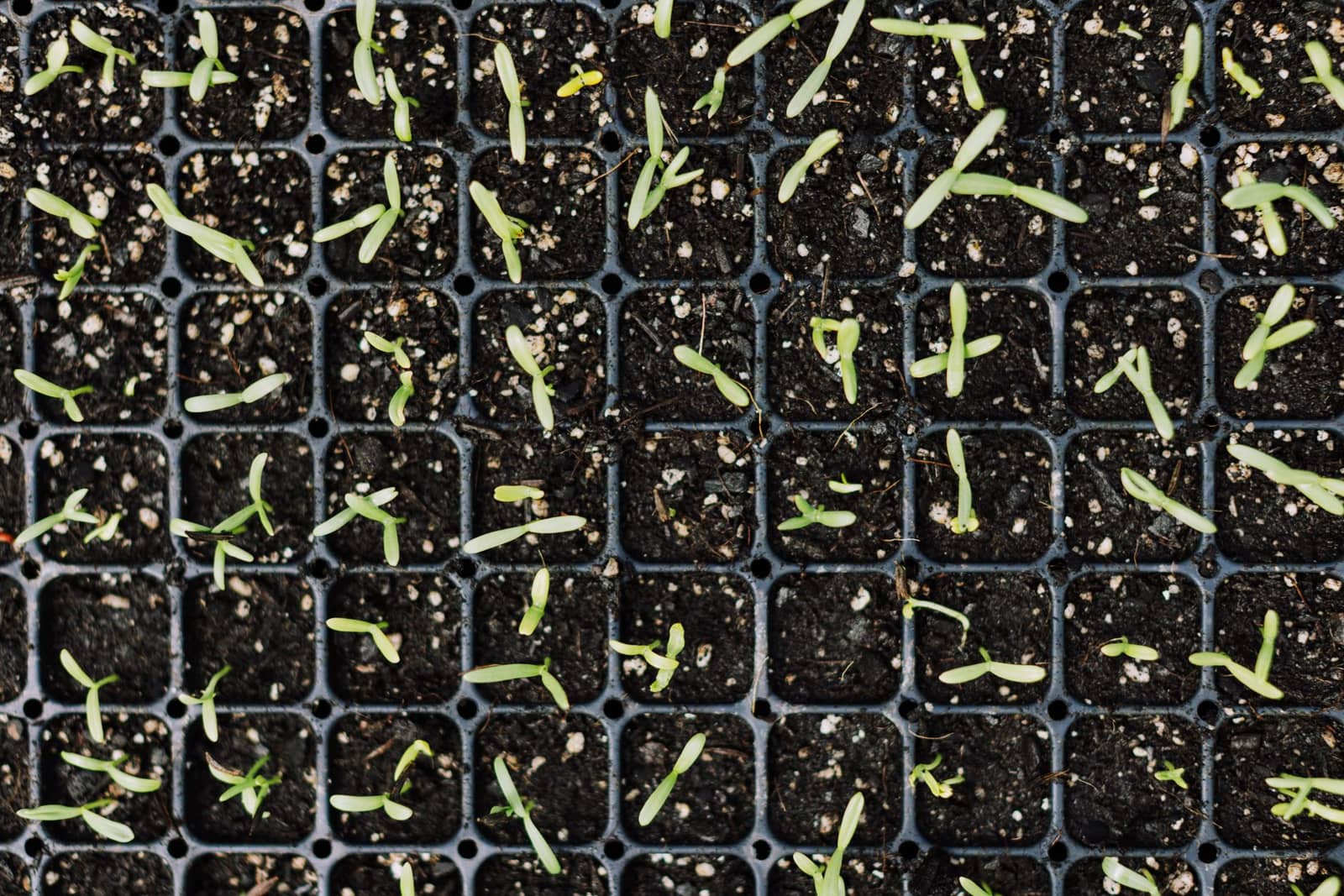
Seedlings are the one case in this section where a windowsill genuinely fails. A houseplant in a dim window sulks slowly; a tray of seedlings in a dim window stretches toward the glass within days, falls over, and never recovers. The plants need more light than a spring window delivers, closer than any window can put it, for more hours than the day has. That is what a grow light is for, and it is the purchase where the difference between a fixture and a lamp is most obvious.
This page is written for an apartment, not a greenhouse: a shelf of basil, a tray of salad greens, a batch of houseplant seed from a swap. The fixtures are the ones this site already ranks for shelves, chosen here for the two properties seedlings care about — how close they can mount, and whether they dim — plus the three pieces of hardware that a seedling light is useless without: a tray that drains, a dome that vents, and a heat mat that knows what temperature it is.
Why seedlings are different from houseplants
Three things. First, distance: light intensity falls with the square of distance from the fixture, so a bar 2 inches above a tray delivers many times what the same bar delivers at a foot, and seedlings, unlike a mature plant, can sit that close because there is nothing to scorch yet. The distance guide works through the arithmetic. Second, duration: seed-starting guidance from extension services generally runs the light longer than for houseplants, 14 hours a day or more, which makes a timer the most important feature after the light itself. Third, the seedlings move: they grow toward the light by the day, so a fixture that cannot be raised is a fixture that is at the wrong height within a week.
That last point is why a shelf beats a lamp. A bar under a shelf is at a fixed height, and the tray beneath it is raised on a book or a box and lowered as the plants grow. A clip lamp aimed at a tray from the side lights one edge of it and leaves the seedlings on the far side leaning. Every fixture below mounts flat above a tray, and the ones that dim are ranked higher because a dimmer is how you avoid scorching new leaves under a bar that is 2 inches away.
What the light has to do, and what it costs to run
Published wattage is a way to compare similar fixtures, not a measure of what a plant receives, and this site says so on every grow-light page. For seedlings the comparison is simpler than usual, because every fixture is at the same close distance: a 20 W bar 2 inches above a tray and a 40 W bar 2 inches above a tray are comparable on wattage in a way that two fixtures at different heights never are. Buy on published output where the listing gives it, on color temperature where it does not, and skip anything that publishes neither.
kWh per day = watts x hours / 1000
Four 1-foot T5 bars at the listing's published total wattage, 16 hours a day: multiply and divide by 1,000 for kWh. A 20 W heat mat for the same 16 hours is 0.32 kWh a day, or about 10 kWh over a month of germination.
The mat's wattage is published; use the bar set's published figure for the light. At typical residential rates both are cents a day, and the mat can be unplugged the day the seedlings are up.
Heat mats: only for a cold room
Seeds germinate on soil temperature, and a tray on a windowsill in late winter can sit well below the room. A heat mat under the tray fixes that, and the one feature that matters is a thermostat with a probe in the mix — a mat without one heats until it is unplugged, and a tray of wet mix on an unregulated mat can cook a batch of seed as easily as it warms it. The mat below publishes its range and its wattage, and it is ETL-listed, which is the mark to look for on anything warm left under a wet tray.
It is also the item most people do not need. A warm apartment shelf germinates basil, most greens and most houseplant seed without help, and the mat is a solution to a cold room specifically. Buy it if the shelf is by a drafty window or the heating goes off at night; skip it if the room stays comfortable.
Domes and trays: vents, drainage, and when to take the lid off
A dome holds humidity over the tray until the seed is up, and then it needs to come off — seedlings under a sealed dome damp off, which is the fungal collapse at the soil line that takes a whole tray in a night. The feature to check is an adjustable vent, so the dome can be cracked on day three and removed by the time the first true leaves show. The other feature is drainage: a cell insert with holes over a solid base, so the mix can be watered from below and never sits wet.
Two trays are below because they suit two different people. The five-pack of lighter trays is for successive sowings — basil this week, cilantro in three — where each batch wants its own dome for a few days. The single heavy dome is for someone who starts one tray of the same things every spring and would rather own one lid that lasts than five that crack.
Quick picks
Ranked, with the published figure each pick turns on. Tap a row for the full reasoning further down this page.
| # | Product | Best for | Price |
|---|---|---|---|
| 1 | 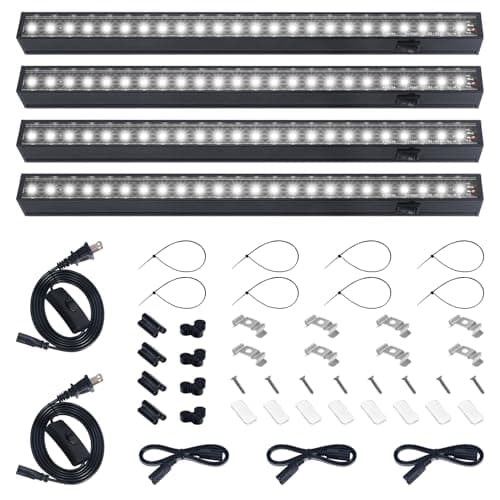 Barrina T5 Grow Light Bars, 1 ft, 5000 K full spectrum, 4 packThe retrofit answer: four short linkable bars that stick to the underside of shelving you already have, which is cheaper and more flexible than buying a lit stand. | Adding light to a shelf you already own | $30.59 at Amazon $36.99 · 17% off |
| 2 | 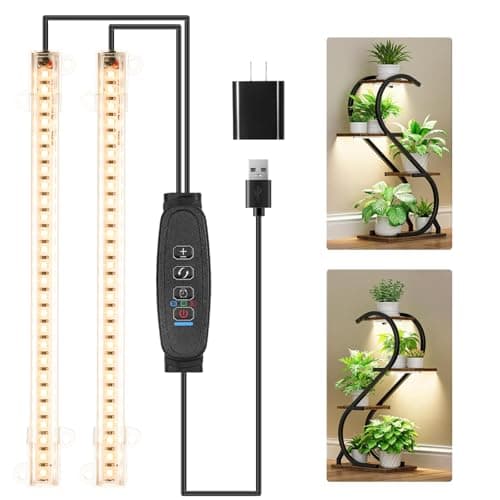 RWNTAO 8.6 in Mini LED Grow Light Strips with timer, 2 heads, 52 LEDsA timer, dimming and four mounting options for the price of a bulb, on a strip small enough to hide under a shelf. The listing publishes no wattage, and that is the trade. | One shelf of succulents on a timer for very little | |
| 3 | 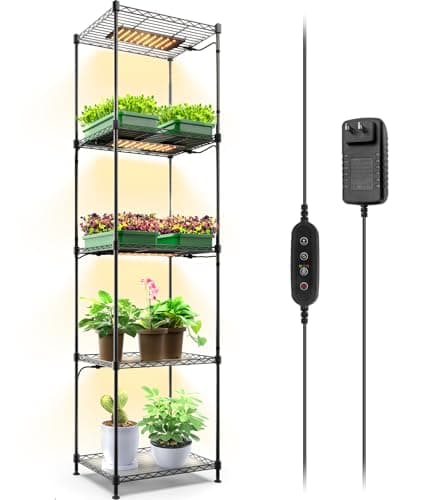 Barrina 5 Tier Plant Shelf with Grow Light, 40 W, 15.7 by 11.8 by 59.1 inThe only lit stand here that publishes both its wattage and its full dimensions, which is the difference between comparing products and comparing photographs. | Published wattage and published dimensions | |
| 4 | 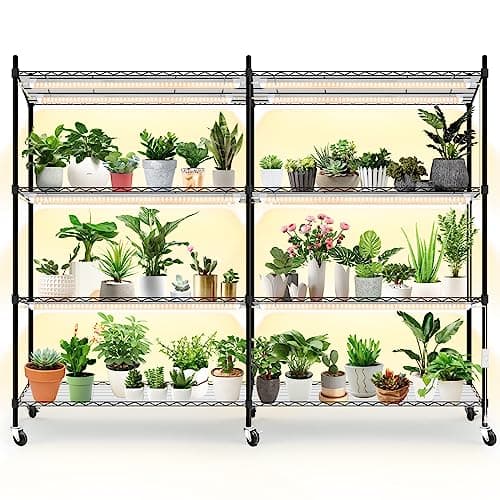 Bstrip 4 Tier Plant Shelf with Grow Lights, 288 W, 58 by 13.8 by 59 in288 W is real growing light rather than supplementary light, and it is published, which makes this the pick for a room where the window is not going to do the job. | A room with no usable daylight | |
| 5 | 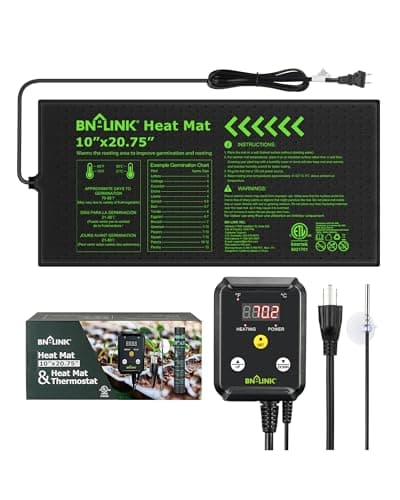 BN-LINK Seedling Heat Mat with Thermostat Controller, 10 by 20.75 in, 20 WA thermostat is the difference between a heat mat and a hot plate, and this one publishes its range, its wattage and its listing mark. | Germinating in a cool apartment without guessing at the temperature | |
| 6 | 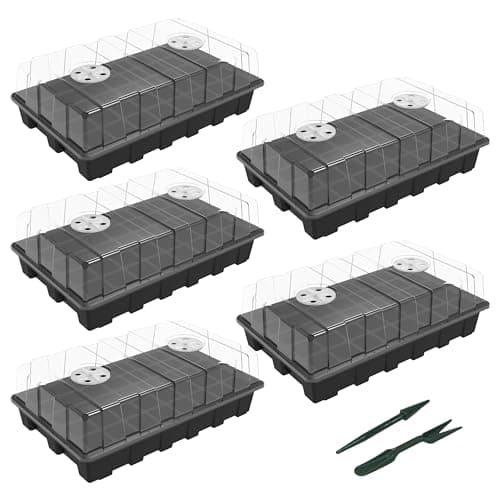 Gardzen Seed Starter Tray Kits with vented humidity domes, 40 cells each, 5 setFive domed trays with adjustable vents for the price of one heavy-duty dome. Thin plastic, but the plastic is not what germinates the seed. | Starting a whole season of herbs for the price of one dome | |
| 7 | 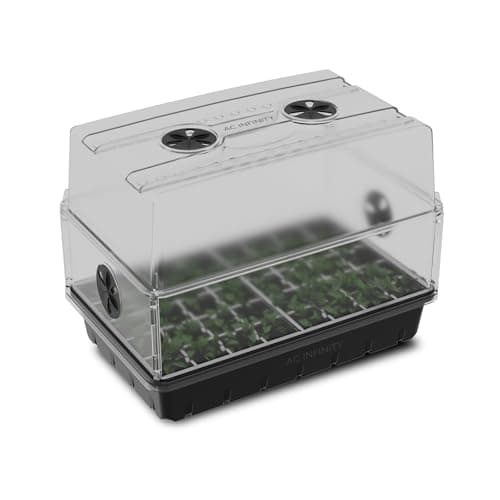 AC Infinity Humidity Dome and Seedling Tray, 5 by 8 cells, 3 mm domeThe only tray here that publishes the thickness of its dome, which is the one number that predicts whether it survives its second spring. | One dome that outlasts the plastic it replaces |
Links to Amazon are affiliate links. Prices and availability are Amazon's and change without notice.
How we ranked these for seedlings
How close the fixture mounts, then whether it dims, then published output. The 1-foot T5 bars lead because they mount flat under any shelf, link together, and publish a color temperature, which for a tray of seedlings is the whole brief at the lowest cost on the page. The small strip ranks second on two features the bars lack — a memory timer and ten dimming levels — and is marked down for publishing no wattage at all. The two shelves are for someone building a permanent seed-starting station rather than borrowing a bookshelf for six weeks, and are ranked by published wattage per tier. The mat and trays are ranked among themselves on what they publish: a thermostat range, a vent, a dome thickness.
| Your situation | Light | Add |
|---|---|---|
| One tray of herbs on a bookshelf | 1-foot T5 bars, four-pack | A domed tray; a timer plug |
| Two trays, cold room by a window | 1-foot T5 bars, four-pack | Heat mat with thermostat; two domed trays |
| A shelf of seedlings every spring | 5-tier shelf with lights, 40 W | The heavy 3 mm dome |
| Seedlings plus a houseplant collection, no daylight | 4-tier shelf, 288 W | Domed trays on the lowest tier |
| A single small tray on a desk | Mini strip with timer and dimmer | Nothing else |
The height routine, which is the whole technique
- Start the bar 2 to 3 inches above the tray, or at the closest height the listing allows. Seedlings that have to reach for light stretch and fall.
- Check daily and raise the tray, not the light, keeping the same gap as the seedlings grow. Books under the tray are the standard tool.
- Dim before you scorch. Pale or crisped leaf edges under a close bar mean too much; dim the fixture or add an inch of gap.
- Run the timer long. Set it for the seed-starting range, 14 hours or more, and leave it alone. Consistency matters more than the exact figure.
- Vent the dome on day three and remove it once the first true leaves show. Then unplug the mat.
What we deliberately do not recommend
Clip lights for trays, which light one side. Any fixture that cannot be brought within a few inches of the tray, because a seedling light at 18 inches is a houseplant light. Unregulated heat mats. Sealed domes with no vent. And the purple panels sold by an 'equivalent' wattage with no published figure of their own — a listing that publishes nothing cannot be compared with one that does, and the full spectrum comparison explains why white light is the right choice for a room you live in anyway.
Every pick, in full
We have not handled any of these. What follows is what each listing publishes, what that means once you put a watered pot on it, and who should buy something else.
1. Adding light to a shelf you already own
Barrina T5 Grow Light Bars, 1 ft, 5000 K full spectrum, 4 pack
The retrofit answer: four short linkable bars that stick to the underside of shelving you already have, which is cheaper and more flexible than buying a lit stand.
- What the listing publishes
- Published 20 W total across four linkable 1 ft bars (4 by 5 W) with 96 LEDs; 5000 K described as full spectrum; black aluminum casing; magnetic bar, clips and cable ties supplied; on/off switch on each bar
- Against a 10-inch pot
- No weight rating is published for this product, so there is nothing to check. That counts against it here rather than being treated as neutral.
5000 K is published, and that matters. Color temperature is the specification that decides whether a grow light is livable in a room, and 5000 K is daylight-neutral rather than the pink-purple of a red-blue fixture.
Linkable means one outlet runs the set. Four separate lights on four plugs is how a plant shelf ends up with a power strip on the floor.
Magnetic mounting works on a steel shelf and not on a wooden one, where the supplied clips or tape become the mounting method.
What is good
- Publishes color temperature, which most of this category does not
- Linkable, so one outlet runs the whole set
- Turns any shelf you already own into a lit one
What is not
- One-foot bars need several to cover a shelf
- The magnetic mount only helps on steel
- 20 W across four feet is about 5 W per foot, so it supplements daylight rather than replacing it
- Names PPFD in the listing and publishes no figure for it
Skip it if you want one purchase that solves lighting. A lit stand arrives assembled and this is a retrofit project.
2. One shelf of succulents on a timer for very little
RWNTAO 8.6 in Mini LED Grow Light Strips with timer, 2 heads, 52 LEDs
A timer, dimming and four mounting options for the price of a bulb, on a strip small enough to hide under a shelf. The listing publishes no wattage, and that is the trade.
#ad · Price as of October 25, 2026. How we are funded
- What the listing publishes
- Published two 8.6 in bars, 52 LEDs total; 3/9/12 h cycle timer; 10 dimming levels; three switch modes; aluminum body; screws, ties, adhesive tape and magnets included; 71 in cord
- Against a 10-inch pot
- No weight rating is published for this product, so there is nothing to check. That counts against it here rather than being treated as neutral.
The timer is why this exists. Succulents on a shelf need the same 12 hours every day, and a light with a memory timer does that without a smart plug or a person remembering. At this price the timer alone would be worth it.
What the listing does not say is how many watts the strip draws or what it delivers at any distance. It states LED count and color temperature and stops. That makes it impossible to compare against the bulbs above on output, and the honest position is that it lights a short shelf of small plants and nothing larger.
Four mounting options — magnets, tape, ties and screws — mean it goes under a metal shelf, a wood shelf or a plastic one, and comes off a rental shelf without a mark. The 71 in cord is long enough to reach a socket from a shelf top.
What is good
- Cycle timer with memory, on a light that costs about what a bulb costs
- Magnets and tape included, so it mounts with no drilling
- Ten dimming levels, which matters for seedlings that scorch
What is not
- No published wattage or light output of any kind
- 8.6 in bars light one short shelf, not a plant collection
- The listing's own bullets disagree on color temperature (3000 K in the title, 3500 K in the text)
Skip it if you want to know what the light delivers before you buy it. The Barrina bars publish 5000 K and the SANSI bulb publishes PPF; this strip publishes an LED count.
3. Published wattage and published dimensions
Barrina 5 Tier Plant Shelf with Grow Light, 40 W, 15.7 by 11.8 by 59.1 in
The only lit stand here that publishes both its wattage and its full dimensions, which is the difference between comparing products and comparing photographs.
#ad · Price as of October 25, 2026. How we are funded
- What the listing publishes
- Published 40 W total; 15.7 by 11.8 by 59.1 in; 5 adjustable tiers
- Against a 10-inch pot
- No weight rating is published for this product, so there is nothing to check. That counts against it here rather than being treated as neutral.
40 W across five tiers is 8 W a tier. That is a modest figure and it is a real one, which is more than most of this category offers, and it tells you this supplements light rather than replacing a window.
15.7 by 11.8 inches is 1.29 square feet for five positions, about 3.9 plants per square foot, all lit.
Adjustable tiers plus published dimensions means you can work out before ordering whether your pots fit. Almost nothing else in this category lets you do that.
What is good
- Publishes wattage and full dimensions
- Adjustable tier heights
- Nearly four lit plants per square foot
What is not
- 40 W total is supplemental light, not a substitute for a window
- 11.8 in depth takes 6-inch pots at most
- No published weight rating
Skip it if you have no window light at all. 8 W a tier supplements daylight, and a windowless room needs the higher-output shelves here.
4. A room with no usable daylight
Bstrip 4 Tier Plant Shelf with Grow Lights, 288 W, 58 by 13.8 by 59 in
288 W is real growing light rather than supplementary light, and it is published, which makes this the pick for a room where the window is not going to do the job.
#ad · Price as of October 25, 2026. How we are funded
- What the listing publishes
- Published 288 W across 12 lights; 58 in wide by 13.8 in deep by 59 in tall
- Against a 10-inch pot
- No weight rating is published for this product, so there is nothing to check. That counts against it here rather than being treated as neutral.
288 W across four tiers is 72 W a tier, nine times the per-tier figure of the 40 W shelf. That is the difference between keeping a plant alive and growing it.
It is also 58 inches wide, which is nearly five feet of wall. Twelve positions on 5.6 square feet is 2.1 plants per square foot, a poor density, because this is a wide bench rather than a tower.
288 W continuous is a real running cost and a real amount of heat in a small room. Both are worth thinking about before it arrives.
What is good
- Publishes 288 W, which is genuine growing output
- Four wide tiers take 8-inch pots
- Twelve lights means even coverage rather than one hot spot
What is not
- Nearly five feet wide, so this is a wall rather than a corner
- 288 W runs warm and costs real money over a winter
- The worst plants-per-square-foot of the lit stands here
Skip it if you have a usable window. This is windowless-room equipment and it is oversized for supplementing daylight.
5. Germinating in a cool apartment without guessing at the temperature
BN-LINK Seedling Heat Mat with Thermostat Controller, 10 by 20.75 in, 20 W
A thermostat is the difference between a heat mat and a hot plate, and this one publishes its range, its wattage and its listing mark.
#ad · Price as of October 25, 2026. How we are funded
- What the listing publishes
- Published 10 by 20.75 in, 20 W mat; thermostat adjustable 40 to 108 F with a probe; IP67 mat; ETL-listed; stated 12 month warranty
- Against a 10-inch pot
- No weight rating is published for this product, so there is nothing to check. That counts against it here rather than being treated as neutral.
Seeds germinate on soil temperature, not air temperature, and a windowsill in February can sit well below the room. An unregulated mat solves that by overshooting; a thermostat with a probe in the tray holds the number you set.
The mat is sized to a standard 10 by 20 nursery tray, which is the common seed-tray format, so one mat under one tray is the usual setup — check a tray's published dimensions before assuming it matches.
Twenty watts is a small, continuous draw. Left on for a month of germination it is a few kilowatt-hours, which is worth knowing before wondering whether the light or the mat is what shows up on the bill.
What is good
- Publishes the thermostat range, mat wattage and dimensions
- ETL-listed, which is the mark to look for on anything warm left under a wet tray
- Sized to the standard 10 by 20 tray
What is not
- The controller and probe are a second box and a second cable on the shelf
- One mat heats one tray; a two-tray shelf needs two
- The mat is only useful until seedlings are up — then it is a drawer item until next year
Skip it if the room stays above 70 F. Most houseplant seed and every cutting on a warm shelf germinates without bottom heat, and the mat is a solution to a cold room specifically.
6. Starting a whole season of herbs for the price of one dome
Gardzen Seed Starter Tray Kits with vented humidity domes, 40 cells each, 5 set
Five domed trays with adjustable vents for the price of one heavy-duty dome. Thin plastic, but the plastic is not what germinates the seed.
#ad · Price as of October 25, 2026. How we are funded
- What the listing publishes
- Published 5 trays of 40 cells (200 cells total); each with a base, a cell insert with a drain hole, and a clear dome with two adjustable vents
- Against a 10-inch pot
- No weight rating is published for this product, so there is nothing to check. That counts against it here rather than being treated as neutral.
Two hundred cells is more than any apartment sows, which is not the point. The point is that five separate domes let you start basil this week and cilantro in three weeks without lifting a lid on seedlings that are already up.
The vents on the dome are the feature that matters. A sealed dome grows mold as readily as it grows seedlings; being able to crack the vents on day three is what the cheap sets without them cannot do.
The drain hole in the cell insert is the other thing to check on any tray. Seedlings in cells that cannot drain die from the bottom up, and an insert with holes over a solid base is the correct arrangement.
What is good
- Five domes, so successive sowings do not share a lid
- Adjustable vents on every dome
- Cell inserts drain into a solid base
What is not
- Lightweight plastic — the listing calls it durable, but 40-cell inserts flex when full and wet
- 200 cells is a market garden's worth of seedlings for an apartment
- No published dimensions beyond the cell count
Skip it if you sow one tray a year. A single sturdier dome outlasts five thin ones, and the AC Infinity kit below is that dome.
7. One dome that outlasts the plastic it replaces
AC Infinity Humidity Dome and Seedling Tray, 5 by 8 cells, 3 mm dome
The only tray here that publishes the thickness of its dome, which is the one number that predicts whether it survives its second spring.
#ad · Price as of October 25, 2026. How we are funded
- What the listing publishes
- Published 3 mm clear dome with adjustable vents; 5 by 8 cell seedling tray stated to hold up to 40 seedlings; separate drip tray; optional height extension panels
- Against a 10-inch pot
- No weight rating is published for this product, so there is nothing to check. That counts against it here rather than being treated as neutral.
Three millimeters is a real specification in a category that usually says 'durable' and nothing else. It is the difference between a dome that stacks in a closet and one that cracks along the hinge line the second time it is dropped.
The optional extension panels are the clever part. Seedlings outgrow a standard dome in a week; being able to raise the lid rather than remove it keeps humidity on cuttings that are not rooted yet.
Forty cells is one sowing. This is a kit for someone who starts the same tray of herbs every spring, not for staggered sowings across a month.
What is good
- Publishes dome thickness — 3 mm — where competitors publish adjectives
- Extension panels raise the dome as seedlings grow
- Separate drip tray stated to support heavier loads without leaking
What is not
- One dome, so successive sowings share a lid
- Costs what five of the lighter trays cost
- Extension panels are optional and may be a separate purchase
Skip it if you want to start several batches on different dates. Five separate domes serve that better than one good one.
Questions people actually ask
How far should a grow light be from seedlings?
How many hours a day do seedlings need a grow light?
Do I need a heat mat to start seeds indoors?
Can I use a regular LED light for seedlings?
When should I take the dome off seedlings?
Why are my seedlings tall and thin?
Sources
- University of Illinois Extension: Houseplants — lighting
- University of Illinois Extension: Houseplants — propagation
- Michigan State University Extension: Smart Gardening — growing houseplants indoors
- Cornell University, Greenhouse Management: bulk density of greenhouse media components
- Biology Insights: how much a cubic foot of potting soil weighs, dry and saturated
Product specifications are quoted from each seller's own listing and are the seller's claim, not a measurement of ours.