Grow Lights
Full Spectrum or Red and Blue?
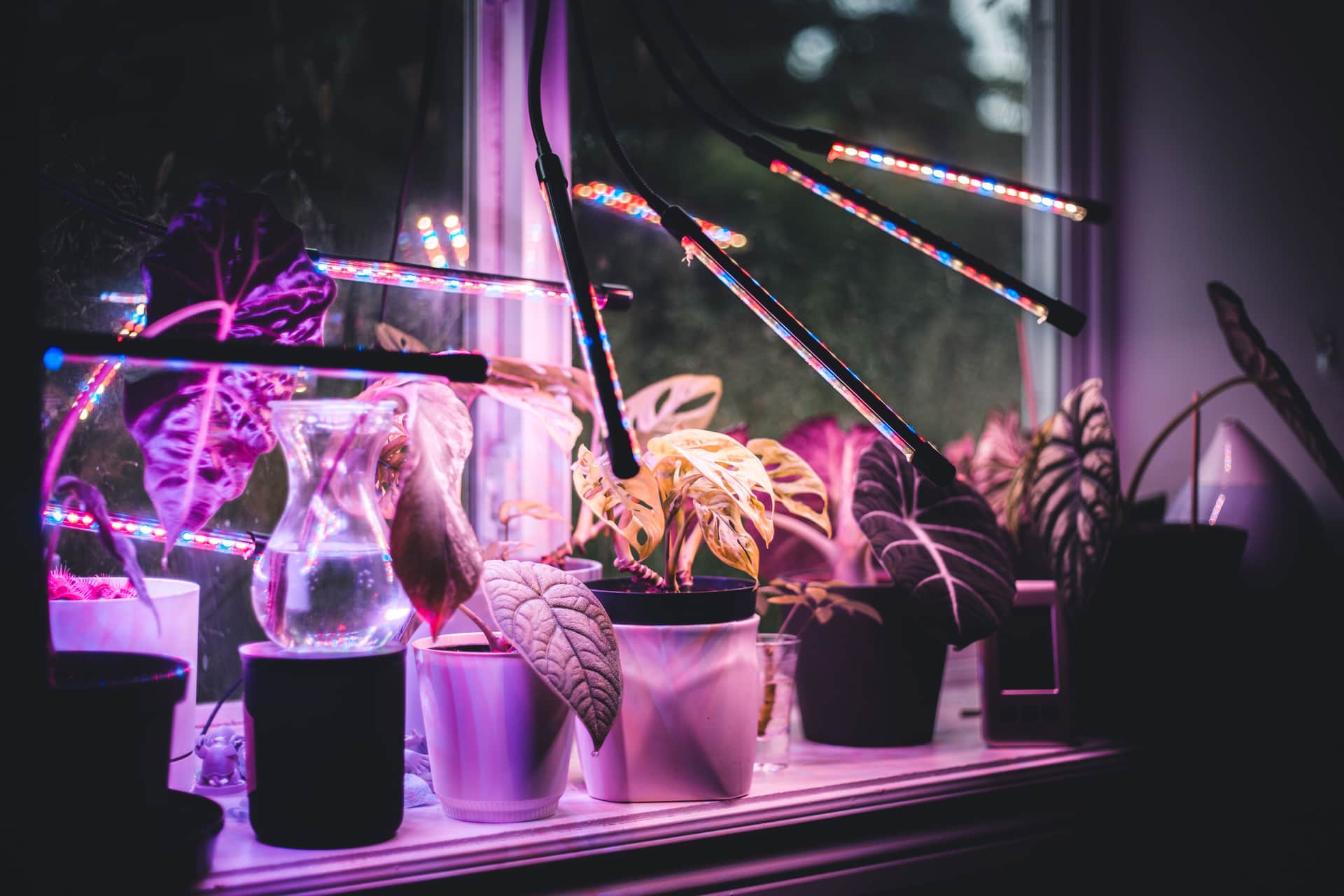
Both grow houseplants. Only one of them lets you see what color your plants are, and in a studio that is not a trivial consideration.
By Scooter M., enthusiast · Published · Last updated
The short answer
White full-spectrum light, for any fixture in a room you spend time in. Red-blue fixtures target the wavelengths chlorophyll absorbs most strongly, which is real, but white light contains those same wavelengths and renders the room normally. Choose red-blue only for a closet, a spare room or a grow tent where nobody has to look at it.
Disclosure Pot & Prop earns a commission when you buy through the Amazon links on this page, at no extra cost to you. It does not change which products get recommended or what we say about them, and we have not been given any of them. How this site is funded.
The spectrum argument is the most technical-sounding thing in this category and one of the least decision-relevant for a houseplant keeper. The underlying fact is true: chlorophyll absorbs most strongly in the blue and red parts of the spectrum, and a fixture that emits mainly at those wavelengths puts a higher proportion of its output into wavelengths a plant uses. That is why the purple fixtures exist and it is not marketing.
What follows from it is smaller than it sounds. White LEDs are not missing red and blue — white light is made of the whole visible range, and a 4000 K or 5000 K fixture emits plenty of both. So the choice is between a fixture that is somewhat more efficient at delivering usable wavelengths and one that lets you see the room. In a commercial operation, efficiency wins. In a studio apartment where the shelf is next to the sofa, it does not.
The two side by side
| White full spectrum | Red and blue | |
|---|---|---|
| Contains red and blue | Yes, within white light | Yes, concentrated |
| Efficiency toward absorbed wavelengths | Good | Somewhat better |
| What the room looks like | Normal | Magenta |
| Can you see plant health | Yes | No — everything reads purple |
| Photographs of your plants | Fine | Unusable |
| Best location | Anywhere you live | Closet, spare room, tent |
| Typical published figure | Color temperature in kelvin | Mode switch or diode ratio |
Why seeing your plants matters more than efficiency
Almost everything that goes wrong with a houseplant announces itself as a color change first: yellowing lower leaves, pale new growth, brown crisping edges, the dull gray-green of a plant that is too dry. Under magenta light every one of those looks the same as healthy foliage. A modest efficiency gain is a poor trade for losing the diagnostic channel you actually use, especially on a shelf you walk past every day.
There is a second, less obvious cost. A magenta glow in a small apartment is genuinely intrusive after dark, and a light you resent is a light you switch off — which turns a 12-hour day length into an erratic one, and inconsistency does far more harm to a plant than a spectrum difference ever will.
What a named diode tells you
The most useful specification in this category is not a spectrum chart but a part number. When a manufacturer names the diode it uses, it is making a claim you can look up, against a component with published performance data, and it has therefore committed to something. Most listings here publish a wattage and a mode switch and nothing checkable at all. A fixture that names its diodes is not automatically better, but it is the only kind whose claim can be verified — and on this site that counts.
Every pick, in full
We have not handled any of these. What follows is what each listing publishes, what that means once you put a watered pot on it, and who should buy something else.
1. Comparing red-blue against white light honestly
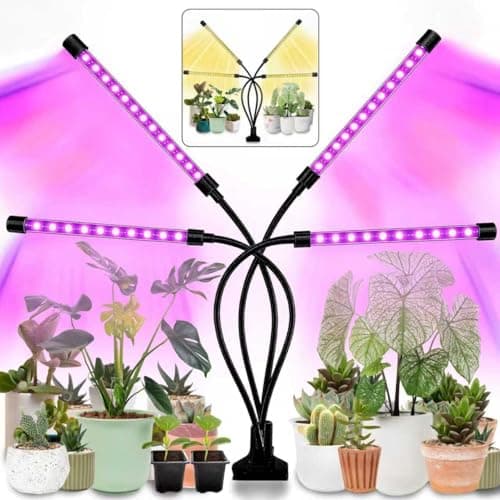
LEOTER Clip Grow Light, 80 LEDs, full spectrum plus red and blue, timer
Switchable between white and red-blue, which makes it the one light here that lets you see for yourself why almost every apartment ends up leaving it on white.
- What the listing publishes
- 80 LEDs, published full spectrum plus red and blue modes, 3/9/12 h timer, 10 dimming levels
- Against a 10-inch pot
- No weight rating is published for this product, so there is nothing to check. That counts against it here rather than being treated as neutral.
Red and blue diodes target the wavelengths chlorophyll absorbs most, so per watt they are more efficient for the plant. That is a real advantage and it is why commercial growers use them.
They also turn a room magenta. In a studio where you sleep six feet from the shelf, that efficiency argument loses to the fact that you live there.
The timer is the underrated feature. Plants respond to day length, and a light left on continuously is worse for many of them than a shorter, timed cycle.
What is good
- Switch between modes and judge the color trade for yourself
- A built-in timer runs a real day-length cycle
- Ten dimming levels for distance tuning
What is not
- Red-blue mode is genuinely unpleasant in a living space
- Total wattage is not published, only the LED count
- Gooseneck arms sag under their own weight over time
Skip it if the shelf is in a bedroom or living room. You will run it on white permanently, and a white-only light publishes better numbers for the same money.
2. Naming the diode instead of the marketing
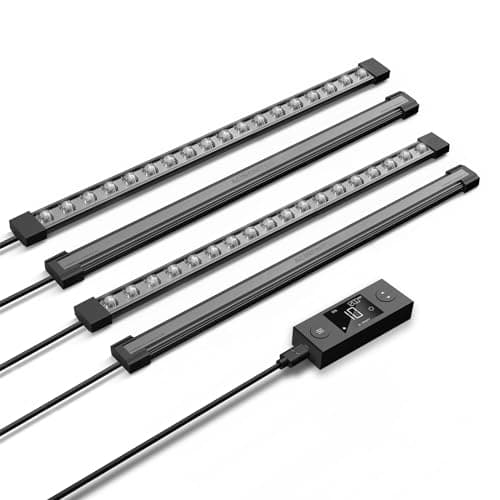
AC Infinity IONBEAM S16 Full Spectrum LED Grow Light Bar, 16 in
The only light here that publishes which diode it uses, which is the difference between a specification and an adjective.
#ad · Price as of October 18, 2026. How we are funded
- What the listing publishes
- 16 in bar; published Samsung LM301H EVO diodes; digital dimming and timer controller
- Against a 10-inch pot
- No weight rating is published for this product, so there is nothing to check. That counts against it here rather than being treated as neutral.
LM301H EVO is a named, documented, third-party-testable component. Full spectrum is not. A listing that tells you the diode is a listing whose claims you can check, which is the standard this whole site is arguing for.
Digital dimming and a timer built into the controller removes the separate mechanical timer that every other light here needs.
It is a bar, not a stand. You are buying light and mounting it to something you already have.
What is good
- Publishes the actual diode, so the output claim is checkable
- Dimming and timer built into the controller
- 16 in covers a shelf properly rather than needing four short bars
What is not
- Costs several times what the generic bars here do
- No stand, so you supply the shelving
- Overspecified for a single pothos
Skip it if you are lighting one plant on a windowsill. A clip light does that for a fraction of the money, and nobody needs a documented diode for a pothos.
3. Adding light to a shelf you already own
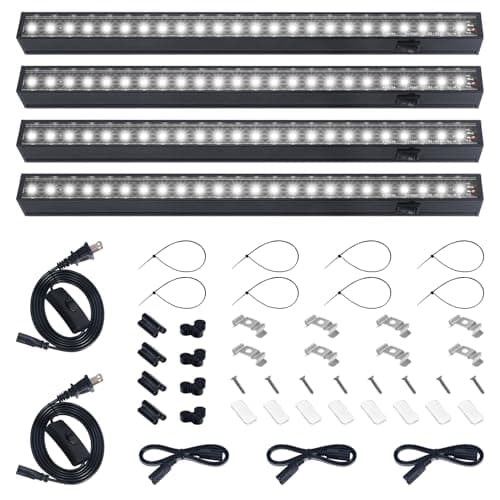
Barrina T5 Grow Light Bars, 1 ft, 5000 K full spectrum, 4 pack
The retrofit answer: four short linkable bars that stick to the underside of shelving you already have, which is cheaper and more flexible than buying a lit stand.
- What the listing publishes
- Published 20 W total across four linkable 1 ft bars (4 by 5 W) with 96 LEDs; 5000 K described as full spectrum; black aluminum casing; magnetic bar, clips and cable ties supplied; on/off switch on each bar
- Against a 10-inch pot
- No weight rating is published for this product, so there is nothing to check. That counts against it here rather than being treated as neutral.
5000 K is published, and that matters. Color temperature is the specification that decides whether a grow light is livable in a room, and 5000 K is daylight-neutral rather than the pink-purple of a red-blue fixture.
Linkable means one outlet runs the set. Four separate lights on four plugs is how a plant shelf ends up with a power strip on the floor.
Magnetic mounting works on a steel shelf and not on a wooden one, where the supplied clips or tape become the mounting method.
What is good
- Publishes color temperature, which most of this category does not
- Linkable, so one outlet runs the whole set
- Turns any shelf you already own into a lit one
What is not
- One-foot bars need several to cover a shelf
- The magnetic mount only helps on steel
- 20 W across four feet is about 5 W per foot, so it supplements daylight rather than replacing it
- Names PPFD in the listing and publishes no figure for it
Skip it if you want one purchase that solves lighting. A lit stand arrives assembled and this is a retrofit project.
Questions people actually ask
Is full spectrum better than red and blue for houseplants?
What color temperature is best for indoor plants?
Do purple grow lights work better?
Does a plant need darkness at night?
Sources
- University of Illinois Extension: Houseplants — lighting
- Michigan State University Extension: Smart Gardening — growing houseplants indoors
- University of Georgia Extension B1318: Growing Indoor Plants with Success
Product specifications are quoted from each seller's own listing and are the seller's claim, not a measurement of ours.