Grow Lights
Grow Light vs Regular Light: What Actually Differs
An ordinary white LED bulb does grow plants. What a grow light adds is intensity, aim, and — on the good ones — a number you can check.
By Scooter M., enthusiast · Published
The short answer
A regular white LED bulb emits light plants can use, and a bright one within a foot of a low-light plant helps. What a grow light adds is intensity and aim — it is designed to put more light on a leaf, and the honest ones publish that in PPF or PPFD, which an ordinary bulb never does. Lumens measure how bright light looks to a person, not what a plant receives. For one low-light plant, a grow bulb in a lamp you own is enough; for anything that wants sun, neither bulb is, and a bar is the answer.
Disclosure Pot & Prop earns a commission when you buy through the Amazon links on this page, at no extra cost to you. It does not change which products get recommended or what we say about them, and we have not been given any of them. How this site is funded.
This is the question people ask before they ask which grow light to buy, and the honest answer is more useful than either side of the argument. Yes, an ordinary LED bulb grows plants: white light contains the wavelengths a leaf uses, and a plant under a bright desk lamp does better than the same plant in a dark corner. And no, that does not make the grow-light label meaningless — it means the difference is one of quantity, aim and honesty, not of kind. This page sets out what actually differs, which figures to look at, and where each option stops being enough.
What a plant does with light, in one paragraph
Leaves use light across roughly the visible range — about 400 to 700 nanometers, the band researchers call photosynthetically active radiation. Ordinary white LEDs emit across that band. So do 'full spectrum' grow LEDs, which are for the most part white LEDs with, sometimes, extra red diodes. The spectrum argument between them is small for houseplants and is dealt with on its own page. What the plant cares about far more is how much of that light lands on the leaf, and for how many hours a day.
Lumens against PPF: the figure that changes everything
Every ordinary bulb is sold in lumens. Lumens weight light by how bright it looks to a human eye, which is most sensitive to green and least to the deep red and blue a leaf uses heavily. A lumen figure therefore tells you how well the bulb lights a room and almost nothing about what it does for a plant. The figure that does is photosynthetic photon flux — PPF, in micromoles per second — which counts the photons in the plant-useful band regardless of how they look; and PPFD, the same thing landing on a square meter at a stated distance.
Here is what that looks like on a real listing. One grow bulb below publishes 1,000 lumens and a PPF of 25 micromoles per second, both from its own bullets. Another publishes 16.8 micromoles per second of PPF and a PPFD of about 98 micromoles per square meter per second at one foot, and no lumen figure at all. A standard 60 W-equivalent household LED is sold at about 800 lumens and publishes nothing about photons. You can compare the first two on the plant's terms. You cannot compare the third on anything but how it looks.
| Bulb | Publishes | What you can conclude |
|---|---|---|
| Ordinary household LED | Lumens, watts, color temperature | How bright it looks; nothing about the plant |
| Grow bulb, budget end | Watts, color temperature, sometimes PPF | Plant-useful output, but not at any distance |
| Grow bulb, better | PPF and PPFD at a stated distance | What actually lands on a leaf a foot away |
| Grow bar | Watts, color temperature, sometimes the diode | Comparable on wattage between similar bars; distance still decides |
Aim and distance, which matter more than the label
The second real difference is optics. A household bulb is designed to throw light in every direction, because that is what a room wants. A grow bulb is usually built with a lens or reflector that pushes its output downward in a cone, because that is what a plant wants. Two bulbs of identical output in identical lamps deliver very different amounts to a leaf if one is spreading its light across the ceiling. This is also why a household bulb in a shaded table lamp does almost nothing for the plant beside it: most of the light never leaves the shade.
Distance then does the rest. Intensity falls with the square of distance, so a bulb at 2 feet delivers a quarter of what it delivers at 1 foot, and a bulb across the room delivers effectively nothing. The most common way a 'regular light' fails a plant is not the spectrum or the lumens — it is that it is a ceiling fixture 6 feet away. The most common way a grow bulb succeeds is that someone put it in a gooseneck lamp 8 inches above a pothos. The distance guide has the arithmetic.
intensity at d2 = intensity at d1 x (d1 / d2)^2
A bulb publishing about 98 micromoles per square meter per second at 1 foot delivers about a quarter of that at 2 feet — roughly 24 — and about a ninth at 3 feet. Moving the lamp from 3 feet to 1 foot does more than any bulb upgrade sold at this price.
The 1-foot figure is the listing's own. The others follow from the inverse-square relationship.
Heat, which used to be the whole argument
For decades the reason not to grow plants under a regular bulb was heat: incandescent bulbs turn most of their power into warmth, and a plant close enough to receive useful light was close enough to scorch. LEDs ended that. A 10 W LED grow bulb and a 10 W household LED run at similar, modest temperatures, and both can sit within a foot of foliage. If the lamp you own still has an incandescent or halogen bulb in it, the upgrade to any LED matters more than the choice between grow and regular.
So which should you buy?
| Your situation | Buy | Why |
|---|---|---|
| One pothos or fern in a dim corner, lamp already there | A bright white household LED, aimed, within a foot | Cheapest possible fix; spectrum is fine |
| Same, but you want to know it is working | A grow bulb that publishes PPF or PPFD | The only version of this purchase with a checkable figure |
| One plant that wants real sun — a fig, a succulent | A clip light, 20 W or more, publishing its wattage | A bulb in a lamp is not enough intensity |
| A shelf of plants | Linkable bars under each tier | Bulbs do not scale; bars do |
| A plant you want to see the diode named for | The bar that names it | Rare, and the most honest listing in the section |
Quick picks
Ranked, with the published figure each pick turns on. Tap a row for the full reasoning further down this page.
| # | Product | Best for | Price |
|---|---|---|---|
| 1 | 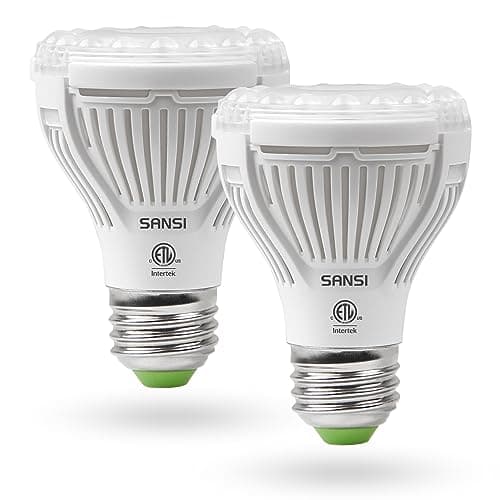 SANSI LED Grow Light Bulb, 10 W, E26, 4000 K, 2 packThe rare cheap bulb that publishes a PPF figure instead of a lumen figure, which is the number that tells you what a plant actually receives. | A grow light that screws into a lamp you already own | $9.95 at Amazon $12.95 · 23% off |
| 2 | 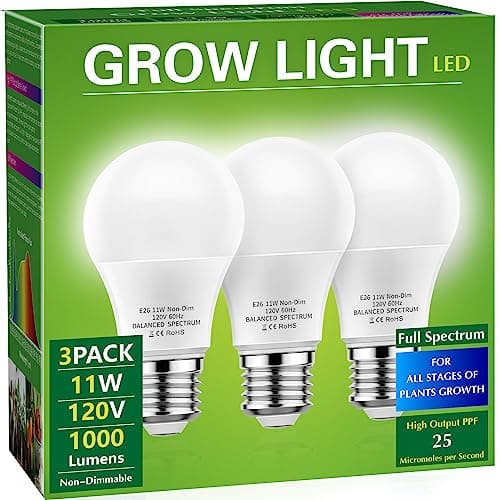 Briignite A19 Full Spectrum Grow Light Bulb, 11 W, 5000 KAn ordinary-looking A19 bulb with a published PPF, sold at a price that makes it the cheapest experiment in this section. | The cheapest way to find out whether a plant wants more light | $11.98 at Amazon $13.99 · 14% off |
| 3 | 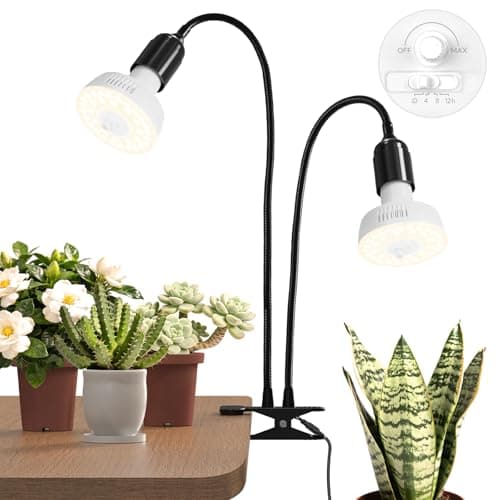 Barrina Clip On Grow Light, 22 W, 4000 KPublishes both its wattage and its color temperature, and clips to a shelf edge. The smallest useful intervention in this entire section. | One plant that needs more light than its corner gives | $27.99 at Amazon $32.99 · 15% off |
| 4 | 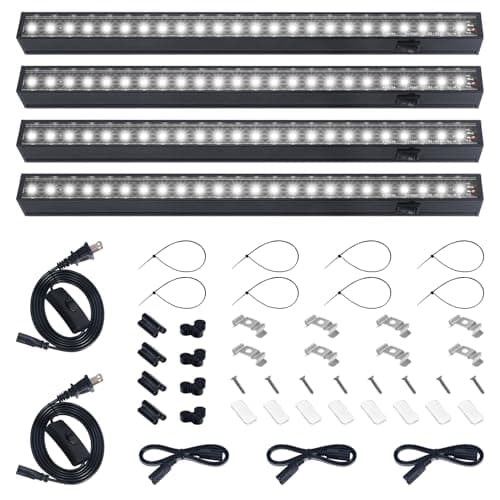 Barrina T5 Grow Light Bars, 1 ft, 5000 K full spectrum, 4 packThe retrofit answer: four short linkable bars that stick to the underside of shelving you already have, which is cheaper and more flexible than buying a lit stand. | Adding light to a shelf you already own | $30.59 at Amazon $36.99 · 17% off |
| 5 | 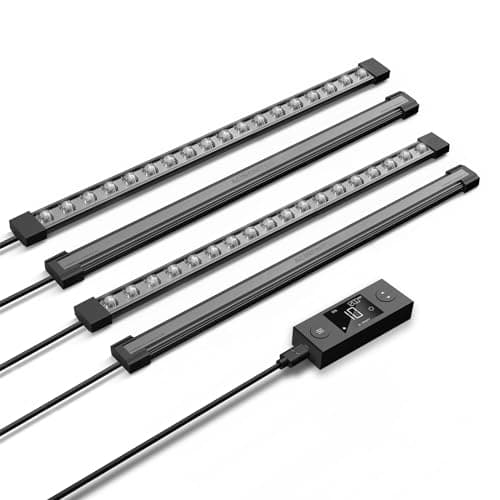 AC Infinity IONBEAM S16 Full Spectrum LED Grow Light Bar, 16 inThe only light here that publishes which diode it uses, which is the difference between a specification and an adjective. | Naming the diode instead of the marketing |
Links to Amazon are affiliate links. Prices and availability are Amazon's and change without notice.
How the picks are ordered
By how much each listing publishes that a plant can be judged on, then by how far the approach scales. The SANSI bulb leads because it is the only screw-in bulb here with a PPFD at a stated distance, which is the figure this whole page is about. The Briignite bulb publishes PPF and lumens side by side, which makes it the clearest demonstration on the page of why the two numbers are not the same thing. The clip light and the bars are where the bulb approach stops and a fixture starts, and the IONBEAM is there because naming the diode is the next level of disclosure up from publishing a photon figure.
What we deliberately do not recommend
Incandescent or halogen bulbs near foliage, for heat. Household bulbs in shaded lamps as a plant fix, because the shade keeps the light. Any grow bulb sold on an 'equivalent' wattage with no output figure of its own — the equivalence is to a bulb nobody is using. And buying a bulb of any kind for a plant that wants sun: a bulb is a low-light fix, and a succulent under a desk lamp still stretches. The succulent lighting page covers what those plants actually need.
Every pick, in full
We have not handled any of these. What follows is what each listing publishes, what that means once you put a watered pot on it, and who should buy something else.
1. A grow light that screws into a lamp you already own
SANSI LED Grow Light Bulb, 10 W, E26, 4000 K, 2 pack
The rare cheap bulb that publishes a PPF figure instead of a lumen figure, which is the number that tells you what a plant actually receives.
- What the listing publishes
- Published 10 W, E26 base, 4000 K; PPF 16.8 umol/s and PPFD 97.91 umol/m2/s at 1 ft, per the listing; ceramic heat sink; stated 25,000 hour life; ETL listed; 2 pack
- Against a 10-inch pot
- No weight rating is published for this product, so there is nothing to check. That counts against it here rather than being treated as neutral.
Almost every screw-in grow bulb is sold on lumens, which measure how bright light looks to a person and say nothing useful about a plant. This listing publishes PPF — the photon flux plants respond to — and a PPFD at one foot. Those are the figures to compare, and most competitors do not print them.
Ten watts is small. The published 97.91 umol/m2/s at one foot is a useful amount for a single low-light plant on a desk and not enough for a sun-loving one, and the honest use of this bulb is in a desk lamp aimed at one pothos or one fern.
4000 K is the same warm-white as the Barrina clip light, so it does not turn a living room purple or clinical. It reads as an ordinary lamp bulb, which is most of why people buy it.
What is good
- Publishes PPF and PPFD, not just lumens
- Fits any E26 lamp you already own — no fixture, no mounting
- 4000 K looks like a normal bulb in a normal room
What is not
- 10 W lights one plant at one foot, not a shelf
- Output falls off sharply beyond a foot, and the listing only publishes the 1 ft figure
- Needs a lamp that can aim downward — a table lamp with a shade wastes most of it
Skip it if you have more than a couple of plants to light. Two bulbs in two lamps is the ceiling of this approach, and a linkable bar set costs about the same.
2. The cheapest way to find out whether a plant wants more light
Briignite A19 Full Spectrum Grow Light Bulb, 11 W, 5000 K
An ordinary-looking A19 bulb with a published PPF, sold at a price that makes it the cheapest experiment in this section.
- What the listing publishes
- Published 11 W A19, 5000 K white; 1000 lumens; PPF stated at 25 umol/s; stated 25,000 hour life
- Against a 10-inch pot
- No weight rating is published for this product, so there is nothing to check. That counts against it here rather than being treated as neutral.
A lot of grow-light shopping is really a diagnosis: is the plant struggling because of light or because of something else? An 11 W bulb in an existing lamp answers that for less than the cost of a takeout order, and if the answer is yes, the next purchase is a bar set with a clearer conscience.
The listing publishes 25 umol/s of PPF, which is more than the SANSI bulb's 16.8 — but it does not publish a PPFD at any distance, so how much of that reaches a leaf depends entirely on the lamp it is in and how close the plant sits.
5000 K is cooler and whiter than 4000 K. In a bedroom lamp it looks like daylight rather than lamplight, which some people want and some do not.
What is good
- Publishes PPF, which most bulbs at this price do not
- Standard A19 shape fits lamps a grow bulb usually will not
- Low enough cost to be a diagnostic rather than a commitment
What is not
- No published PPFD at any distance, so real delivery is unknown
- 5000 K reads as clinical in a warm-lit room
- Marketed at vegetables — useful for houseplants, but the listing is not written for them
Skip it if the plant is a succulent or a cactus. 11 W in a lamp is a low-light fix, and sun plants need the clip or bar options rather than a bulb.
3. One plant that needs more light than its corner gives
Barrina Clip On Grow Light, 22 W, 4000 K
Publishes both its wattage and its color temperature, and clips to a shelf edge. The smallest useful intervention in this entire section.
- What the listing publishes
- Published 22 W (2 by 11 W) at 4000 K; clip mount
- Against a 10-inch pot
- No weight rating is published for this product, so there is nothing to check. That counts against it here rather than being treated as neutral.
22 W on one plant is a genuinely useful amount of light. The same 22 W spread across a six-tier shelf would be nothing, which is why per-plant clip lights outperform their wattage.
4000 K is warmer than the 5000 K bars and noticeably less clinical in a living room, at a small cost in usable output for the plant.
A clip needs something to clip to, with a lip. Shelf edges work; a windowsill usually does not.
What is good
- Publishes watts and color temperature
- 22 W concentrated on one plant does real work
- No mounting, no fixing, and it moves with the plant
What is not
- Needs a shelf edge or similar to clip to
- Lights one plant, not a collection
- Two heads means two points of aim to get right
Skip it if you have a whole shelf to light. Clip lights do not scale, and a linkable bar set is the right tool at that point.
4. Adding light to a shelf you already own
Barrina T5 Grow Light Bars, 1 ft, 5000 K full spectrum, 4 pack
The retrofit answer: four short linkable bars that stick to the underside of shelving you already have, which is cheaper and more flexible than buying a lit stand.
- What the listing publishes
- Published 20 W total across four linkable 1 ft bars (4 by 5 W) with 96 LEDs; 5000 K described as full spectrum; black aluminum casing; magnetic bar, clips and cable ties supplied; on/off switch on each bar
- Against a 10-inch pot
- No weight rating is published for this product, so there is nothing to check. That counts against it here rather than being treated as neutral.
5000 K is published, and that matters. Color temperature is the specification that decides whether a grow light is livable in a room, and 5000 K is daylight-neutral rather than the pink-purple of a red-blue fixture.
Linkable means one outlet runs the set. Four separate lights on four plugs is how a plant shelf ends up with a power strip on the floor.
Magnetic mounting works on a steel shelf and not on a wooden one, where the supplied clips or tape become the mounting method.
What is good
- Publishes color temperature, which most of this category does not
- Linkable, so one outlet runs the whole set
- Turns any shelf you already own into a lit one
What is not
- One-foot bars need several to cover a shelf
- The magnetic mount only helps on steel
- 20 W across four feet is about 5 W per foot, so it supplements daylight rather than replacing it
- Names PPFD in the listing and publishes no figure for it
Skip it if you want one purchase that solves lighting. A lit stand arrives assembled and this is a retrofit project.
5. Naming the diode instead of the marketing
AC Infinity IONBEAM S16 Full Spectrum LED Grow Light Bar, 16 in
The only light here that publishes which diode it uses, which is the difference between a specification and an adjective.
#ad · Price as of October 25, 2026. How we are funded
- What the listing publishes
- 16 in bar; published Samsung LM301H EVO diodes; digital dimming and timer controller
- Against a 10-inch pot
- No weight rating is published for this product, so there is nothing to check. That counts against it here rather than being treated as neutral.
LM301H EVO is a named, documented, third-party-testable component. Full spectrum is not. A listing that tells you the diode is a listing whose claims you can check, which is the standard this whole site is arguing for.
Digital dimming and a timer built into the controller removes the separate mechanical timer that every other light here needs.
It is a bar, not a stand. You are buying light and mounting it to something you already have.
What is good
- Publishes the actual diode, so the output claim is checkable
- Dimming and timer built into the controller
- 16 in covers a shelf properly rather than needing four short bars
What is not
- Costs several times what the generic bars here do
- No stand, so you supply the shelving
- Overspecified for a single pothos
Skip it if you are lighting one plant on a windowsill. A clip light does that for a fraction of the money, and nobody needs a documented diode for a pothos.
Questions people actually ask
Can a regular LED bulb be used as a grow light?
What is the difference between a grow light and a regular light?
Are lumens a good measure for grow lights?
Do plants grow under normal room lighting?
Is a grow light bulb worth it over a regular bulb?
Will a regular bulb burn my plant?
Sources
- University of Illinois Extension: Houseplants — lighting
- Michigan State University Extension: Smart Gardening — growing houseplants indoors
- University of Georgia Extension B1318: Growing Indoor Plants with Success
Product specifications are quoted from each seller's own listing and are the seller's claim, not a measurement of ours.