Grow Lights
The Best Budget Grow Lights
At the cheap end, the difference between a good light and a bad one is not the price. It is whether the listing publishes a figure you can check.
By Scooter M., enthusiast · Published
The short answer
The best cheap grow light is the one that publishes a number: a 10 W screw-in bulb that states its PPFD at one foot, or a four-pack of 1-foot T5 bars that state their color temperature and link under a shelf. Both cost about what a bag of potting mix does. Spend on a timer before spending on more wattage, keep the light within a foot of the plant, and ignore any listing sold on an 'equivalent' wattage with no figure of its own.
Disclosure Pot & Prop earns a commission when you buy through the Amazon links on this page, at no extra cost to you. It does not change which products get recommended or what we say about them, and we have not been given any of them. How this site is funded.
Budget grow lights are where the category's honesty problem is worst, and where an honest ranking is therefore worth most. The cheap end is full of purple panels sold on an equivalent wattage nobody can check, strips that publish an LED count and nothing else, and bulbs that publish lumens because lumens sound like a lot. A few products at the same price publish real figures. This page ranks those, says plainly which of them publish nothing, and sets out what a small budget actually buys.
The framing is an apartment: one plant in a dim corner, a shelf of small pots, a windowsill that faces the wrong way. Nothing here is for a tent or a harvest. The question is what the least money does for a houseplant, and the answer, worked through below, is that it does quite a lot if it is spent on distance and a timer rather than on watts.
What budget buys, and what it does not
At the cheap end there are four shapes. A screw-in bulb, which uses a lamp you own and lights one plant. A small strip, which mounts under a shelf and lights a few small pots. A clip light, which grips a shelf edge and lights one plant harder than a bulb can. And a set of short linkable bars, which is the cheapest way to light a whole shelf and the approach this site recommends most often. Each is below, and they are not ranked by shape but by what the listing discloses — because at this price the disclosure is the only thing that separates them.
| Shape | Lights | Needs | The catch |
|---|---|---|---|
| Screw-in bulb | One plant, within a foot | A lamp that aims down | Does not scale past two |
| Mini strip | A short shelf of small pots | A shelf to mount under | Often publishes no output |
| Clip light | One plant, harder | A shelf edge to clip to | Two heads to aim |
| Linkable bars | A whole shelf | A shelf, one outlet | The most parts to mount |
The figure to look for at this price
Wattage and color temperature are the minimum: a listing that publishes neither cannot be compared with anything and should not be bought. Beyond that, the figure worth paying a little more for is a photon measure — PPF in micromoles per second, or better, PPFD at a stated distance — because that is what a plant receives and lumens are not. The grow light against regular light page explains the difference. Two of the bulbs below publish a PPF; one publishes a PPFD at one foot. The strip publishes an LED count. That difference, not the price, decides the order.
The other feature worth money at the cheap end is a timer. A grow light that runs 12 hours every day does more for a plant than a stronger light that runs when someone remembers, and a built-in memory timer costs a fraction of what a smart plug does. Two of the picks have one built in; for the others, a plug-in timer is the first accessory to buy, and it costs less than any of them.
Distance is free, and it is worth more than watts
The budget buyer's biggest lever costs nothing. Light intensity falls with the square of distance, so a 10 W bulb at 8 inches delivers roughly nine times what it delivers at 2 feet. Moving a lamp closer is a bigger upgrade than any bulb sold at this price. Every pick below is meant to sit within a foot of foliage, and the ones that mount under a shelf are ranked partly on how close they can get. The distance guide has the numbers.
kWh per day = watts x hours / 1000
A 10 W bulb for 12 hours: 10 x 12 / 1000 = 0.12 kWh a day, about 3.6 kWh a month. A 22 W clip light for 12 hours: 0.26 kWh a day, about 8 kWh a month.
Both are cents a day at typical residential rates. The purchase price is the whole cost of a budget light; the electricity is not where the money goes.
Quick picks
Ranked, with the published figure each pick turns on. Tap a row for the full reasoning further down this page.
| # | Product | Best for | Price |
|---|---|---|---|
| 1 | 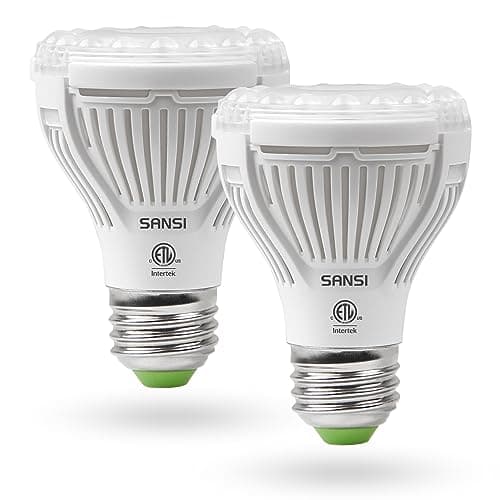 SANSI LED Grow Light Bulb, 10 W, E26, 4000 K, 2 packThe rare cheap bulb that publishes a PPF figure instead of a lumen figure, which is the number that tells you what a plant actually receives. | A grow light that screws into a lamp you already own | $9.95 at Amazon $12.95 · 23% off |
| 2 | 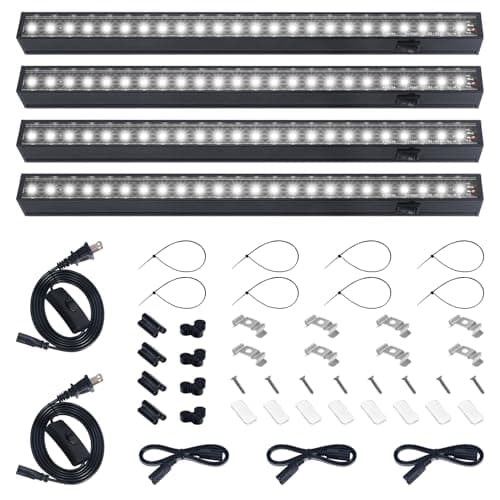 Barrina T5 Grow Light Bars, 1 ft, 5000 K full spectrum, 4 packThe retrofit answer: four short linkable bars that stick to the underside of shelving you already have, which is cheaper and more flexible than buying a lit stand. | Adding light to a shelf you already own | $30.59 at Amazon $36.99 · 17% off |
| 3 | 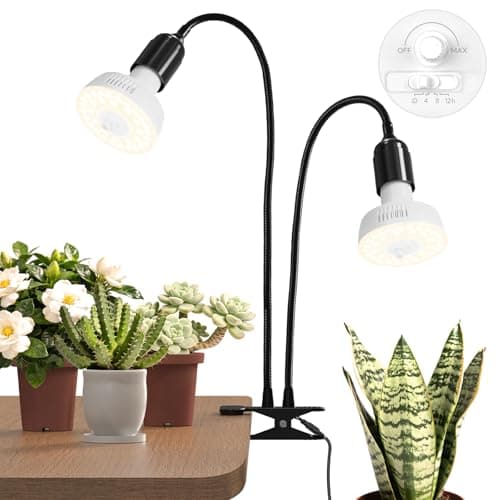 Barrina Clip On Grow Light, 22 W, 4000 KPublishes both its wattage and its color temperature, and clips to a shelf edge. The smallest useful intervention in this entire section. | One plant that needs more light than its corner gives | $27.99 at Amazon $32.99 · 15% off |
| 4 | 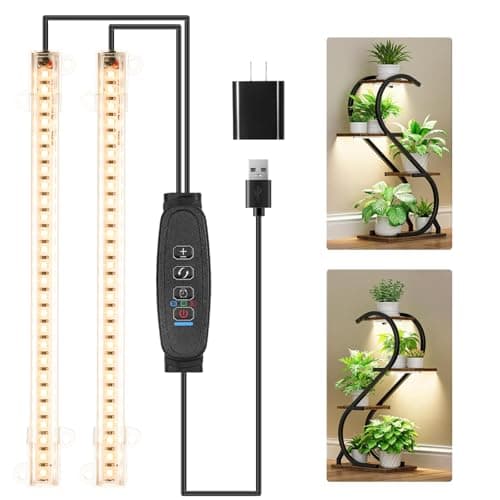 RWNTAO 8.6 in Mini LED Grow Light Strips with timer, 2 heads, 52 LEDsA timer, dimming and four mounting options for the price of a bulb, on a strip small enough to hide under a shelf. The listing publishes no wattage, and that is the trade. | One shelf of succulents on a timer for very little | |
| 5 | 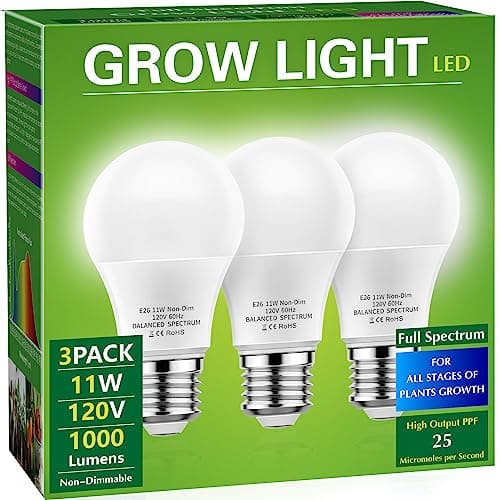 Briignite A19 Full Spectrum Grow Light Bulb, 11 W, 5000 KAn ordinary-looking A19 bulb with a published PPF, sold at a price that makes it the cheapest experiment in this section. | The cheapest way to find out whether a plant wants more light | $11.98 at Amazon $13.99 · 14% off |
| 6 | 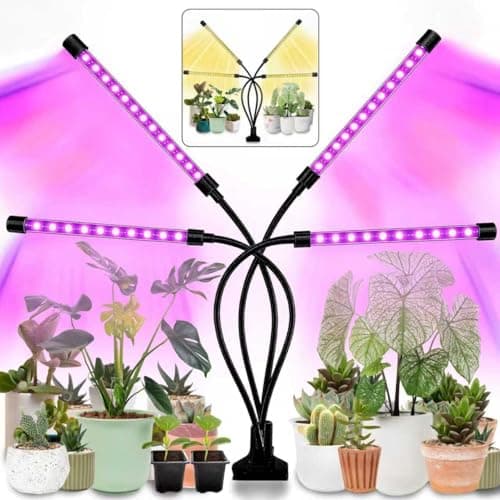 LEOTER Clip Grow Light, 80 LEDs, full spectrum plus red and blue, timerSwitchable between white and red-blue, which makes it the one light here that lets you see for yourself why almost every apartment ends up leaving it on white. | Comparing red-blue against white light honestly |
Links to Amazon are affiliate links. Prices and availability are Amazon's and change without notice.
How we ranked these
Disclosure first, then how far the approach scales, then price. The SANSI bulb leads because it publishes a PPFD at one foot — the one figure on this page that says what a plant receives — and screws into any lamp. The T5 bars are second because they publish their color temperature, link under a shelf, and light more plants per dollar than anything else here. The clip light publishes its wattage and puts more of it on one plant than a bulb can. The mini strip has the best feature set on the page — timer, dimmer, four mounting options — and is marked down for publishing no wattage. The Briignite bulb publishes PPF but no distance figure. The LEOTER clip is last on this list not because it is bad but because its value is the white-against-red-blue switch rather than its output, which its own comparison page covers.
| Your problem | Buy | Then |
|---|---|---|
| One pothos in a dim corner, lamp already there | 10 W bulb, 2-pack | Aim it within a foot; add a timer plug |
| Three small pots on a bookshelf | 1-foot T5 bars, four-pack | Mount under the shelf above; timer plug |
| One fiddle leaf fig leaning | 22 W clip light | Clip to the nearest shelf edge; aim both heads |
| A short shelf of succulents, no timer plug | Mini strip with built-in timer | Set 12 hours and forget it |
| Not sure the plant needs light at all | 11 W A19 bulb | Two weeks in a lamp is the cheapest diagnosis |
When the budget option stops being enough
A bulb lights one plant. Two bulbs in two lamps light two. At the third plant the approach has failed on cost and on outlets, and a four-pack of bars under a shelf is cheaper and better. A clip light is the same: it does one plant well and does not scale. The signal to stop buying cheap is not that the cheap light is weak — it is that the plants are spreading, and the clip against shelf comparison is where that decision lives. The other signal is the plant itself: a succulent or a fig under a bulb still stretches, because a bulb is a low-light fix and those plants want sun.
What we deliberately do not recommend
Purple panels sold on 'equivalent' wattage, at any price. Any listing that publishes neither watts nor color temperature. Bulbs in shaded table lamps, where the shade keeps the light. And spending the same money on a second cheap light before spending a fraction of it on a timer for the first one.
Every pick, in full
We have not handled any of these. What follows is what each listing publishes, what that means once you put a watered pot on it, and who should buy something else.
1. A grow light that screws into a lamp you already own
SANSI LED Grow Light Bulb, 10 W, E26, 4000 K, 2 pack
The rare cheap bulb that publishes a PPF figure instead of a lumen figure, which is the number that tells you what a plant actually receives.
- What the listing publishes
- Published 10 W, E26 base, 4000 K; PPF 16.8 umol/s and PPFD 97.91 umol/m2/s at 1 ft, per the listing; ceramic heat sink; stated 25,000 hour life; ETL listed; 2 pack
- Against a 10-inch pot
- No weight rating is published for this product, so there is nothing to check. That counts against it here rather than being treated as neutral.
Almost every screw-in grow bulb is sold on lumens, which measure how bright light looks to a person and say nothing useful about a plant. This listing publishes PPF — the photon flux plants respond to — and a PPFD at one foot. Those are the figures to compare, and most competitors do not print them.
Ten watts is small. The published 97.91 umol/m2/s at one foot is a useful amount for a single low-light plant on a desk and not enough for a sun-loving one, and the honest use of this bulb is in a desk lamp aimed at one pothos or one fern.
4000 K is the same warm-white as the Barrina clip light, so it does not turn a living room purple or clinical. It reads as an ordinary lamp bulb, which is most of why people buy it.
What is good
- Publishes PPF and PPFD, not just lumens
- Fits any E26 lamp you already own — no fixture, no mounting
- 4000 K looks like a normal bulb in a normal room
What is not
- 10 W lights one plant at one foot, not a shelf
- Output falls off sharply beyond a foot, and the listing only publishes the 1 ft figure
- Needs a lamp that can aim downward — a table lamp with a shade wastes most of it
Skip it if you have more than a couple of plants to light. Two bulbs in two lamps is the ceiling of this approach, and a linkable bar set costs about the same.
2. Adding light to a shelf you already own
Barrina T5 Grow Light Bars, 1 ft, 5000 K full spectrum, 4 pack
The retrofit answer: four short linkable bars that stick to the underside of shelving you already have, which is cheaper and more flexible than buying a lit stand.
- What the listing publishes
- Published 20 W total across four linkable 1 ft bars (4 by 5 W) with 96 LEDs; 5000 K described as full spectrum; black aluminum casing; magnetic bar, clips and cable ties supplied; on/off switch on each bar
- Against a 10-inch pot
- No weight rating is published for this product, so there is nothing to check. That counts against it here rather than being treated as neutral.
5000 K is published, and that matters. Color temperature is the specification that decides whether a grow light is livable in a room, and 5000 K is daylight-neutral rather than the pink-purple of a red-blue fixture.
Linkable means one outlet runs the set. Four separate lights on four plugs is how a plant shelf ends up with a power strip on the floor.
Magnetic mounting works on a steel shelf and not on a wooden one, where the supplied clips or tape become the mounting method.
What is good
- Publishes color temperature, which most of this category does not
- Linkable, so one outlet runs the whole set
- Turns any shelf you already own into a lit one
What is not
- One-foot bars need several to cover a shelf
- The magnetic mount only helps on steel
- 20 W across four feet is about 5 W per foot, so it supplements daylight rather than replacing it
- Names PPFD in the listing and publishes no figure for it
Skip it if you want one purchase that solves lighting. A lit stand arrives assembled and this is a retrofit project.
3. One plant that needs more light than its corner gives
Barrina Clip On Grow Light, 22 W, 4000 K
Publishes both its wattage and its color temperature, and clips to a shelf edge. The smallest useful intervention in this entire section.
- What the listing publishes
- Published 22 W (2 by 11 W) at 4000 K; clip mount
- Against a 10-inch pot
- No weight rating is published for this product, so there is nothing to check. That counts against it here rather than being treated as neutral.
22 W on one plant is a genuinely useful amount of light. The same 22 W spread across a six-tier shelf would be nothing, which is why per-plant clip lights outperform their wattage.
4000 K is warmer than the 5000 K bars and noticeably less clinical in a living room, at a small cost in usable output for the plant.
A clip needs something to clip to, with a lip. Shelf edges work; a windowsill usually does not.
What is good
- Publishes watts and color temperature
- 22 W concentrated on one plant does real work
- No mounting, no fixing, and it moves with the plant
What is not
- Needs a shelf edge or similar to clip to
- Lights one plant, not a collection
- Two heads means two points of aim to get right
Skip it if you have a whole shelf to light. Clip lights do not scale, and a linkable bar set is the right tool at that point.
4. One shelf of succulents on a timer for very little
RWNTAO 8.6 in Mini LED Grow Light Strips with timer, 2 heads, 52 LEDs
A timer, dimming and four mounting options for the price of a bulb, on a strip small enough to hide under a shelf. The listing publishes no wattage, and that is the trade.
#ad · Price as of October 25, 2026. How we are funded
- What the listing publishes
- Published two 8.6 in bars, 52 LEDs total; 3/9/12 h cycle timer; 10 dimming levels; three switch modes; aluminum body; screws, ties, adhesive tape and magnets included; 71 in cord
- Against a 10-inch pot
- No weight rating is published for this product, so there is nothing to check. That counts against it here rather than being treated as neutral.
The timer is why this exists. Succulents on a shelf need the same 12 hours every day, and a light with a memory timer does that without a smart plug or a person remembering. At this price the timer alone would be worth it.
What the listing does not say is how many watts the strip draws or what it delivers at any distance. It states LED count and color temperature and stops. That makes it impossible to compare against the bulbs above on output, and the honest position is that it lights a short shelf of small plants and nothing larger.
Four mounting options — magnets, tape, ties and screws — mean it goes under a metal shelf, a wood shelf or a plastic one, and comes off a rental shelf without a mark. The 71 in cord is long enough to reach a socket from a shelf top.
What is good
- Cycle timer with memory, on a light that costs about what a bulb costs
- Magnets and tape included, so it mounts with no drilling
- Ten dimming levels, which matters for seedlings that scorch
What is not
- No published wattage or light output of any kind
- 8.6 in bars light one short shelf, not a plant collection
- The listing's own bullets disagree on color temperature (3000 K in the title, 3500 K in the text)
Skip it if you want to know what the light delivers before you buy it. The Barrina bars publish 5000 K and the SANSI bulb publishes PPF; this strip publishes an LED count.
5. The cheapest way to find out whether a plant wants more light
Briignite A19 Full Spectrum Grow Light Bulb, 11 W, 5000 K
An ordinary-looking A19 bulb with a published PPF, sold at a price that makes it the cheapest experiment in this section.
- What the listing publishes
- Published 11 W A19, 5000 K white; 1000 lumens; PPF stated at 25 umol/s; stated 25,000 hour life
- Against a 10-inch pot
- No weight rating is published for this product, so there is nothing to check. That counts against it here rather than being treated as neutral.
A lot of grow-light shopping is really a diagnosis: is the plant struggling because of light or because of something else? An 11 W bulb in an existing lamp answers that for less than the cost of a takeout order, and if the answer is yes, the next purchase is a bar set with a clearer conscience.
The listing publishes 25 umol/s of PPF, which is more than the SANSI bulb's 16.8 — but it does not publish a PPFD at any distance, so how much of that reaches a leaf depends entirely on the lamp it is in and how close the plant sits.
5000 K is cooler and whiter than 4000 K. In a bedroom lamp it looks like daylight rather than lamplight, which some people want and some do not.
What is good
- Publishes PPF, which most bulbs at this price do not
- Standard A19 shape fits lamps a grow bulb usually will not
- Low enough cost to be a diagnostic rather than a commitment
What is not
- No published PPFD at any distance, so real delivery is unknown
- 5000 K reads as clinical in a warm-lit room
- Marketed at vegetables — useful for houseplants, but the listing is not written for them
Skip it if the plant is a succulent or a cactus. 11 W in a lamp is a low-light fix, and sun plants need the clip or bar options rather than a bulb.
6. Comparing red-blue against white light honestly
LEOTER Clip Grow Light, 80 LEDs, full spectrum plus red and blue, timer
Switchable between white and red-blue, which makes it the one light here that lets you see for yourself why almost every apartment ends up leaving it on white.
#ad · Price as of October 25, 2026. How we are funded
- What the listing publishes
- 80 LEDs, published full spectrum plus red and blue modes, 3/9/12 h timer, 10 dimming levels
- Against a 10-inch pot
- No weight rating is published for this product, so there is nothing to check. That counts against it here rather than being treated as neutral.
Red and blue diodes target the wavelengths chlorophyll absorbs most, so per watt they are more efficient for the plant. That is a real advantage and it is why commercial growers use them.
They also turn a room magenta. In a studio where you sleep six feet from the shelf, that efficiency argument loses to the fact that you live there.
The timer is the underrated feature. Plants respond to day length, and a light left on continuously is worse for many of them than a shorter, timed cycle.
What is good
- Switch between modes and judge the color trade for yourself
- A built-in timer runs a real day-length cycle
- Ten dimming levels for distance tuning
What is not
- Red-blue mode is genuinely unpleasant in a living space
- Total wattage is not published, only the LED count
- Gooseneck arms sag under their own weight over time
Skip it if the shelf is in a bedroom or living room. You will run it on white permanently, and a white-only light publishes better numbers for the same money.
Questions people actually ask
Are cheap grow lights any good?
What is the cheapest way to add a grow light?
Is a 10 W grow light enough?
Do budget grow lights use a lot of electricity?
Should I buy a timer for a cheap grow light?
Are purple grow lights better than white ones?
Sources
- University of Illinois Extension: Houseplants — lighting
- Michigan State University Extension: Smart Gardening — growing houseplants indoors
- University of Georgia Extension B1318: Growing Indoor Plants with Success
Product specifications are quoted from each seller's own listing and are the seller's claim, not a measurement of ours.