Grow Lights
How to Set Up a Grow Light Shelf
Nine steps to turn shelving you already own into the best plant position in the apartment, without buying new furniture.
By Scooter M., enthusiast · Published · Last updated
The short answer
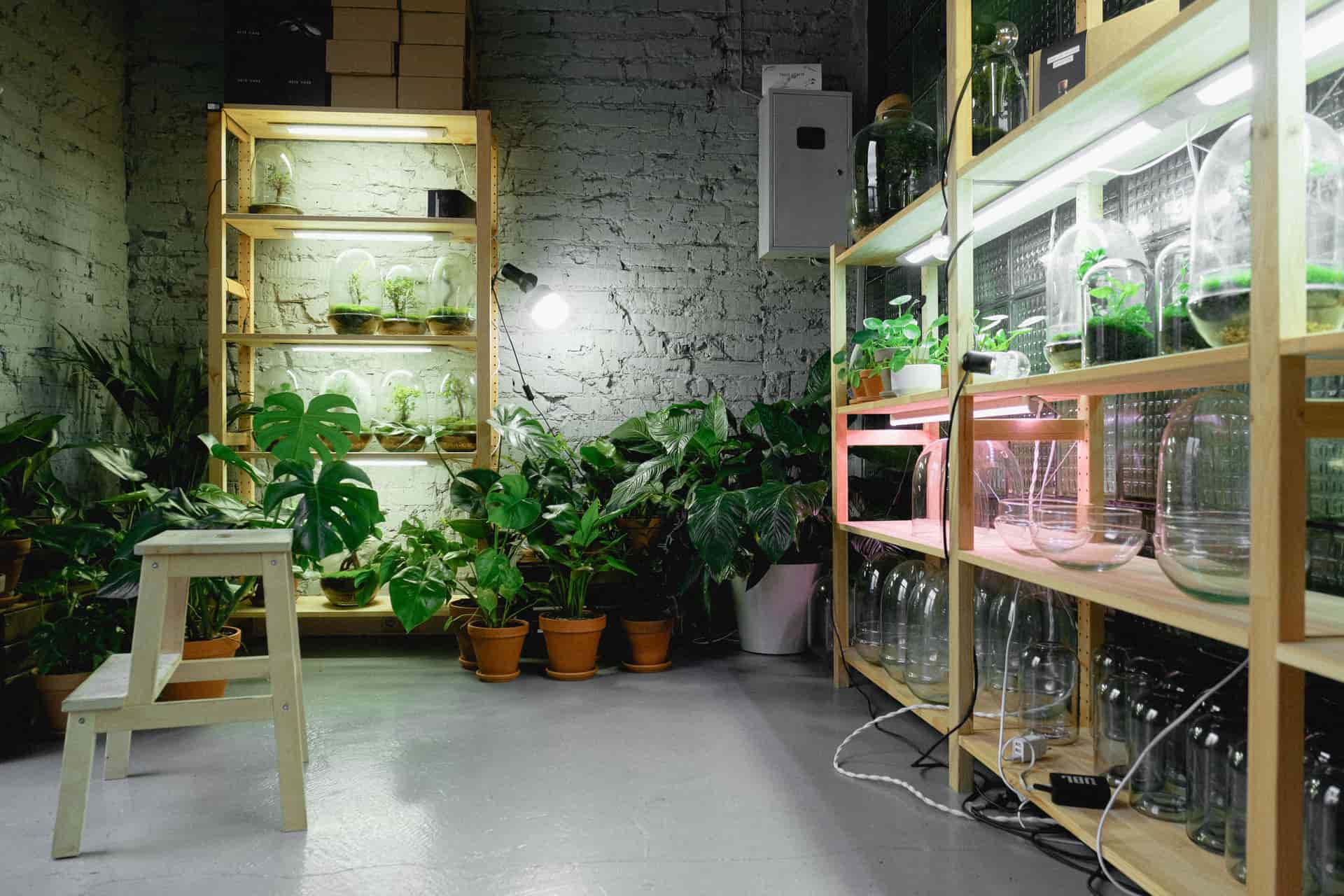
Mount linkable LED bars under each shelf rather than one fixture above the whole unit, put every bar on a single plug-in timer set to 12 to 14 hours, keep the bars as close to the plants as the manufacturer allows, and put something white behind and beside the shelf. That last step costs almost nothing and is the most noticeable improvement of the lot.
Disclosure Pot & Prop earns a commission when you buy through the Amazon links on this page, at no extra cost to you. It does not change which products get recommended or what we say about them, and we have not been given any of them. How this site is funded.
Buying a purpose-built lit shelf is one option and adding light to a shelf you already own is usually the better one — cheaper, more flexible, and you get to choose the spacing rather than accepting whatever the manufacturer settled on. This is how to do it properly. It applies equally to a bookcase, a wire rack, a cupboard shelf or a plain plank on brackets.
The steps
- Pick the shelf before the light. Depth and clearance decide everything downstream: you need enough height between shelves for a plant plus a bar plus the recommended gap, which realistically means eight inches minimum and twelve is more comfortable.
- Choose linkable bars. Daisy-chained bars need one outlet, one switch and one timer. Non-linkable ones need one of each per bar, and that is the constraint that actually bites in an apartment.
- Check the mounting method against your shelf material. Magnetic mounts need steel; clips need a lip; adhesive needs a smooth, clean underside and is a one-way decision on furniture you may want back.
- Mount bars under the shelf above, not on top of the shelf below. Light from above is what a plant is built for, and it keeps the shelf surface clear for pots and saucers.
- Run two bars per shelf where the shelf is wide. One bar down the center of a 24-inch shelf leaves the front and back edges considerably dimmer, which shows up as plants leaning inward.
- Set the height using the manufacturer's recommendation, and get as close inside the range as the tallest plant allows. Intensity falls with the square of distance, so this is where the performance is.
- Put everything on one plug-in timer set to 12 to 14 hours. A timer that runs to clock time beats a cycle timer, which drifts every time you switch the shelf off.
- Add something white behind and beside the shelf — paint, card, or a sheet of foam board. Light that would have escaped sideways gets returned to the plants for almost nothing.
- Deal with the cables. Adhesive cable clips along the back edge of each shelf, so nothing hangs where a watering can swings. This is the step everyone skips and then lives with.
Spacing, in practice
| Shelf width | Bars per shelf | Notes |
|---|---|---|
| Up to 18 in | 1 | Centered; edges are acceptable at this width |
| 18 to 30 in | 2 | Split the width in thirds and place at the two divisions |
| 30 to 48 in | 2 to 3 | Depends on bar length; overlap the ends slightly |
| Over 48 in | 3 or more | Check total wattage against a single outlet |
Power, and how much it costs to run
This is arithmetic you can do exactly, which makes a pleasant change in this category. Multiply the published wattage by the hours per day, divide by a thousand, and you have kilowatt-hours per day. A 40 W fixture on for 12 hours uses 0.48 kWh, which at typical residential rates is a matter of cents. Multiply by your own tariff and by the number of bars for the real figure — the answer is almost always smaller than people expect.
kWh per day = watts x hours / 1000
4 bars x 20 W = 80 W x 12 h = 960 Wh = 0.96 kWh per day
Multiply by your own rate per kWh. Nothing here depends on a figure we would have to invent.
What goes on which shelf
- Top shelf — the highest-light plants, because a top shelf usually gets ambient room light as well as its own bar.
- Middle shelves — the workhorses: pothos, philodendron, peperomia, small ferns.
- Bottom shelf — the heaviest pots, for stability, and the most shade-tolerant plants, because bottom shelves get the least spill light.
- Not on any shelf — anything in a 10-inch pot or larger. That is 14.7 lb of watered mix on furniture that almost certainly publishes no rating.
| Pot size | Mix volume | Dry | Watered | Rating needed |
|---|---|---|---|---|
| 4 in | 0.017 cu ft | 0.4 lb | 0.9 lb | 2 lb |
| 5 in | 0.034 cu ft | 0.7 lb | 1.8 lb | 3 lb |
| 6 in | 0.058 cu ft | 1.3 lb | 3.2 lb | 5 lb |
| 8 in | 0.137 cu ft | 3 lb | 7.5 lb | 12 lb |
Every pick, in full
We have not handled any of these. What follows is what each listing publishes, what that means once you put a watered pot on it, and who should buy something else.
1. Adding light to a shelf you already own
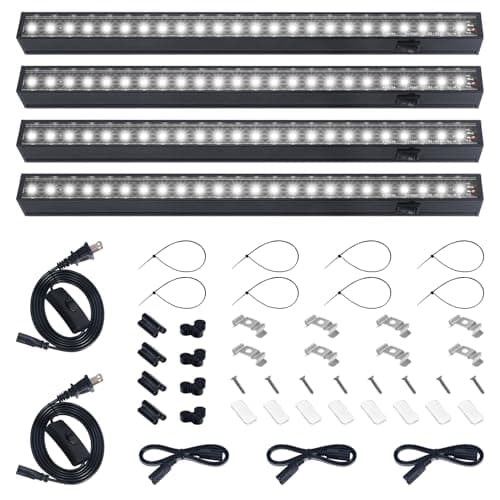
Barrina T5 Grow Light Bars, 1 ft, 5000 K full spectrum, 4 pack
The retrofit answer: four short linkable bars that stick to the underside of shelving you already have, which is cheaper and more flexible than buying a lit stand.
- What the listing publishes
- Published 20 W total across four linkable 1 ft bars (4 by 5 W) with 96 LEDs; 5000 K described as full spectrum; black aluminum casing; magnetic bar, clips and cable ties supplied; on/off switch on each bar
- Against a 10-inch pot
- No weight rating is published for this product, so there is nothing to check. That counts against it here rather than being treated as neutral.
5000 K is published, and that matters. Color temperature is the specification that decides whether a grow light is livable in a room, and 5000 K is daylight-neutral rather than the pink-purple of a red-blue fixture.
Linkable means one outlet runs the set. Four separate lights on four plugs is how a plant shelf ends up with a power strip on the floor.
Magnetic mounting works on a steel shelf and not on a wooden one, where the supplied clips or tape become the mounting method.
What is good
- Publishes color temperature, which most of this category does not
- Linkable, so one outlet runs the whole set
- Turns any shelf you already own into a lit one
What is not
- One-foot bars need several to cover a shelf
- The magnetic mount only helps on steel
- 20 W across four feet is about 5 W per foot, so it supplements daylight rather than replacing it
- Names PPFD in the listing and publishes no figure for it
Skip it if you want one purchase that solves lighting. A lit stand arrives assembled and this is a retrofit project.
2. Published wattage and published dimensions
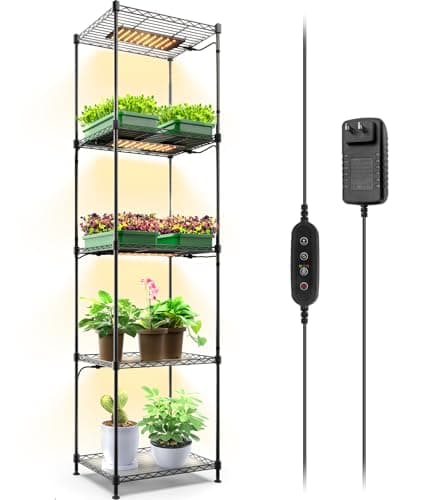
Barrina 5 Tier Plant Shelf with Grow Light, 40 W, 15.7 by 11.8 by 59.1 in
The only lit stand here that publishes both its wattage and its full dimensions, which is the difference between comparing products and comparing photographs.
#ad · Price as of October 18, 2026. How we are funded
- What the listing publishes
- Published 40 W total; 15.7 by 11.8 by 59.1 in; 5 adjustable tiers
- Against a 10-inch pot
- No weight rating is published for this product, so there is nothing to check. That counts against it here rather than being treated as neutral.
40 W across five tiers is 8 W a tier. That is a modest figure and it is a real one, which is more than most of this category offers, and it tells you this supplements light rather than replacing a window.
15.7 by 11.8 inches is 1.29 square feet for five positions, about 3.9 plants per square foot, all lit.
Adjustable tiers plus published dimensions means you can work out before ordering whether your pots fit. Almost nothing else in this category lets you do that.
What is good
- Publishes wattage and full dimensions
- Adjustable tier heights
- Nearly four lit plants per square foot
What is not
- 40 W total is supplemental light, not a substitute for a window
- 11.8 in depth takes 6-inch pots at most
- No published weight rating
Skip it if you have no window light at all. 8 W a tier supplements daylight, and a windowless room needs the higher-output shelves here.
Questions people actually ask
Can I turn a bookshelf into a grow light shelf?
How many grow light bars do I need per shelf?
Do grow light shelves use a lot of electricity?
Should the lights be above or below the shelf?
Sources
- University of Illinois Extension: Houseplants — lighting
- University of Georgia Extension B1318: Growing Indoor Plants with Success
- Cornell University, Greenhouse Management: bulk density of greenhouse media components
- Biology Insights: how much a cubic foot of potting soil weighs, dry and saturated
Product specifications are quoted from each seller's own listing and are the seller's claim, not a measurement of ours.