Propagation
Wall or Desktop Propagation Station?
One costs you a wall fixing and a permanent position. The other costs you a third of a square foot of surface. In a rented apartment those are not equivalent prices.
By Scooter M., enthusiast · Published · Last updated

The short answer
Desktop first, wall second. A desktop station needs no fixing, can move to wherever the light actually is, and is easy to clean — all of which matter more in the first three months than looks do. Move to a wall station once you know you will keep propagating and you have found the spot that stays bright.
Disclosure Pot & Prop earns a commission when you buy through the Amazon links on this page, at no extra cost to you. It does not change which products get recommended or what we say about them, and we have not been given any of them. How this site is funded.
This looks like a styling choice and it is really a light-and-permanence choice. Cuttings root faster in bright indirect light, and in an apartment the location of bright indirect light moves — with the season, with the furniture, and with whatever you learn about your own rooms in the first month of trying. A desktop station follows that. A wall station is a decision you make once, with a fixing, before you have the information.
The renter constraint sharpens it further. A wall station needs a hook or a screw, and a screw is usually not available. That is a solvable problem — the arithmetic is in the wall station roundup and the hardware in the no-drill picks — but it is an extra purchase and an extra failure mode that a desktop rack simply does not have.
The two side by side
| Desktop station | Wall station | |
|---|---|---|
| Surface used | About a third of a square foot | None |
| Fixing needed | None | Two adhesive hooks or screws |
| Can it follow the light | Yes | No |
| Cleaning vessels | Easy — lift them out at a sink | Awkward, and therefore skipped |
| Looks when half empty | Fine | Noticeably unfinished |
| Knock risk | Low | Depends entirely on where you hang it |
| Typical capacity | 5 to 24 vessels | 4 to 21 vessels |
| Renter friendly | Completely | With the right hooks, yes |
The case for desktop
It is the low-commitment option, and propagation is a low-commitment activity for most people — which is not a criticism, it is just what the failure data of every plant hobby looks like. A desktop rack costs a third of a square foot of surface you probably have, and if you lose interest it goes in a cupboard. It also gets cleaned, because cleaning it means picking up five jars and taking them to the sink rather than reaching over furniture with a brush.
The light argument is the strongest one though. You genuinely do not know where the good light in your apartment is until you have watched something try to grow in several places, and a station you can pick up gives you that experiment for free.
The case for the wall
It uses no surface at all, and in a small flat surface is scarcer than wall. If your desks and shelves are already full — which in a studio they usually are — the wall is the only unused plane left, and this is one of very few products that uses it well. A tiered wall station is also genuinely lovely to look at in a way a rack of jars is not, and that is a legitimate reason to buy something you will look at every day.
Every pick, in full
We have not handled any of these. What follows is what each listing publishes, what that means once you put a watered pot on it, and who should buy something else.
1. Cuttings you want to actually watch root
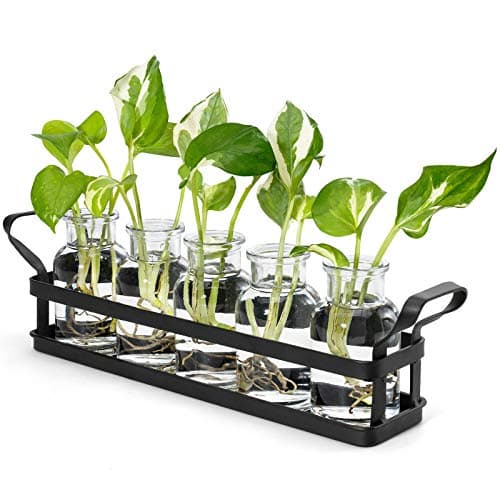
Mkono 5 Jar Desktop Propagation Station with Stand
Wide-mouth jars rather than narrow test tubes, which is the difference between changing the water in ten seconds and fishing a cutting out with tweezers.
#ad · Price as of October 18, 2026. How we are funded
- What the listing publishes
- Five wide-mouth glass jars in a stand; wide openings for water changes
- Against a 10-inch pot
- No weight rating is published for this product, so there is nothing to check. That counts against it here rather than being treated as neutral.
Neck diameter is the specification nobody compares and everybody feels. A narrow tube means you cannot get a finger in to clean the algae, and algae is what ends most propagation stations.
Five jars on roughly a 12 by 4 inch footprint is a third of a square foot for five cuttings, the densest thing on the site by a wide margin, because water weighs less than mix.
Wide jars also take a thicker cutting. A monstera node with an aerial root does not fit a 15 mm test tube.
What is good
- Wide mouths make water changes and cleaning trivial
- Fits thick cuttings and aerial roots
- Five positions in a third of a square foot
What is not
- Wider jars mean more water and more evaporation surface
- Jars lift out, which is convenient and also means they get knocked out
- Glass on a desk with a cat is a decision
Skip it if you are rooting thin herb cuttings in bulk. Narrow tubes hold more cuttings per inch and use a fraction of the water.
2. Propagating at volume
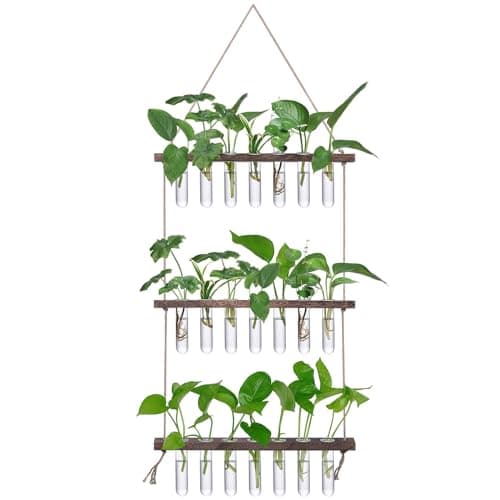
XXXFLOWER Wall Hanging Propagation Station, 21 test tubes, 3 tiers
Twenty-one positions, which stops being a decoration and starts being a production line, and puts real weight on one wall fixing.
#ad · Price as of October 18, 2026. How we are funded
- What the listing publishes
- 21 glass test tubes across three tiers on a wall-hung frame
- Against a 10-inch pot
- No weight rating is published for this product, so there is nothing to check. That counts against it here rather than being treated as neutral.
Twenty-one full test tubes is a meaningful load hanging off whatever the frame is screwed into. Water alone at 20 ml a tube is under a pound, but the frame, glass and cuttings add up and it all bears on one or two points.
At this scale the maintenance is the constraint, not the space. Twenty-one tubes is twenty-one water changes, and stations this size are usually half empty within a season.
Buy it if you propagate to give away or to sell. Buy five tubes if you propagate for yourself.
What is good
- Twenty-one positions on no floor at all
- Three tiers keep every tube reachable
- Genuinely useful if you propagate in batches
What is not
- Needs a wall fixing
- Twenty-one tubes is twenty-one water changes
- Most buyers will never fill it
Skip it if you take a cutting or two a season. This is production equipment, and five tubes on a desk is the honest size.
Questions people actually ask
Do wall propagation stations root cuttings faster?
Can I move a wall station later?
Which holds more cuttings?
Is a wall station safe above a desk or a bed?
Sources
- University of Illinois Extension: Houseplants — propagation
- University of Illinois Extension: Houseplants — lighting
- Cornell University, Greenhouse Management: bulk density of greenhouse media components
- Biology Insights: how much a cubic foot of potting soil weighs, dry and saturated
Product specifications are quoted from each seller's own listing and are the seller's claim, not a measurement of ours.