Grow Lights
SANSI 36W Grow Light Bulb Review
Most plant lights hide behind adjectives. This one prints its photon numbers, which makes it the rare fixture you can actually do arithmetic on.
By Scooter M., enthusiast · Published
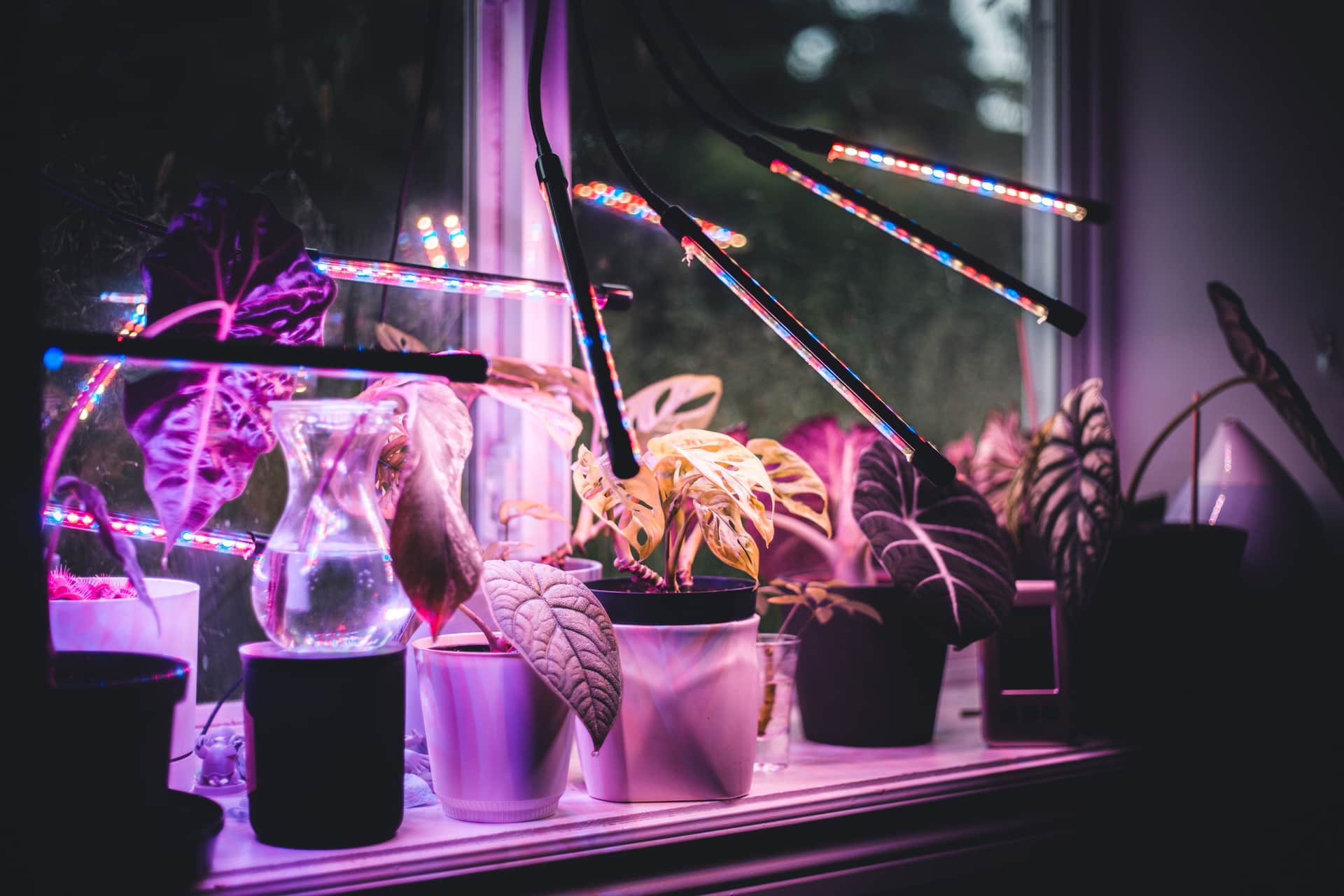
The short answer
It publishes what almost nothing else in plant lighting does: PPF 65.6 umol/s, PPFD 265.58 umol/m2/s, and the distance that density was measured at (1 ft). That makes it checkable. The practical consequence of those numbers is mounting height - photon density falls with the square of distance, so the same bulb delivers roughly 265 at a foot and about 66 at two feet. Buy it to light one plant from close range in a fixture you can aim. Do not buy it to light a shelf, and do not hang it from a ceiling and expect the numbers to survive the trip.
Disclosure Pot & Prop earns a commission when you buy through the Amazon links on this page, at no extra cost to you. It does not change which products get recommended or what we say about them, and we have not been given any of them. How this site is funded.
This site reviewed a Barrina T5 bar set a few weeks ago and spent several paragraphs on one sentence in its listing: "Super Bright and High PPFD", followed by no PPFD. Naming the metric that would settle the argument and then not providing it is the standard behavior of plant lighting, and it is why most reviews in this category are people describing how green their pothos looks.
This bulb does the opposite. It publishes photosynthetic photon flux, photon flux density, and — crucially — the distance the density was measured at. So this review can be a different kind of thing: not a complaint about missing numbers, but an attempt to work out what the numbers actually mean once the bulb is in a room.
For the avoidance of doubt: nothing here was measured. No meter was put under this bulb and no plant was grown under it. Every figure below is either quoted from the listing or derived from a quoted figure and labeled as such.
What it publishes
| Specification | Published figure |
|---|---|
| Power | 36 W |
| PPF (total photon output) | 65.6 umol/s |
| PPFD at 1 ft | 265.58 umol/m2/s |
| Color temperature | 4000 K |
| Stated spectral range | 400-780 nm |
| Base | E26 |
| Heat path | Chip on Ceramic, ceramic heat sink |
| Safety | ETL listed, flame-retardant V0 body |
| Warranty | Stated 5-year protection plan |
| Beam angle | Not published |
| Spectral distribution chart | Not published |
Two absences at the bottom of that table matter and we will come back to them. Everything above them is more than the rest of this category offers.
The efficacy number nobody prints
PPF divided by watts gives efficacy in micromoles per joule — how many usable photons you get per unit of electricity. It is the single best way to compare two fixtures and no manufacturer puts it on a box, because it requires publishing PPF, which most of them do not.
PPF (umol/s) / power (W) = umol/J
65.6 / 36 = 1.82 umol/J. SANSI publishes 16.8 umol/s for its own 10 W bulb, which derives to 1.68 umol/J.
Derived from the manufacturer's own published figures, not measured. The comparison is useful precisely because both numbers come from the same manufacturer using the same test approach.
So the 36 W bulb is modestly more efficient per watt than SANSI's own smaller one, as well as producing roughly four times the photons for 3.6 times the power. That is not a given — scaling a fixture up often costs efficiency to heat — and it is a point in this bulb's favor that you can only see because the company published enough to compute it.
The number that actually decides your result
Here is the part that matters more than anything else in this review. Photon density falls with the square of the distance from the source. The published 265.58 is at one foot. Almost nobody mounts a lamp exactly one foot from a plant.
| Distance | PPFD (derived) | Share of the 1 ft figure | 12 h daily total (derived) |
|---|---|---|---|
| 6 in | About 1,060 umol/m2/s | 4x | About 46 mol/m2/day |
| 1 ft (published) | 265.58 umol/m2/s | 1x | About 11.5 mol/m2/day |
| 18 in | About 118 umol/m2/s | 0.44x | About 5.1 mol/m2/day |
| 2 ft | About 66 umol/m2/s | 0.25x | About 2.9 mol/m2/day |
| 3 ft | About 30 umol/m2/s | 0.11x | About 1.3 mol/m2/day |
Read the last row. Move this bulb from a foot away to three feet away and it delivers about a ninth of the light. A bulb in a ceiling pendant over a plant on the floor is doing almost nothing, whatever it cost. The single most valuable thing you can do with this product is put it close and aim it, which means the fixture you screw it into matters nearly as much as the bulb.
The two things it does not publish
No beam angle. This is the real gap. PPFD at 1 ft tells you the density at a point directly underneath; without a beam angle you cannot work out how wide the lit area is, so you cannot say whether this covers one plant or three. For a bulb — a device whose entire character is throwing a cone — that is the missing half of the specification.
No spectral distribution. The listing states a range, 400 to 780 nm, which is a boundary rather than a shape. Two bulbs can both span that range and put wildly different proportions into each part of it. A distribution chart would settle it; a range does not.
Neither omission is unusual. Both are worth naming precisely because this listing publishes so much else — it demonstrates that the company can produce measured figures when it chooses to, which makes the absences look like decisions rather than ignorance.
Construction, briefly
Chip on Ceramic is a heat-path claim: the LED die is soldered onto a ceramic substrate rather than onto the aluminum board most bulbs use. Heat is what degrades LED output over years, so aiming at the thermal path is aiming at the right long-run failure. It is not something a buyer can verify, and it is a statement about construction rather than an adjective about brightness, which puts it a level above most of this category's marketing.
ETL listing and a flame-retardant V0 body are meaningful in an application where a 36 W bulb may sit in an old lamp under a shade. The stated five-year protection plan is a long horizon for a bulb at this price.
Quick picks
Ranked, with the published figure each pick turns on. Tap a row for the full reasoning further down this page.
| # | Product | Best for | Price |
|---|---|---|---|
| 1 | 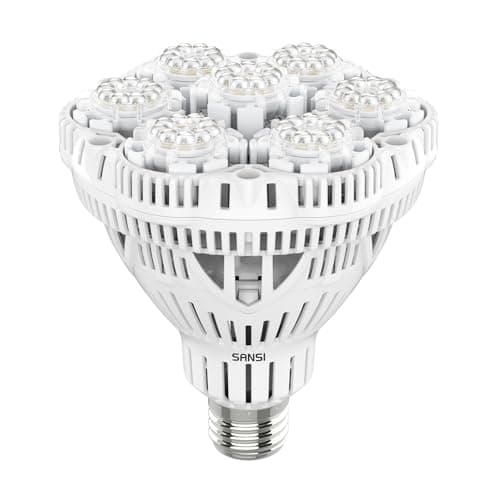 SANSI LED Grow Light Bulb, 36 W, E26, 4000 KPublishes photosynthetic photon flux, photon flux density and the distance it was measured at — three things most of the lighting on this site does not print at all. | One plant that needs real light, from the only listing that prints both photon numbers | $33.26 at Amazon $39.95 · 17% off |
| 2 | 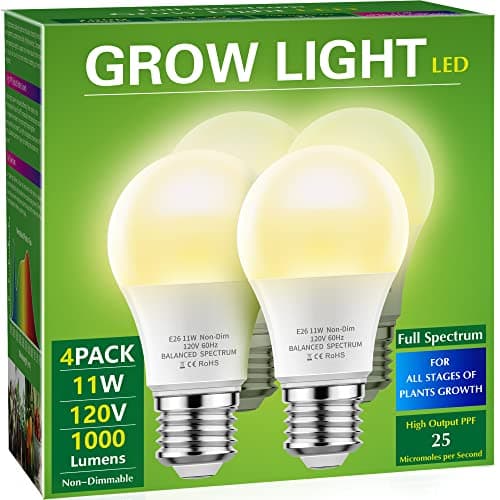 Briignite A19 Grow Light Bulbs, 4 pack, E26, 4000 KThe cheapest way to convert existing lamps into plant lights — and the clearest example on this page of a listing publishing the wrong unit. | Putting a grow bulb in four lamps you already own, cheaply | $16.99 at Amazon $18.99 · 11% off |
| 3 | 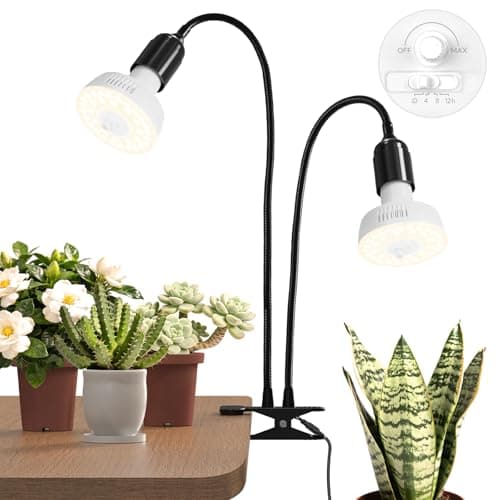 Barrina Clip On Grow Light, 22 W, 4000 KPublishes both its wattage and its color temperature, and clips to a shelf edge. The smallest useful intervention in this entire section. | One plant that needs more light than its corner gives | $25.99 at Amazon $32.99 · 21% off |
Links to Amazon are affiliate links. Prices and availability are Amazon's and change without notice.
Who should buy it
Someone lighting one plant, properly, in a fixture they can aim. That is the honest answer. A fiddle leaf fig in a dim corner, a monstera two meters from the nearest window, a large plant that has been leaning toward the glass for a year — with a clamp lamp or a gooseneck holding this bulb a foot or so away and angled at the foliage, this is one of the more straightforward fixes available.
It also suits anyone who wants to be able to check what they bought. The ability to compute efficacy and falloff from published figures is worth something in itself, and very little else in this category permits it.
Who should not
Anyone lighting a shelf. A bulb makes a bright middle and dim edges; a shelf wants an even line, which is what linkable bars do. Anyone planning to screw it into a ceiling fitting, because the falloff table above shows what happens. And anyone putting it in a fully enclosed shade, which traps the heat the ceramic heat sink exists to move.
| If you want to... | This bulb is... | Because |
|---|---|---|
| Light one large plant from a foot away | The right buy | 265 umol/m2/s published at that distance |
| Light a shelf evenly | The wrong shape | A cone has a bright middle and dim edges |
| Convert several lamps cheaply | Overkill | A four-pack of A19 bulbs does that for less |
| Light one plant on a shelf edge | Beaten by a clip light | 22 W with its own arm, no lamp needed |
| Know what you are actually getting | The best on this site | It publishes PPF, PPFD and a distance |
| Know how wide the light spreads | Frustrating | No beam angle published |
The verdict
It is the most honestly specified plant light on this site, and that alone earns it a recommendation for a buyer who wants a checkable purchase. The figures survive the check: 1.82 umol/J is respectable, it is better than the company's own smaller bulb, and a published density with a stated distance is exactly what a specification should look like.
The catch is not the bulb, it is the physics. Everything good about these numbers lives within about eighteen inches of the fixture. Mount it close, aim it at the plant, put it on a timer, and it does real work. Screw it into a ceiling fitting and you have bought a 36 W lamp.
Every pick, in full
We have not handled any of these. What follows is what each listing publishes, what that means once you put a watered pot on it, and who should buy something else.
1. One plant that needs real light, from the only listing that prints both photon numbers
SANSI LED Grow Light Bulb, 36 W, E26, 4000 K
Publishes photosynthetic photon flux, photon flux density and the distance it was measured at — three things most of the lighting on this site does not print at all.
- What the listing publishes
- Published PPF 65.6 umol/s and PPFD 265.58 umol/m2/s measured at 1 ft; 36 W at 4000 K covering a stated 400-780 nm; stated Chip-on-Ceramic construction with a ceramic heat sink rather than an aluminum substrate; stated flame-retardant V0 body; ETL listed with a stated 5-year protection plan
- Against a 10-inch pot
- No weight rating is published for this product, so there is nothing to check. That counts against it here rather than being treated as neutral.
PPF and PPFD with a stated distance is the specification that makes a plant light checkable. PPF, 65.6 umol/s, is the total photon output of the bulb. PPFD, 265.58 umol/m2/s at 1 ft, is what actually lands on a square meter directly underneath. Publishing both with a measurement distance is rare enough in this category to be the reason this leads.
It also lets you compute efficacy, which nothing on a box ever shows you: 65.6 umol/s divided by 36 W is about 1.82 umol per joule. SANSI publishes 16.8 umol/s for its own 10 W bulb, which derives to 1.68 umol/J — so the bigger bulb is modestly more efficient per watt as well as brighter, and both figures come from the manufacturer rather than from us.
Ceramic rather than aluminum is a heat-path claim, and heat is what kills LED output over years. It is not something a buyer can verify, but it is at least a statement about construction rather than an adjective about brightness.
What is good
- Publishes PPF, PPFD and the distance PPFD was measured at
- Enough published output to be one plant's main light source
- ETL listed with a stated 5-year protection plan
What is not
- Most expensive bulb here by a wide margin
- 36 W in a table lamp is a lot of light to sit beside in the evening
- PPFD is a figure directly underneath; it falls off steeply toward the edges
Skip it if you are lighting a shelf rather than a plant. A bulb throws a cone; linkable bars spread the same watts along a row, which is a different job.
2. Putting a grow bulb in four lamps you already own, cheaply
Briignite A19 Grow Light Bulbs, 4 pack, E26, 4000 K
The cheapest way to convert existing lamps into plant lights — and the clearest example on this page of a listing publishing the wrong unit.
- What the listing publishes
- Published 1000 lm output across a stated 180 degree spread; A19 format on an E26 base, stated 4000 K white with a red and blue spectrum; stated equivalent to a 100 W traditional bulb; 4 bulbs per pack; no PPF or PPFD figure published
- Against a 10-inch pot
- No weight rating is published for this product, so there is nothing to check. That counts against it here rather than being treated as neutral.
A thousand lumens is a real, measured figure and it is not a plant measurement. Lumens weight light by how bright the human eye perceives it, which peaks in the green that plants reflect. A bulb can be high in lumens and modest in photons, or the reverse. It is better than an adjective and it is not comparable with the PPFD figures elsewhere on this page.
Four bulbs is the actual argument. An A19 in an E26 base fits essentially every table lamp, floor lamp and pendant in a US home, so four bulbs is four existing fixtures converted for the price of one purpose-built bulb.
"Equivalent to 100 W traditional" is an energy-consumption comparison, not a plant-light claim, and it should not be read as one. It tells you about your electricity bill.
What is good
- Four bulbs, so several existing lamps become plant lights at once
- Publishes a lumen figure and a beam spread, unlike most of this category
- 4000 K white rather than a magenta glow in a living room
What is not
- No PPF or PPFD published, so it cannot be compared on photons
- Lumens measure what the eye sees, not what the plant uses
- 180 degree spread means a lot of the light goes where no plant is
Skip it if you want to know what the plant is receiving. Two bulbs on this page publish photon figures and this one publishes a brightness figure.
3. One plant that needs more light than its corner gives
Barrina Clip On Grow Light, 22 W, 4000 K
Publishes both its wattage and its color temperature, and clips to a shelf edge. The smallest useful intervention in this entire section.
- What the listing publishes
- Published 22 W (2 by 11 W) at 4000 K; clip mount
- Against a 10-inch pot
- No weight rating is published for this product, so there is nothing to check. That counts against it here rather than being treated as neutral.
22 W on one plant is a genuinely useful amount of light. The same 22 W spread across a six-tier shelf would be nothing, which is why per-plant clip lights outperform their wattage.
4000 K is warmer than the 5000 K bars and noticeably less clinical in a living room, at a small cost in usable output for the plant.
A clip needs something to clip to, with a lip. Shelf edges work; a windowsill usually does not.
What is good
- Publishes watts and color temperature
- 22 W concentrated on one plant does real work
- No mounting, no fixing, and it moves with the plant
What is not
- Needs a shelf edge or similar to clip to
- Lights one plant, not a collection
- Two heads means two points of aim to get right
Skip it if you have a whole shelf to light. Clip lights do not scale, and a linkable bar set is the right tool at that point.
Questions people actually ask
Is the SANSI 36W grow light bulb any good?
How far should the SANSI 36W bulb be from plants?
What is PPF and PPFD on a grow bulb?
How much light does it actually deliver in a day?
What does the SANSI bulb not tell you?
Can I use it in a normal lamp?
Sources
- University of Illinois Extension: Houseplants — lighting
- University of Georgia Extension B1318: Growing Indoor Plants with Success
- Michigan State University Extension: Smart Gardening — growing houseplants indoors
Product specifications are quoted from each seller's own listing and are the seller's claim, not a measurement of ours.