Grow Lights
AC Infinity IONBEAM S16 Review
It names its diode and publishes an efficacy figure, which almost nothing in plant lighting does. It still will not tell you how much light comes out.
By Scooter M., enthusiast · Published
The short answer
Buy it if you want a dimmable, scheduled, IP65 bar kit whose component you can look up, and you accept paying roughly four times what a generic bar set costs for that. AC Infinity publishes the diode (Samsung LM301H EVO, rated 3.14 umol/J) and the wattage (42 W) but no PPF or PPFD for the fixture, so the most you can say about its output is a ceiling: 3.14 x 42 is about 132 umol/s, and the real figure is lower because driver losses and thermal derating are not published. That ceiling is still roughly double what the only comparable bulb on this site publishes as an actual measured output. Skip it if you are lighting one plant, or if you want the light to come with the shelf.
Disclosure Pot & Prop earns a commission when you buy through the Amazon links on this page, at no extra cost to you. It does not change which products get recommended or what we say about them, and we have not been given any of them. How this site is funded.
This site has now reviewed three plant lights, and the interesting thing about them is that each represents a different way of handling the question "how much light does this produce?"
- The Barrina T5 bars advertise "Super Bright and High PPFD" and publish no PPFD. That review is mostly about the gap between those two facts.
- The SANSI 36W bulb publishes PPF, PPFD and the distance the density was measured at. That review could therefore do arithmetic on real numbers.
- The IONBEAM S16 does something I have not seen elsewhere in the category: it publishes the diode by part number and its rated efficacy, and no output figure for the fixture at all.
That third posture is more interesting than it sounds, because it is not evasion. A named diode is a checkable, third-party-documented component — you can go and read its datasheet, which is more than any amount of "full spectrum" marketing offers. It just is not the same thing as telling you what the light does.
For the avoidance of doubt: nothing here was measured. No meter was put under this fixture and no plant was grown under it. Every number below is quoted from AC Infinity's own specification page or derived from a quoted number and labeled as derived.
What AC Infinity publishes
| Specification | Published figure |
|---|---|
| Wattage | 42 W |
| Diode | Samsung LM301H EVO |
| LED chip count | 18 per bar |
| Diode efficacy | 3.14 umol/J PPE, stated per diode |
| PPF (fixture total) | Not published |
| PPFD at any distance | Not published |
| Coverage area | Not published |
| Spectrum | 3000 K, 5000 K |
| Bar dimensions | 15.98 by 1.12 in |
| Input | 100-240 V AC, 50/60 Hz, 0.06 A |
| Control | Ten brightness levels, with OFF, ON and SCHEDULE modes |
| Ingress rating | IP65 |
| Life expectancy | 50,000 hours |
| In the box | Controller, four LED bars, four steel bars |
That is a genuinely full specification table by the standards of this category, and it is still missing the only number a buyer wants. Note also that the 42 W is the figure published for the product, which is the four-bar kit — not 42 W per bar.
Deriving the output ceiling
PPE — photosynthetic photon efficacy — is photons out per joule of electricity in. Multiply it by the watts going in and you get photons per second, which is PPF. So the published figures do constrain the output, from above.
PPF (ceiling) = published diode PPE x published wattage
3.14 umol/J x 42 W = 131.9 umol/s for the four-bar kit
DERIVED, and a ceiling rather than an estimate. The 3.14 figure is published per diode, so it describes the diode at its rated drive current and junction temperature. The real fixture loses some of that at the driver, more to heat as the diodes run above datasheet temperature, and more again if the bars are driven harder or softer than the rating assumes. None of those losses is published, so the honest statement is: no more than about 132 umol/s, by an unpublished margin.
How big is an unpublished margin, typically? There is no way to know for this fixture without a meter, which is exactly the problem. What can be done is to compare the ceiling against the one fixture on this site that publishes a real measured output, and see whether the ceiling is even plausible.
| Fixture | Published watts | PPF | Implied fixture efficacy |
|---|---|---|---|
| IONBEAM S16 kit | 42 W | Not published — ceiling of about 132 umol/s (derived) | 3.14 umol/J at the diode; lower at the wall (derived) |
| SANSI 36W bulb | 36 W | 65.6 umol/s (published) | about 1.8 umol/J (derived) |
So the ceiling is roughly double the SANSI's actual published fixture efficacy. That is plausible rather than suspicious: a modern linear bar running mid-power diodes genuinely should beat a screw-in bulb that has to dump its heat through a small housing, and LM301H EVO is a current-generation horticultural diode where the SANSI is a general-purpose white LED package. The direction of the difference is credible. The magnitude is not knowable from what is published.
Watts per foot, which you can compare
Where output is unpublished across a whole category, the comparison that survives is electrical power per unit of lit length. It is a crude proxy — it says nothing about efficiency — but it is published by everything, and this site has used it before.
W/ft = published watts / (bars x published bar length in feet)
42 W / (4 x 1.33 ft) = 7.9 W per foot of bar
DERIVED from published figures on both sides. The Barrina T5 review computed about five watts per foot for the comparison set, so this is meaningfully denser electrically — about 58 percent more power per foot of bar, before any efficiency difference is counted.
Combine that with the diode's rated efficacy being materially higher than a general-purpose white LED's and the plausible read is that this kit delivers noticeably more light per foot than the generic bars, at four times the price. "Noticeably more" is as precise as the published data permits, and anyone telling you a specific multiple without a meter is guessing.
The things that are not about output at all
On reflection, the output argument may be the least important part of this purchase, because three of the published specifications are features the cheap bars simply do not have, and they are all checkable.
- Ten brightness levels with scheduling, in the controller. Every generic bar on this site needs a separate mechanical timer plug — this site sells a whole page of them — and an outlet to put it in. This kit has the schedule built in. For a renter with one accessible outlet behind a shelf, that is a real constraint solved.
- IP65. Published ingress protection, which matters in exactly one apartment scenario and it is a common one: bars mounted under a shelf directly above pots you water from above.
- 50,000 hours published life. At the 14 to 16 hours Illinois Extension describes as sufficient for low-light conditions, that is a figure you can divide out — and it comes to roughly nine years of daily use.
- Four bars in the box, linkable. Four 16-inch bars is 64 inches of lit length, which covers a standard 48-inch shelf with overlap or two narrower ones.
- No shelf. You are buying light and mounting it to furniture you already own. If you wanted the shelf too, the lit stands are here.
published life / daily hours / 365
50,000 h / 15 h per day / 365 = about 9.1 years
DERIVED. The 15 hours is the midpoint of the 14 to 16 hour duration Illinois Extension describes as sufficient in low-light conditions, not a figure invented here. LED life ratings conventionally describe the point of substantial output decline rather than failure, which the listing does not clarify.
Who should buy this, and who should not
| Your situation | Buy | Why |
|---|---|---|
| Lighting a 4 ft shelf you already own, want it scheduled | IONBEAM S16 kit | Built-in scheduling and 64 in of bar; no timer plug needed |
| Lighting a bookshelf on a budget | Generic 1 ft T5 bars | A fifth of the price; add a timer plug |
| Want the shelf and the light as one purchase | A lit plant stand | Arrives assembled; this is a retrofit project |
| One plant in a dark corner | A clip light or a bulb | A 64 in bar kit for one pothos is nobody's best purchase |
| Watering from above, over the bars | IONBEAM S16 kit | IP65 is published; the generic bars publish nothing |
| Need to verify any of the above | A quantum PAR meter | Nothing here publishes PPFD, and a meter is the only way to find out |
What we would want AC Infinity to publish
One number, and the distance it was taken at. A PPFD figure at 12 inches, measured at the center of a four-bar array, would make this fixture directly comparable with every manufacturer claim in the category and would almost certainly flatter it. The company has published the harder-to-find inputs — a part number, an efficacy, an ingress rating, a cord length to a tenth of an inch — and withheld the one output figure buyers ask for. That is the single criticism in this review, and it is the same criticism this site makes of everyone.
Every pick, in full
We have not handled any of these. What follows is what each listing publishes, what that means once you put a watered pot on it, and who should buy something else.
1. Naming the diode instead of the marketing
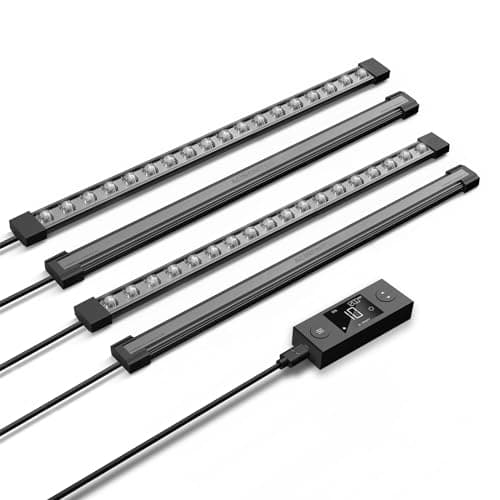
AC Infinity IONBEAM S16 Full Spectrum LED Grow Light Bar, 16 in
The only light here that publishes which diode it uses, which is the difference between a specification and an adjective.
#ad · Price as of October 18, 2026. How we are funded
- What the listing publishes
- 16 in bar; published Samsung LM301H EVO diodes; digital dimming and timer controller
- Against a 10-inch pot
- No weight rating is published for this product, so there is nothing to check. That counts against it here rather than being treated as neutral.
LM301H EVO is a named, documented, third-party-testable component. Full spectrum is not. A listing that tells you the diode is a listing whose claims you can check, which is the standard this whole site is arguing for.
Digital dimming and a timer built into the controller removes the separate mechanical timer that every other light here needs.
It is a bar, not a stand. You are buying light and mounting it to something you already have.
What is good
- Publishes the actual diode, so the output claim is checkable
- Dimming and timer built into the controller
- 16 in covers a shelf properly rather than needing four short bars
What is not
- Costs several times what the generic bars here do
- No stand, so you supply the shelving
- Overspecified for a single pothos
Skip it if you are lighting one plant on a windowsill. A clip light does that for a fraction of the money, and nobody needs a documented diode for a pothos.
2. Adding light to a shelf you already own
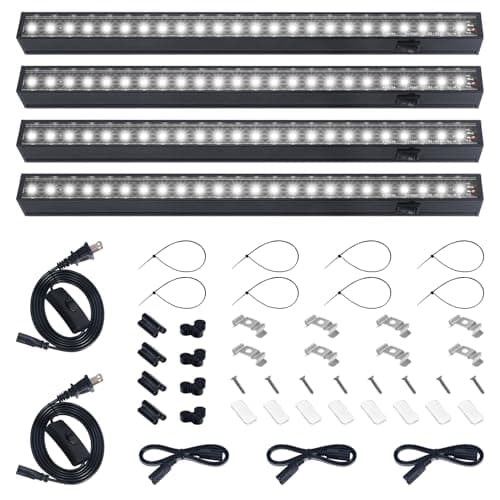
Barrina T5 Grow Light Bars, 1 ft, 5000 K full spectrum, 4 pack
The retrofit answer: four short linkable bars that stick to the underside of shelving you already have, which is cheaper and more flexible than buying a lit stand.
- What the listing publishes
- Published 20 W total across four linkable 1 ft bars (4 by 5 W) with 96 LEDs; 5000 K described as full spectrum; black aluminum casing; magnetic bar, clips and cable ties supplied; on/off switch on each bar
- Against a 10-inch pot
- No weight rating is published for this product, so there is nothing to check. That counts against it here rather than being treated as neutral.
5000 K is published, and that matters. Color temperature is the specification that decides whether a grow light is livable in a room, and 5000 K is daylight-neutral rather than the pink-purple of a red-blue fixture.
Linkable means one outlet runs the set. Four separate lights on four plugs is how a plant shelf ends up with a power strip on the floor.
Magnetic mounting works on a steel shelf and not on a wooden one, where the supplied clips or tape become the mounting method.
What is good
- Publishes color temperature, which most of this category does not
- Linkable, so one outlet runs the whole set
- Turns any shelf you already own into a lit one
What is not
- One-foot bars need several to cover a shelf
- The magnetic mount only helps on steel
- 20 W across four feet is about 5 W per foot, so it supplements daylight rather than replacing it
- Names PPFD in the listing and publishes no figure for it
Skip it if you want one purchase that solves lighting. A lit stand arrives assembled and this is a retrofit project.
3. Published wattage and published dimensions
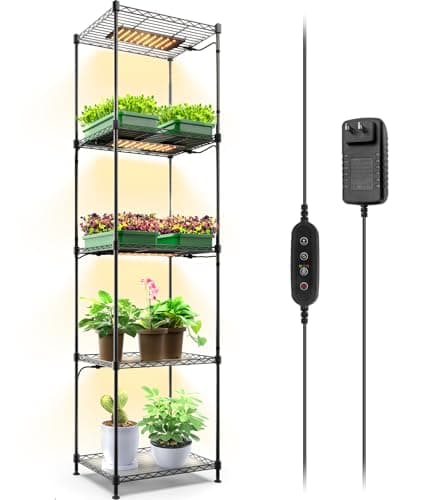
Barrina 5 Tier Plant Shelf with Grow Light, 40 W, 15.7 by 11.8 by 59.1 in
The only lit stand here that publishes both its wattage and its full dimensions, which is the difference between comparing products and comparing photographs.
#ad · Price as of October 18, 2026. How we are funded
- What the listing publishes
- Published 40 W total; 15.7 by 11.8 by 59.1 in; 5 adjustable tiers
- Against a 10-inch pot
- No weight rating is published for this product, so there is nothing to check. That counts against it here rather than being treated as neutral.
40 W across five tiers is 8 W a tier. That is a modest figure and it is a real one, which is more than most of this category offers, and it tells you this supplements light rather than replacing a window.
15.7 by 11.8 inches is 1.29 square feet for five positions, about 3.9 plants per square foot, all lit.
Adjustable tiers plus published dimensions means you can work out before ordering whether your pots fit. Almost nothing else in this category lets you do that.
What is good
- Publishes wattage and full dimensions
- Adjustable tier heights
- Nearly four lit plants per square foot
What is not
- 40 W total is supplemental light, not a substitute for a window
- 11.8 in depth takes 6-inch pots at most
- No published weight rating
Skip it if you have no window light at all. 8 W a tier supplements daylight, and a windowless room needs the higher-output shelves here.
Questions people actually ask
What is the PPFD of the AC Infinity IONBEAM S16?
Is the AC Infinity IONBEAM S16 worth it?
How many watts is the IONBEAM S16?
Does the IONBEAM S16 come with a shelf?
Do I need a separate timer for the IONBEAM S16?
What does LM301H EVO mean on a grow light listing?
Sources
- AC Infinity: IONBEAM S16 specifications (manufacturer)
- University of Illinois Extension: Houseplants — lighting
- Clemson HGIC: Indoor Plants — cleaning, fertilizing, containers and light requirements
Product specifications are quoted from each seller's own listing and are the seller's claim, not a measurement of ours.