Plant Stands
Plant Stand Ideas for Small Spaces
Eight positions in an apartment that are already wasted, with what fits in each and what it costs in floor.
By Scooter M., enthusiast · Published · Last updated
The short answer
The space in an apartment is not where you think it is. Room corners, the gap beside a sofa, the top of a radiator cover, the dead area behind a door and the sill above a kitchen counter are all positions that furniture uses badly, and each takes a different stand shape. Start with the corner: it is the largest piece of consistently wasted floor in most rooms.
Disclosure Pot & Prop earns a commission when you buy through the Amazon links on this page, at no extra cost to you. It does not change which products get recommended or what we say about them, and we have not been given any of them. How this site is funded.
Most advice about small-space plants is about buying smaller things. This is about finding the space that is already there, which in an apartment is usually more than people assume — it is just distributed in awkward shapes that rectangular furniture cannot use. Each idea below comes with the footprint it costs and the pot size it realistically takes, because an idea without those two numbers is a photograph rather than a plan.
One: the room corner
The largest piece of consistently wasted floor in most rooms. Rectangular furniture leaves corners empty, traffic does not cross them, and a tiered corner frame puts five plants on about two square feet of floor you were not using. This is why corner stands dominate the plant stands section despite being only middling on plants per square foot — the floor is free.
Two: the gap beside a sofa or a bed
Usually eight to twelve inches, always awkward, and exactly what narrow tiered display stands are built for. A four-tier narrow display holds five pots on about 1.2 square feet, and it lives in a slot no other furniture wants.
Three: on top of a radiator cover
Free surface, at a good height, usually below a window. The caution is heat: put a riser or a tabletop tier under the pots so the bases are not sitting directly on a warm surface, and expect faster drying in winter. Plants that like to dry out do well here; ferns do not.
Four: the windowsill itself, doubled
A tabletop tiered riser on a sill converts one row of pots into two or three without touching the walls. It is the single cheapest way to increase plant positions in the best light in the apartment, and it works on sills too shallow for anything else. Keep pots small — a sill riser is not a place for a 10-inch pot.
Five: behind a door that is always open
Most interior doors in an apartment are open permanently, and the wall behind them is dead space of exactly the depth of the open door. A narrow stand or a tension pole lives there and disappears. Check the door swing first; a plant discovered by a door in a hurry does not survive.
Six: floor to ceiling in a corner
A tension pole uses the ceiling for stability, which means it needs no wide base at all: six positions on a little over a square foot. It also comes down leaving no trace, which matters in a rented apartment. The trade is small pots — see renter-friendly shelves.
Seven: raising one good plant to eye level
A pedestal holds exactly one plant on a square foot of floor, which is the worst density figure in the category — and it is still sometimes the right purchase. A trailing plant needs height to trail from, and a plant at eye level is seen while a plant on the floor is stepped over. Spend that square foot deliberately, on one plant that earns it.
Eight: under the pots you already have
Pot feet cost very little, take no floor at all, lift the pot base clear of its saucer so air can circulate, and stop a wet base sitting against a rented floor. Not a stand, but the cheapest improvement on this list and the one most likely to protect a deposit.
What each idea costs in floor
| Position | Stand type | Floor cost | Pot size |
|---|---|---|---|
| Room corner | Tiered corner frame | About 2.0 sq ft | Up to 8 in |
| Gap beside furniture | Narrow tiered display | About 1.2 sq ft | Up to 8 in |
| Radiator cover | Tabletop riser | None | Up to 6 in |
| Windowsill | Tabletop tiered riser | None | Up to 4 in |
| Behind an open door | Narrow stand or pole | 0.7 to 1.2 sq ft | Up to 6 in |
| Floor to ceiling | Tension pole | About 0.7 sq ft | Up to 6 in |
| Eye level, one plant | Pedestal | About 1.0 sq ft | Up to 10 in |
| Under existing pots | Pot feet | None | Any |
Every pick, in full
We have not handled any of these. What follows is what each listing publishes, what that means once you put a watered pot on it, and who should buy something else.
1. A studio where nothing bigger fits
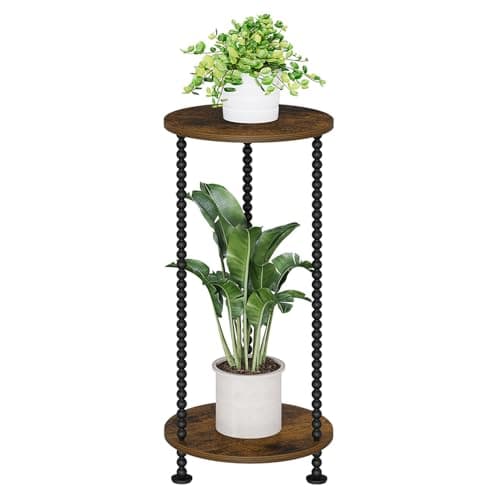
YINMIT 2 Tier Small Corner Plant Stand, 23.2 in tall
The smallest honest floor stand here: one square foot of floor, two positions, and it stops below the windowsill so it shades nothing.
#ad · Price as of October 18, 2026. How we are funded
- What the listing publishes
- 23.2 in tall, 2 tiers, spindle legs; no published weight rating
- Against a 10-inch pot
- No weight rating is published for this product, so there is nothing to check. That counts against it here rather than being treated as neutral.
At 23 inches it sits under almost every sill, so it adds plants without taking light from the ones already there. Tall stands in front of a window do the opposite.
Two positions on one square foot is two plants per square foot, the same ratio as the five-tier towers, in a form that fits a room you cannot rearrange.
Spindle legs concentrate the load on four small contact points. On carpet that is a dent; on a soft floor with a 12-inch pot on top it is worth putting a coaster under each foot.
What is good
- Fits where a tower does not
- Stays below the sill, so it shades nothing
- Two-plant footprint that still reads as furniture rather than a rack
What is not
- No published weight rating
- Only two positions
- Narrow feet mark carpet and vinyl
Skip it if you have the corner to spare. For the same floor a tiered frame gives you three more plants.
2. Putting a windowsill's worth of succulents in the light
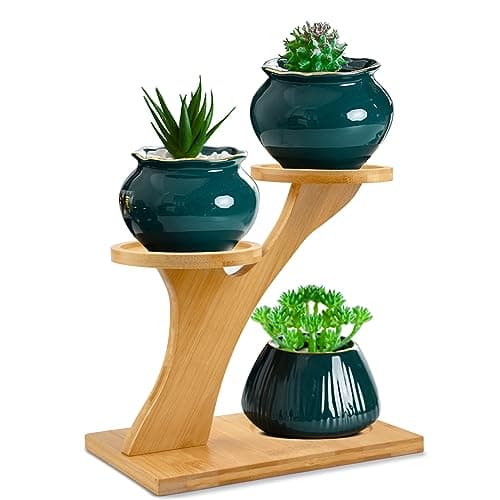
XXXFLOWER Bamboo 3 Tier Windowsill Plant Shelf, tabletop
Not a floor stand at all. A stepped riser that goes on a sill or a desk and triples the number of small pots that fit in the light you already have.
#ad · Price as of October 18, 2026. How we are funded
- What the listing publishes
- 3-tier bamboo tabletop riser, sized for a sill rather than a floor
- Against a 10-inch pot
- No weight rating is published for this product, so there is nothing to check. That counts against it here rather than being treated as neutral.
The scarcest resource in a rented apartment is not floor, it is glass. A riser does not buy floor space, it buys sill area, which is a different and usually more valuable thing.
Sized for 3 to 4 inch pots. A 4-inch pot of saturated mix computes to under a pound, so bamboo is entirely adequate here and the missing weight rating matters far less than it does on a floor stand.
About 16 by 8 inches of sill for six small positions is close to seven plants per square foot, the highest density on the site, because the plants are tiny.
What is good
- Multiplies sill area, which is the constraint that actually binds
- Loads are small enough that an unrated bamboo frame is not a risk
- Light enough to move as the sun angle changes through the year
What is not
- Only takes 3 to 4 inch pots
- Bamboo and standing water are a bad long-term pairing, so use saucers
- Blocks part of the window it stands in
Skip it if you were looking for a floor stand. This is sill furniture and it will not hold anything you would call a houseplant.
3. One feature plant lifted, on a rating you can check
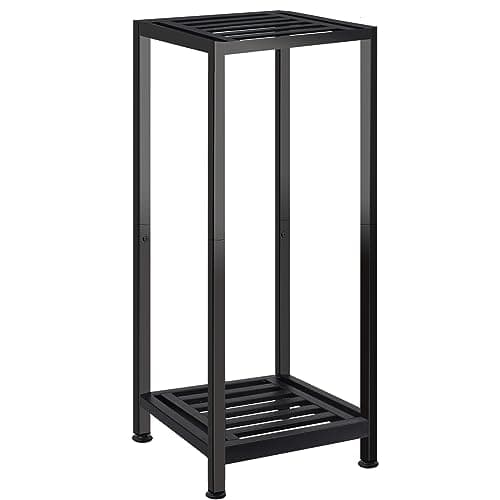
Lilybud--lily Wrought Iron Pedestal Plant Stand, 30.7 in, 200 lb
A single-position column that publishes a 200 lb capacity, which makes it one of the few stands on this site where the load question has an answer instead of an estimate.
#ad · Price as of October 18, 2026. How we are funded
- What the listing publishes
- Published 30.7 in tall on a 12 by 12 in footprint; all-metal construction in 0.8 in tube; published maximum load capacity 200 lb; 6.97 lb empty; the listing does not publish a top-plate diameter
- Against a 10-inch pot
- Rated 200 lb against 14.7 lb of saturated mix in a 10-inch pot — 13.6x, clear of the 1.5x margin this site requires.
Thirty inches is the height at which a trailing plant stops pooling on the floor, and a pedestal gets it there with no fixings at all — the answer when the lease forbids a ceiling hook and the pothos is currently a puddle.
The published 200 lb figure is the reason to prefer this over the unrated columns. A 10-inch pot of saturated mix computes to 14.7 lb, so the rating is roughly thirteen times the load this will ever see. That margin is not the point; being able to check it at all is.
What the listing does not publish is the diameter of the top plate, and on a wrought-iron pedestal that is the number that decides whether your pot actually sits on it. Measure the base of the pot before ordering, because a 12-inch footprint does not mean a 12-inch top.
What is good
- Publishes a 200 lb maximum load, which almost nothing in this category does
- Lifts one plant with no drilling and no ceiling fixing
- All-metal 0.8 in tube, so it does not rely on a board staying flat
What is not
- The top-plate diameter is not published, so pot fit is a measurement you have to make
- Costs a square foot of floor for a single plant
- Metal and dark: it reads as hardware rather than furniture in a soft room
Skip it if you can put one adhesive hook in the ceiling. A rated 30 lb hook holds the same trailing plant, costs less and takes no floor at all.
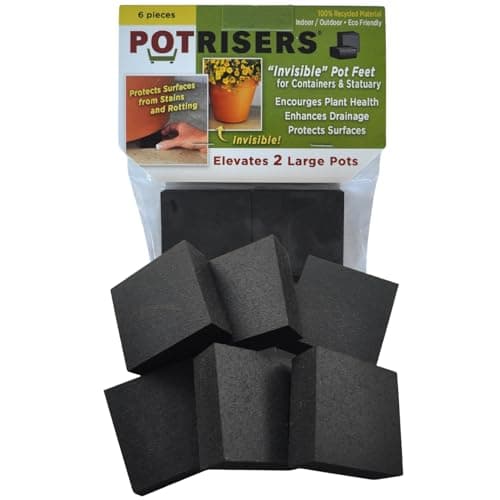
4. Airflow under a pot with no height cost
POTRISERS Invisible Pot Feet and Plant Risers, 2 in wide, 6 pack
Three quarters of an inch of lift, which is not a plant stand at all and solves a problem no plant stand solves: the pot base sitting in its own drainage.
#ad · Price as of October 18, 2026. How we are funded
- What the listing publishes
- 2 in wide by 3/4 in tall feet; lifts the pot base clear of its saucer
- Against a 10-inch pot
- No weight rating is published for this product, so there is nothing to check. That counts against it here rather than being treated as neutral.
A pot standing apartment in a saucer wicks the water it just drained straight back up. Feet break that contact, which is the difference between drainage that works and a saucer that is a reservoir.
It also protects the floor. Terracotta sitting wet on wood for a year leaves a ring that does not come out, and a few cents of plastic prevents it.
Six feet is two or three pots. Buy per pot, not per apartment.
What is good
- Fixes the wicking problem that drainage holes alone do not
- Keeps wet pot bases off wood floors
- Costs and weighs almost nothing
What is not
- Six feet only covers two or three pots
- Raises the pot enough to matter under a tight sill
- Not a substitute for a saucer
Skip it if your pots are already in cachepots with a gap at the bottom. You have the airflow, and feet just make the pot taller.
Questions people actually ask
Where can I put plants in a small apartment?
What is the best plant stand for a tiny apartment?
Can I put plants on a radiator cover?
How do I add plants without losing floor space?
Sources
- Cornell University, Greenhouse Management: bulk density of greenhouse media components
- Biology Insights: how much a cubic foot of potting soil weighs, dry and saturated
- University of Illinois Extension: Houseplants — lighting
- Clemson HGIC: Indoor Plants — cleaning, fertilizing, containers and light requirements
Product specifications are quoted from each seller's own listing and are the seller's claim, not a measurement of ours.